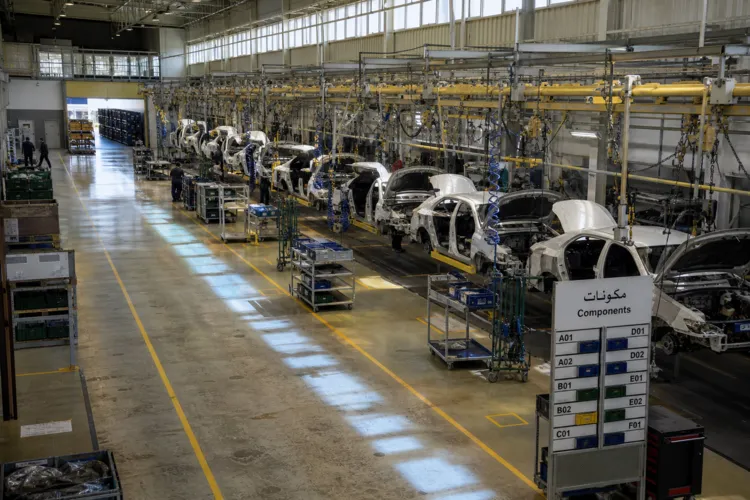
Ceer has moved from an industrial plan to visible vehicles. In September 2026 it unveiled its first sedan and SUV, positioned as opening models in a planned range, with Reuters reporting Saudi sales expected in early 2027. That milestone is commercial, not just technical. It creates an immediate question for market entry: how should Saudi-made EVs be sold and supported at scale when serial production, customer deliveries, and manufacturing yields were not yet evidenced in the same launch materials? For a brand backed by the Public Investment Fund (PIF) and formed as a joint venture with Foxconn, distribution choices become part of proving demand, aftersales readiness, and repeatability.
Dealer-led entry has a clear advantage in Saudi Arabia’s current buying behavior. Mordor Intelligence estimates OEM dealers led across sales channels with 60.57% of vehicle spending in 2026, while online platforms are forecast to grow fastest at a 6% CAGR during 2027–2032. Those two signals can be read together. A practical route is to use dealers for near-term trust, test drives, trade-ins, and service scheduling, while building the processes to capture future growth where customers increasingly expect digital discovery and transaction steps. In this framing, distribution is not just “where the sale happens,” but how inventory, financing, and delivery coordination are executed when buyers want faster, clearer conversion.
Dealer, Direct, and Digital: Three Routes Ceer Can Combine
A dealer channel can also help Ceer navigate the realities of the wider Saudi vehicle market. Mordor Intelligence values the Saudi Arabia automobile market at USD 50.33 billion in 2026 and estimates growth from USD 53.37 billion in 2027 to USD 70.58 billion by 2032, at a 5.75% CAGR (2027–2032). Passenger cars led with 76.62% share in 2026, and personal use led with 70.84% of vehicle spending in 2026. These details matter because Ceer’s first two vehicles are a sedan and an SUV, aimed at local and regional customers, and the biggest spending base is still personal buyers. A strong dealer footprint in Riyadh, the largest demand center in the report, can help match that spending concentration with local availability and service capacity.
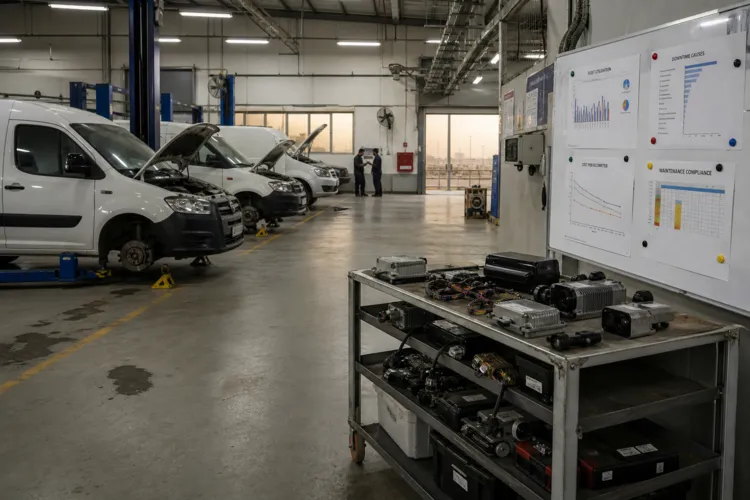
Direct distribution can be used more selectively, especially for early adopters and premium-leaning positioning. It also reduces dependence on third-party retail execution when a new brand needs tight control over product education, pricing logic, and delivery standards. But direct does not eliminate the need for physical support. Ceer’s rollout sits inside a supply-chain and industrialization push that depends on partners and localized suppliers: Reuters-linked reporting cited Foxconn delivering electrical architecture and BMW handling engineering, while suppliers such as Lear, Shin Young, Benteler, and Fangxin have established factories in Saudi Arabia. As that ecosystem matures, a hybrid approach can link direct ordering to localized service points, rather than treating retail and aftersales as separate systems.
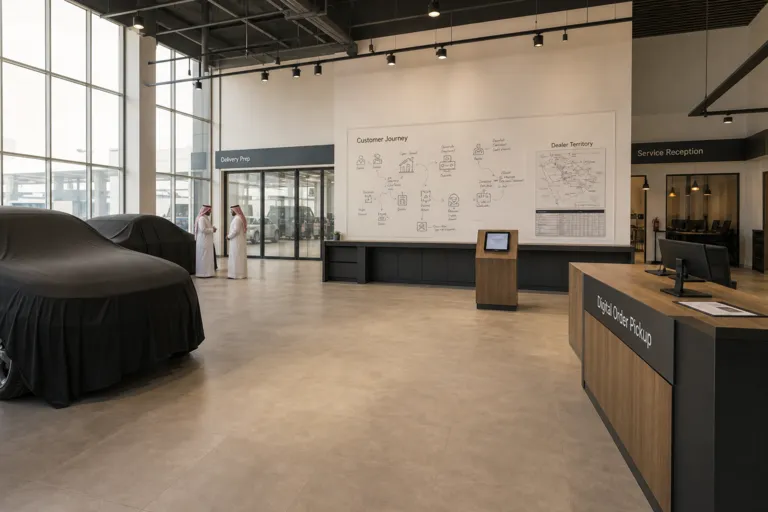
Digital distribution should be treated as a growth engine, not a side project. Mordor Intelligence forecasts online platforms as the fastest-growing sales channel at 6% CAGR for 2027–2032, alongside broader market shifts such as subscription-based ownership forecast to grow fastest at 6.05% CAGR over the same period. A coherent Ceer dealer distribution network model can therefore be “dealer-backed, digitally driven”: online configuration, lead capture, and appointment setting that routes into dealer test drives and delivery, while preserving a direct path for buyers who want a brand-owned journey. The goal is consistency as Ceer scales beyond its first two EVs and as it pursues its wider portfolio timeline, which sources describe as five additional vehicles by 2030, while noting a separate Reuters-recorded remark indicating seven vehicles by 2034.
When are Ceer deliveries expected to begin in Saudi Arabia?
Which sales channel leads vehicle spending in Saudi Arabia today?
Why should Ceer still invest in digital distribution if dealers dominate?
How can the Ceer dealer distribution network model blend dealer and direct options naturally?
What market context supports a mixed distribution strategy for Ceer?