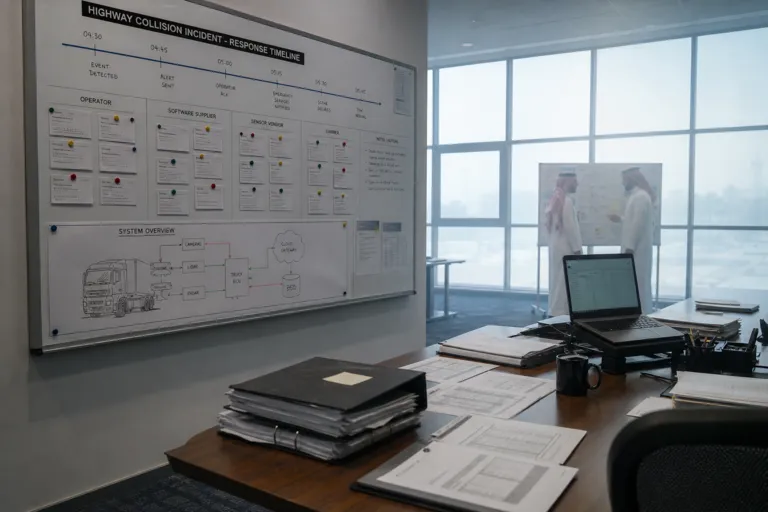
When a driverless truck crashes, the familiar question of “which driver made the mistake?” can disappear. Multiple sources describing U.S. deployments and claims patterns say liability can move to the automated driving system developer, the truck manufacturer that integrated the technology, the fleet operator that deployed the vehicle, and even other contributors such as sensor suppliers, mapping data providers, or remote monitoring operators. In other words, removing the driver can fracture the usual chain of accountability. That is exactly why any Saudi autonomous truck liability cybersecurity framework needs to identify who is responsible for system performance, maintenance, monitoring, and post-crash cooperation, before driverless freight scales beyond limited corridors.
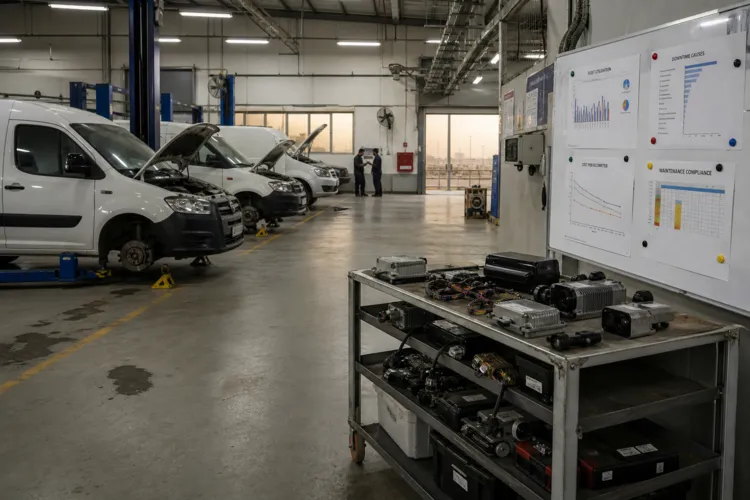
The commercial rationale for autonomy often leads with costs, but costs do not settle blame. One analysis citing Goldman Sachs Research says equipping a truck with autonomous technology currently runs USD 125,000 to 150,000 per truck, with a projection of USD 35,000 to 40,000 by 2035. That same source cites industry ROI estimates that place break-even at 2.5 to 3 years for large fleets on optimized corridors, 3.5 to 4.5 years for mid-size fleets, and 4.5 to 6 years for smaller operators. It also notes that added sensor and system maintenance is estimated at roughly USD 8,000 to 15,000 per truck per year beyond conventional service. These figures highlight why contracts and insurance will scrutinize who pays for calibration, updates, diagnostics, and continuous operation that can increase wear.
Liability Without a Driver: Product Claims, Negligence, and Shared Blame
Legal commentary focused on autonomous and ADAS truck accidents argues that at SAE Level 4, there is no human driver in the cab to blame, so recovery often runs through product-liability and corporate-negligence claims against the developer, the carrier, and the truck manufacturer. Another analysis emphasizes there is no single federal regulatory framework governing autonomous trucks in the U.S., and that a single crash can involve multiple defendants at once: the AV technology company, the truck OEM, the fleet operator, software developers, sensor manufacturers, mapping providers, and remote monitoring. For Saudi freight autonomy, the practical implication is less about copying U.S. law and more about building clarity: define what “minimal-risk condition” means operationally, define who controls updates, and define who must preserve and disclose event data after a crash.
Insurance signals how the market expects disputes to play out. One insurance-focused source notes Bot Auto announced in 2025 that it secured coverage for autonomous freight operations including auto liability, property, general liability, cargo, inland marine, and a separate cyber policy. That same source lists claim factors that may show up in driverless crashes, including software bugs, sensor failures, mapping errors, failed updates, cybersecurity issues, or poor integration between the truck and the autonomous system. A separate insurance briefing adds that commercial auto liability stays core, but autonomy agreements can raise questions about contractual liability, technology errors and omissions, physical damage for specialized equipment, cargo obligations, vendor insurance requirements, and cyber risk. In a Saudi context, these categories point to the building blocks regulators and fleets can standardize through licensing, operating rules, and contract templates.
Cyber rules matter because cyber events can look like “driving errors” after the fact. The sources repeatedly tie autonomy risk to cybersecurity issues and to the need for separate cyber coverage, but they also show why governance has to be broader than a policy purchase. One briefing asks the operational questions that can decide who pays: who must maintain, calibrate, and update the autonomous hardware and software; who owns and preserves the event data after a crash; and which party indemnifies the other for technology failures, operational mistakes, or maintenance failures. Another legal overview adds that the Uniform Law Commission is developing model legislation for autonomous vehicle liability, but adoption is voluntary. For Saudi Arabia, the gap to close is a clear, local framework that links cyber hardening, maintenance duties, evidence retention, and insurance requirements into one enforceable accountability chain.
Who can be liable when a driverless truck crashes?
What insurance coverages are being discussed for autonomous freight operations?
Why does cybersecurity change crash investigations and payouts?
What costs make responsibility disputes more likely after a crash?
What should a Saudi Arabia autonomous truck liability and cybersecurity framework clarify first?