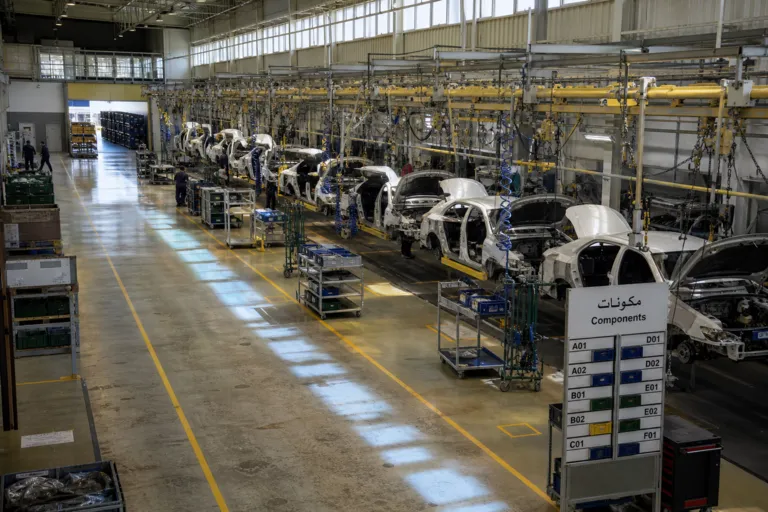
Hyundai Motor Company’s new manufacturing footprint in Saudi Arabia centers on King Abdullah Economic City (KAEC) and a joint venture structure that is designed to pull more automotive value into the Kingdom. Public Investment Fund (PIF) holds a 70% stake in Hyundai Motor Manufacturing Middle East (HMMME), while Hyundai retains 30%. The partnership traces back to December 2020 and was formalized in October 2023. Groundbreaking took place in May 2025 and was attended by more than 200 senior officials from Saudi Arabia and South Korea, including Saudi Arabia’s Minister of Industry and Mineral Resources. The KAEC location also places Hyundai inside a national push to strengthen local content and supply chains to serve domestic and regional demand.
For planning and supply-chain forecasting, the most concrete operational signal is the start-of-production timing and the initial build rate. The KAEC facility is scheduled to begin production in late 2026, with the Alromaih source specifying the fourth quarter of 2026. It is designed for an annual capacity of 50,000 vehicles, with the ability to expand based on demand. The plant is also described as spanning half a million square meters and as being projected to contribute approximately SAR 18.7 billion (USD 5 billion) to Saudi Arabia’s GDP by 2045, alongside creating thousands of direct and indirect jobs. Those figures frame what the Saudi Hyundai KAEC plant start of production could mean: a step change in the local industrial base that supports inbound parts flows, local service networks, and outbound finished-vehicle logistics.
What A KAEC Assembly Line Changes in the Supply Chain
Local assembly changes the supply chain first through availability and responsiveness, not automatically through price. Gulf Auto notes that the early effect of localisation shows in availability and in localised parts supply rather than in price, because set-up costs are loaded onto the first units. That perspective aligns with consumer-facing expectations highlighted by ArabWheels, which links local production to reduced shipping costs and faster spare parts availability and after-sales support. Hyundai’s KAEC line is also positioned as a dual production setup: internal combustion engine sedans and SUVs for current demand, plus electric vehicles aligned with sustainability and clean-energy goals. For suppliers, that mix matters, because it widens the bill of materials Saudi-based logistics providers and parts distributors must handle, while also encouraging more structured aftersales stocking inside the Kingdom.
Hyundai is not arriving in isolation. The KAEC plant sits inside the King Salman Automotive Cluster on Saudi Arabia’s Red Sea coast, which is designed to attract three to four major global automakers and targets combined annual production capacity exceeding 300,000 vehicles. Hyundai joins Lucid Motors and Ceer, which are already tied to KAEC’s automotive build-out. In this context, supply-chain localization becomes a system outcome, not a single-plant outcome. Ceer’s disclosures show how supplier pipelines can be built in parallel: it announced 16 supply-chain agreements worth more than SAR 3.7 billion in February 2026, building on SAR 5.5 billion from the prior year’s forum, and set a target to source 45% of materials and components from Saudi suppliers by 2034. Those benchmarks offer a reference point for how industrial policy, supplier contracts, and plant launches can interlock across KAEC.
Market pull is the other side of the supply-chain equation, because a local factory still needs a stable sales base to keep procurement and logistics flowing. Gulf Auto states the Saudi market absorbs 681,000 units a year and emphasizes that locally built product does not inherit a market; it takes share, and that is slow in a relatively open market. Yet Hyundai’s brand demand is already visible: Yallamotor reports nearly 130,000 vehicles sold in the Saudi market last year, and also notes Hyundai’s relationship with the market spans over 40 years and that it is the second-largest company in Saudi automotive market share. Taken together, the story is less about a single facility and more about how a late-2026 production launch, a 50,000-vehicle annual line, and KAEC cluster co-location can shift sourcing, inventory strategy, and domestic supplier participation over time.
When is Hyundai’s KAEC plant scheduled to start production in Saudi Arabia?
What is the planned annual capacity for Hyundai Motor Manufacturing Middle East (HMMME) at KAEC?
How is HMMME owned between PIF and Hyundai Motor Company?
How could the Saudi Hyundai KAEC plant start of production affect spare parts availability?
What other automotive players are connected to the King Salman Automotive Cluster at KAEC?