Saudi Arabia’s railways logged more than 40.9 million passenger journeys in the third quarter of 2026, according to the Transport General Authority (TGA). In its quarterly report, the TGA said passenger numbers rose compared with the same period last year, reflecting growing demand for rail travel across the Kingdom. The latest breakdown shows that growth is being powered primarily by urban services, with specific systems contributing large shares of total journeys. For readers tracking Saudi railways Q3 2026 passenger growth, the Q3 data highlights a market where day-to-day city travel is doing most of the heavy lifting.
Looking inside the total, intra-city rail services carried 38.3 million passengers in Q3 2026. Riyadh Metro alone accounted for 30.4 million journeys during the quarter. Other intra-city services included seven million passengers on the King Abdulaziz International Airport Automated Train (an airport people mover in Jeddah) and about 911,200 riders on the Princess Nourah bint Abdulrahman University line. Together, these figures show that the largest volumes are coming from urban and campus-linked mobility, where frequent trips quickly add up over a quarter.
What the Q3 Split Says About Demand: Urban Up, Intercity Softer
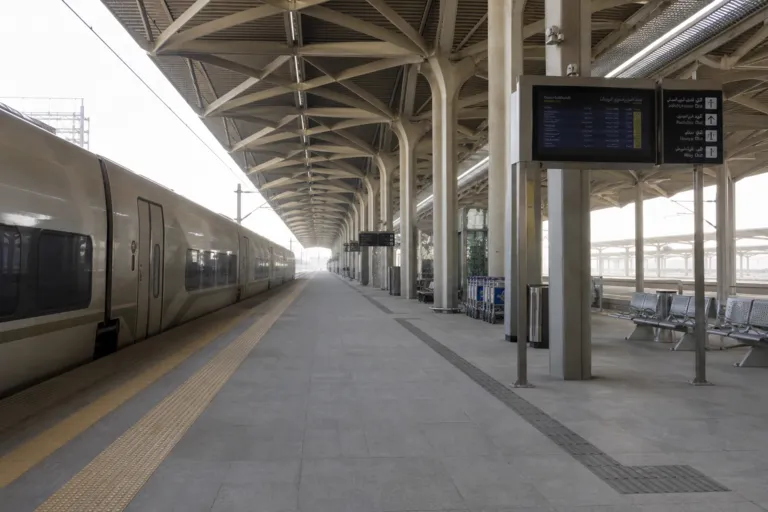
While urban ridership dominated, intercity services carried more than 2.5 million passengers in Q3 2026. The Haramain High Speed Railway, linking Makkah and Madinah via Jeddah, King Abdulaziz International Airport, and King Abdullah Economic City, carried over 1.9 million passengers in the quarter. Another read on momentum comes from year-on-year comparisons published by Railway Supply. It reported that Saudi rail passengers topped 40.9 million in Q3 2026, about 5% above the same quarter of 2025, while Riyadh Metro ridership was up roughly 21% to 30.4 million. Over the same comparison, intercity traffic fell to more than 2.5 million from more than 2.7 million, and Haramain eased to over 1.9 million from 2.07 million.
SAR’s regional networks add more texture to how people are traveling. The East Network, running from Riyadh through Abqaiq and Hofuf to Dammam, recorded about 393,900 trips over Q3 2026. The North Network, connecting Riyadh with Majmaah, Qassim, Hail, Al-Jouf, and Qurayyat, carried 258,600 trips. These totals are much smaller than metro volumes, but they are important for understanding corridor demand beyond the urban core. They also help explain why the TGA’s overall conclusion focused on growing demand across the Kingdom, even as the intercity segment showed a softer year-on-year comparison in the Railway Supply figures.
Passenger journeys were not the only signal in the quarterly update. Saudi Arabia’s railway network also transported 3.9 million tonnes of freight and 46,300 containers in Q3 2026, as cited across multiple reports. That parallel freight performance matters for interpreting demand because it indicates the rail system is being used intensively across passenger and logistics activity in the same quarter. Separately, Asharq Al-Awsat reported that Riyadh is moving to expand the capacity of its metro system by supplying 27 new driverless trains and 52 additional carriages for the Riyadh Metro, aimed at increasing capacity on the Blue and Red lines (Lines 1 and 2) to meet growing public transport demand in the capital.
What did Q3 2026 passenger numbers show about rail demand in Saudi Arabia?
How many passengers used intra-city rail services in Q3 2026?
How did intercity and Haramain ridership compare year on year?
What does Saudi railways Q3 2026 passenger growth suggest about where riders are coming from?
What freight volumes were reported for Saudi railways in Q3 2026?