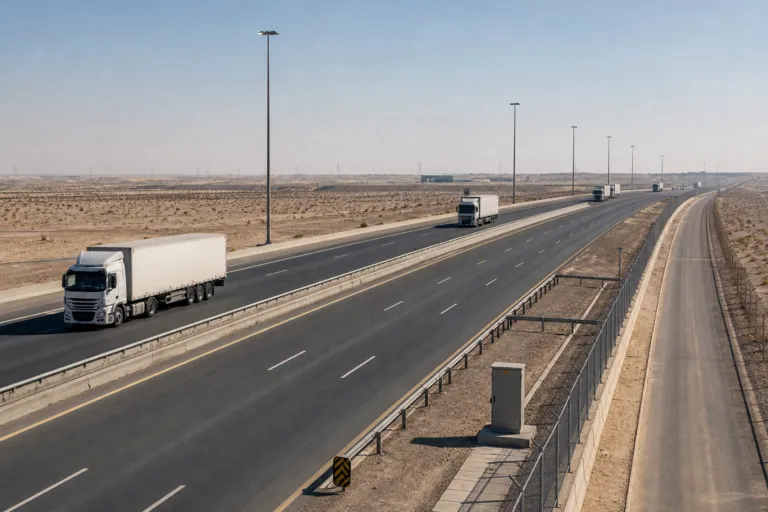
Saudi Arabia is placing autonomous freight at the center of a national-scale push for “physical AI.” HUMAIN, a PIF company delivering full-stack artificial intelligence capabilities globally, and Applied Intuition have announced a strategic collaboration to establish a foundational framework for autonomy across the Kingdom. The project begins with driverless trucks and aims to deploy thousands of autonomous trucks throughout key Saudi logistics corridors by 2030. The partners describe the planned rollout as the largest autonomous trucking network in the world, and they frame it as the first major initiative under HUMAIN’s physical AI strategy.
The collaboration combines HUMAIN’s sovereign AI infrastructure in Saudi Arabia with Applied Intuition’s end-to-end physical AI stack, delivered through a long-term commercial partnership. Applied Intuition says its Self-Driving System (SDS) will be the centerpiece, supported by Vehicle OS and other vehicle-intelligence technologies. SDS is already operating on roads in the U.S., Europe, and Japan, and Applied Intuition notes it is running Level 4 trucking with Isuzu Motors. The partners also highlight why Saudi deployment is demanding for trucking, pointing to extreme heat, blowing sand, and long-haul routes that can push vehicles to their limits.
Why Saudi Arabia Is Starting With Autonomous Trucking
Both companies argue trucking is a natural starting point because it is a large-scale, measurable use case for AI beyond the data center. HUMAIN CEO Tareq Amin says thousands of autonomous trucks operating around the clock can transform the speed, cost, and capacity of the Kingdom’s logistics network, with a multiplier effect across economies. In parallel, Applied Intuition emphasizes that the work is meant to create a unified autonomous logistics network at national scale, not a single pilot. For local execution, Applied Intuition has established an office in Riyadh and is building a local technical presence to support the project.
Applied Intuition positions its platform as adaptable across vehicles and environments, while keeping the underlying architecture consistent. It says data from every mile driven feeds back into its large-scale simulation and development infrastructure, where engineers recreate real-world scenarios, validate improvements, and push updated models back to the fleet. The company also points to its work in mining with Komatsu, where Vehicle OS, autonomous haulage, and collision avoidance systems are used in conditions defined by heat, dust, uneven terrain, and remote sites. It argues many of those challenges overlap with what must be solved for Saudi freight corridors.
The ambition extends beyond freight. The partners say future phases will explore expansion into robotaxis, ports, mining, manufacturing, agriculture, construction, and other industries. Separate reporting also describes a timeline expectation of first Level 4 trucks on Saudi roads within a year, alongside the longer horizon of thousands operating by 2030. In the same wider Vision 2030 context, Al Majalla reports a broader target of equipping 25% of freight transport vehicles with autonomous-driving technologies, and notes Saudi Arabia has around 16 million vehicles. Together, the HUMAIN and Applied Intuition plan is being presented as a foundation for intelligent infrastructure that can scale across sectors.
What is the HUMAIN and Applied Intuition plan for autonomous trucking in Saudi Arabia?
Which technologies will power the Saudi driverless truck rollout?
When do the partners expect autonomous trucks to be on Saudi roads?
Beyond trucking, what sectors could this physical AI partnership expand into?