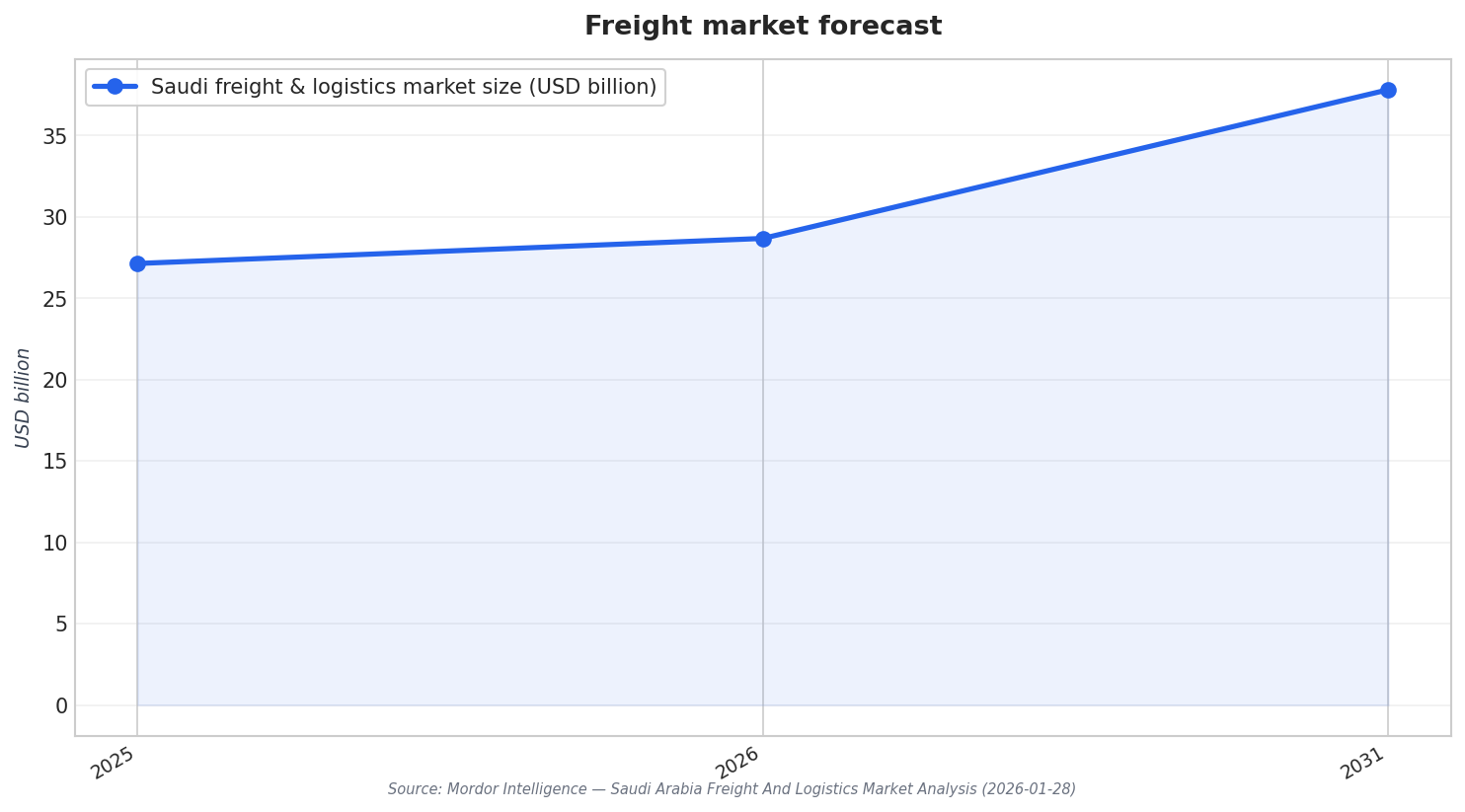
Truck stops can be framed as an infrastructure-adjacent asset class when they are planned as networked service nodes rather than isolated retail sites. In Saudi Arabia, that logic sits inside a broader logistics buildout and a rising use of private participation through concessions and PPP frameworks. Mordor Intelligence values the Saudi Arabia freight and logistics market at USD 27.14 billion in 2025, with estimates rising to USD 28.68 billion in 2026 and USD 37.82 billion by 2031, at a 5.69% CAGR (2026–2031). Freight transport alone captured 58.92% of the market share in 2025, reinforcing why road-facing support assets matter when throughput grows and service expectations rise.
Road freight is a central feeder to ports, airports, industrial hubs, and cross-border gateways, so long-haul utilization is a practical driver of rest-area demand. Mordor Intelligence projects the Saudi Arabia road freight transport market to grow from USD 6.74 billion in 2025 to USD 7.09 billion in 2026 and USD 9.17 billion by 2031, at a 5.27% CAGR over 2026–2031. In 2025, long-haul captured 71.66% share, a pattern linked to the Kingdom’s 73,000 km highway grid. Domestic movements represented 61.25% of market size in 2025, while international routes are forecast to grow faster at 5.96% CAGR, pointing to corridors where standardized rest-area provision can be positioned as a reliability tool.
Why PPP-Style Rest Areas Fit the Vision 2030 Logistics Push
PPP readiness is strengthened by the way Saudi infrastructure policy is already pulling private capital into transport-adjacent systems. Mordor Intelligence estimates the infrastructure construction market at USD 63.84 billion in 2025, reaching USD 81.64 billion by 2030 at a 5.04% CAGR. The same source states that private investment represents 23% of total spend and is rising at a 6.18% CAGR as PPP pipelines mature. Vision 2030.ai’s National Transport and Logistics Strategy analysis also highlights privatisation, noting that airport operations, port terminals, and rail services have been progressively opened to private operators through concessions and PPP frameworks. For rest areas, that policy direction supports concession-style models where uptime, safety, and service levels can be contracted and financed as part of corridor performance.
Cross-border trucking makes the “network” angle even more investable, because border friction reductions can lift consistent, repeatable flows. Mordor Intelligence values the Saudi Arabia cross-border road freight transport market at USD 2.57 billion in 2025, estimated at USD 2.65 billion in 2026 and USD 3.54 billion by 2031 (5.96% CAGR, 2026–2031). It also cites near-universal two-hour electronic customs clearance via the FASAH system, alongside corridor upgrades such as the four-laning of the Batha–Al Ghuwaifat corridor. In 2025, the UAE held 47.47% of Saudi Arabia’s cross-border road freight market share. For an operator, these specifics help define where rest areas can be sequenced as predictable “stops” tied to border ports, long-haul legs, and compliance needs.
From an investor lens, rest-area revenue durability depends on the mix of freight activity that repeats daily. Wholesale and retail trade held 40.12% of Saudi Arabia’s road freight transport market share in 2025 and is projected to advance at a 5.79% CAGR (2026–2031), a signal of steady replenishment flows. In the broader freight and logistics market, wholesale and retail trade commanded 39.35% share in 2025, while Courier, Express, and Parcel services are advancing at a 6.45% CAGR between 2026–2031. Meanwhile, temperature-controlled road freight was only 5.72% of 2025 value but is the fastest-growing segment at 5.92% CAGR (2026–2031). A Saudi truck stop rest area PPP can be positioned to serve these segments with scalable service standards, while staying aligned with the NTLS emphasis on digitisation, tracking, and modernised logistics operations.
How does a Saudi truck stop rest area PPP connect to Saudi Arabia’s logistics growth?
What road-freight indicators support a network of rest areas along freight corridors?
What do the sources say about PPP momentum in Saudi infrastructure?
Why does cross-border trucking matter for rest-area placement?