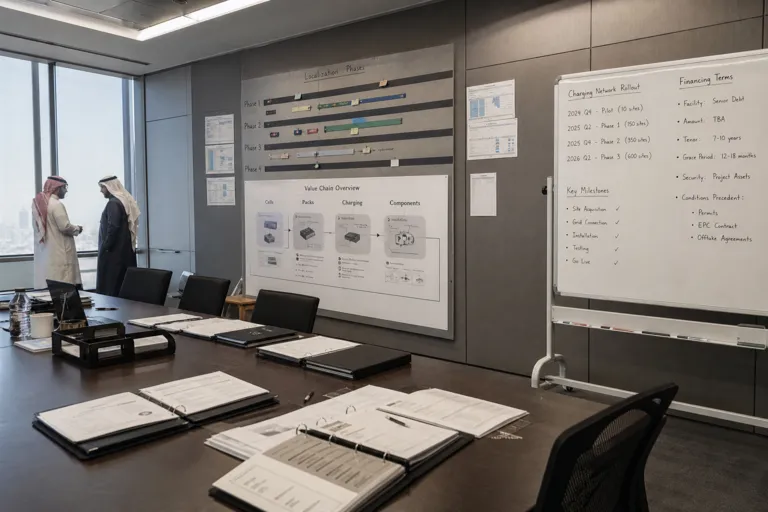
EVS Saudi 2026 electric vehicle investment decisions are increasingly guided by a few measurable signals: demand growth from a low base, government targets under Vision 2030, and the pace of enabling infrastructure. IndexBox estimates Saudi Arabia’s Battery EV market in 2026 at roughly 8,000–12,000 units, with passenger cars accounting for an estimated 85–90% of new Battery EV registrations that year. The same source frames Riyadh’s Vision 2030 target as a 30% EV share by 2030 and points to a domestic annual EV production capacity target of 300,000 by 2030. These targets shape how investors benchmark timelines, especially for projects tied to fleet procurement, charging networks, and localization.
Supply-side constraints also define where returns may concentrate first. As of early 2026, IndexBox puts Saudi Arabia at approximately 1,200–1,500 public charging points (AC and DC combined), concentrated in Riyadh, Jeddah, and Dammam, with a target of 5,000 chargers by 2030 under the National Electric Vehicle Charging Infrastructure initiative. Another market view notes public charging stations growing from 150 in 2022 to over 1,000 by early 2024, and adds that the Saudi Electricity Company plans 3,500 additional charging points across 1,000 locations by end-2025, tied to SAR 500 million (USD 133 million) in investment. Together, these figures signal that charging density remains a pacing item for adoption and a near-term deployment opportunity.
Value-Chain Signals Investors Are Watching in 2026
Localization is a second, clearly measurable signal, but it comes with timing risk. IndexBox estimates that over 95% of Battery EVs sold in Saudi Arabia in 2026 are imported, mainly from China, Europe, and the United States. Domestic assembly is emerging through Ceer (a PIF and Foxconn joint venture) and Lucid Motors’ AMP-2 facility in King Abdullah Economic City, yet IndexBox expects meaningful local production volumes to reach commercial scale only in late 2027–2028. This gap helps explain why investors focus on transitional plays such as logistics, homologation, distributor networks, and fleet delivery capacity while local assembly ramps.
Battery economics and parts industrialization form the third signal. IndexBox estimates battery pack costs in Saudi Arabia in 2026 at USD 115–135/kWh at the pack level (CIF), and says pack costs represent 35–45% of vehicle MSRP. On the components side, IndexBox projects the Saudi Arabia Automotive Electric Drivetrain Components market at USD 85–120 million in 2026, growing to over USD 1.2–1.8 billion by 2035. It also notes the aftermarket is under 5% of market value in 2026, but could reach 10–15% by 2035. These markers highlight why investors look beyond vehicle assembly toward drivetrain sourcing, testing, service tooling, and long-run aftermarket readiness.
Financing is the fourth signal because it scales adoption even when retail incentives are still evolving. IndexBox estimates the Saudi Arabia Electric Vehicle Finance market at about USD 1.2–1.8 billion in 2026. It also reports that incumbent Saudi banks hold around 55–65% of auto finance assets, while specialist EV lenders and subscription providers capture 20–30% of new EV loan origination by 2026, with share projected to rise to 35–45% by 2030. Subscription bundles account for 8–12% of new EV finance agreements in 2026, and EV subscription and ride-hailing fleet financing is growing 40–50% annually. For EVS Saudi 2026 watchers, these numbers point to underwriting, residual value tools, and fleet-focused products as key value-chain levers.
How should investors interpret EVS Saudi 2026 electric vehicle investment signals?
What are Saudi Arabia’s key EV policy targets referenced by market sources?
How dependent is Saudi Arabia on imported EVs in 2026?
What do sources say about the scale of EV financing in Saudi Arabia in 2026?
What is the outlook for Saudi electric drivetrain components and aftermarket demand?