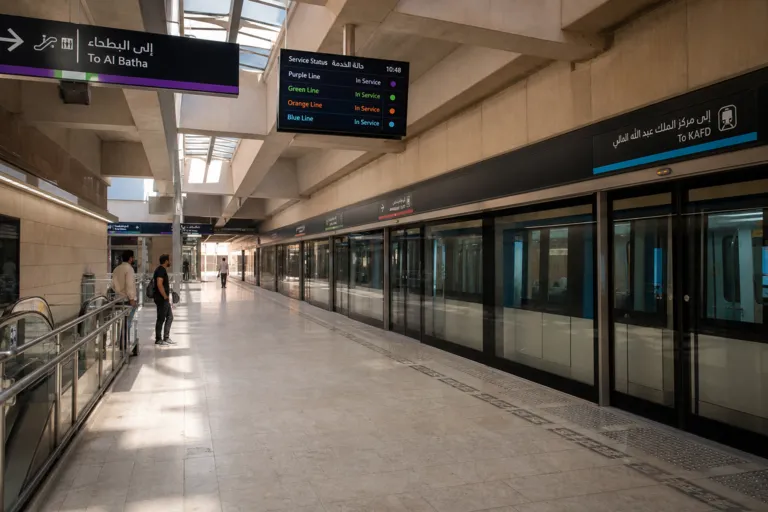
Riyadh is trying to change how people move, in a city long shaped by road traffic. Since services began in December 2024, the Riyadh Metro has posted rapid early growth. The Royal Commission for Riyadh City reported more than 18 million passengers in the first 11 weeks, and CNN reported that the system welcomed its 100 millionth passenger by August 2025. Another published roundup cited a similar pace, describing more than 18 million passengers in just over two months and 100 million riders in less than nine months. By March 2026, separate coverage said cumulative trips had moved beyond 200 million, positioning ridership momentum as a key test of whether a larger modal shift can follow.
Scale and capacity matter when the goal is to make public transport feel like the default choice. A Riyadh 2030 ridership dashboard describes the metro as six lines spanning 176 kilometres with 85 stations, and calls it the largest single public transport infrastructure investment in the Middle East at a total programme cost of SAR 86 billion (USD 22.9 billion). CNN separately framed it as a $22.5-billion project. The same ecosystem of sources points to high theoretical capacity: CNN notes capacity of at least 3.6 million passengers a day, while other coverage describes a daily capacity of around 3.6 million. That gap between present use and designed headroom is central to how far mode share could realistically move.
Ridership Signals: Peaks, Lines, and the Case for a Mode-Share Jump
Operational detail shows where demand is strongest and where a shift from cars might be easier to win. The Riyadh 2030 dashboard reports a peak of 17.48 million riders in November 2025, coinciding with the Riyadh Season entertainment programme and favourable weather conditions. It also highlights a December–January dip tied to seasonal patterns such as school holidays and reduced commuting, followed by recovery in February–March. For March 2026, the dashboard projects 17.8 million riders, which it converts to a daily average of approximately 574,000 riders. It adds that this is approaching a designed Phase 1 capacity of 700,000 daily riders, a figure that can inform how quickly the network could absorb additional demand as habits change.
Which lines and stations dominate usage matters for network effects. In February 2026, Line 1 (Blue) carried 28.7% of the system total, reflecting its east–west role connecting KAFD with residential areas in eastern Riyadh. Line 3 (Orange) was second at 23.5%, serving the system’s longest route and linking western residential suburbs to eastern industrial employment zones. Another roundup said the Blue Line was the busiest, followed by the Red Line and then the Orange Line, and it highlighted key transfer hubs such as Qasr Al Hokm, the King Abdullah Financial District, the stc station, and the National Museum. It added that these stations collectively attract close to a third of passengers, reinforcing the idea that interchange convenience can accelerate a Riyadh Metro ridership modal shift milestone.
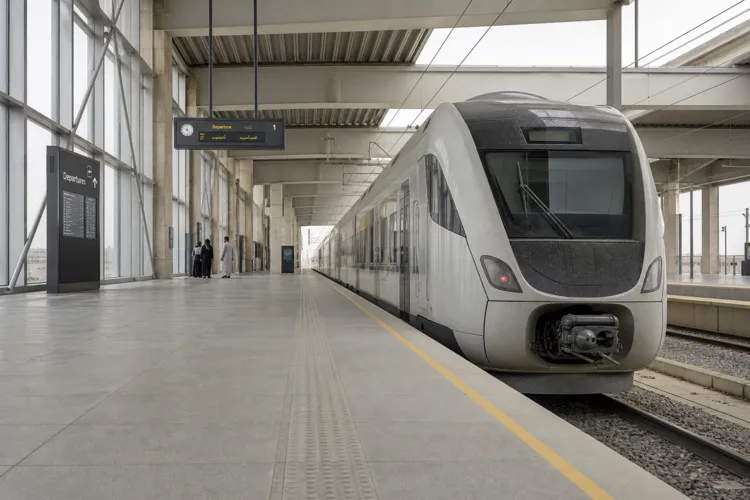
The metro’s ability to lift public-transport share depends on the wider system that feeds it. Coverage describes the Riyadh Metro as the backbone of a broader public transport ecosystem that includes buses, on-demand services, and extensive park and ride facilities. The dashboard also notes that all trains are driverless, operating on a fully automated Grade of Automation 4 (GoA4) system supplied by a consortium of Siemens, Alstom, and Bombardier (now Alstom), and that services include Standard Class, Family Class, and First Class. Regionally, market research frames the context as a Middle East public transportation market valued at USD 11 billion, and another report cites the Middle East and Africa region recording over 6.2 billion public transport trips in 2023. Those regional figures are not Riyadh-specific, but they underline why a sustained ridership climb in Riyadh would be watched as a meaningful indicator of changing travel behavior.
When did the Riyadh Metro start service, and how quickly did it grow ridership?
What are the Riyadh Metro’s core system specs that affect ridership growth?
Which lines are carrying the most passengers right now?
What does the Riyadh Metro ridership modal shift milestone look like in practical terms?
Is the Riyadh Metro only about commuting, or is it also used for events and leisure trips?