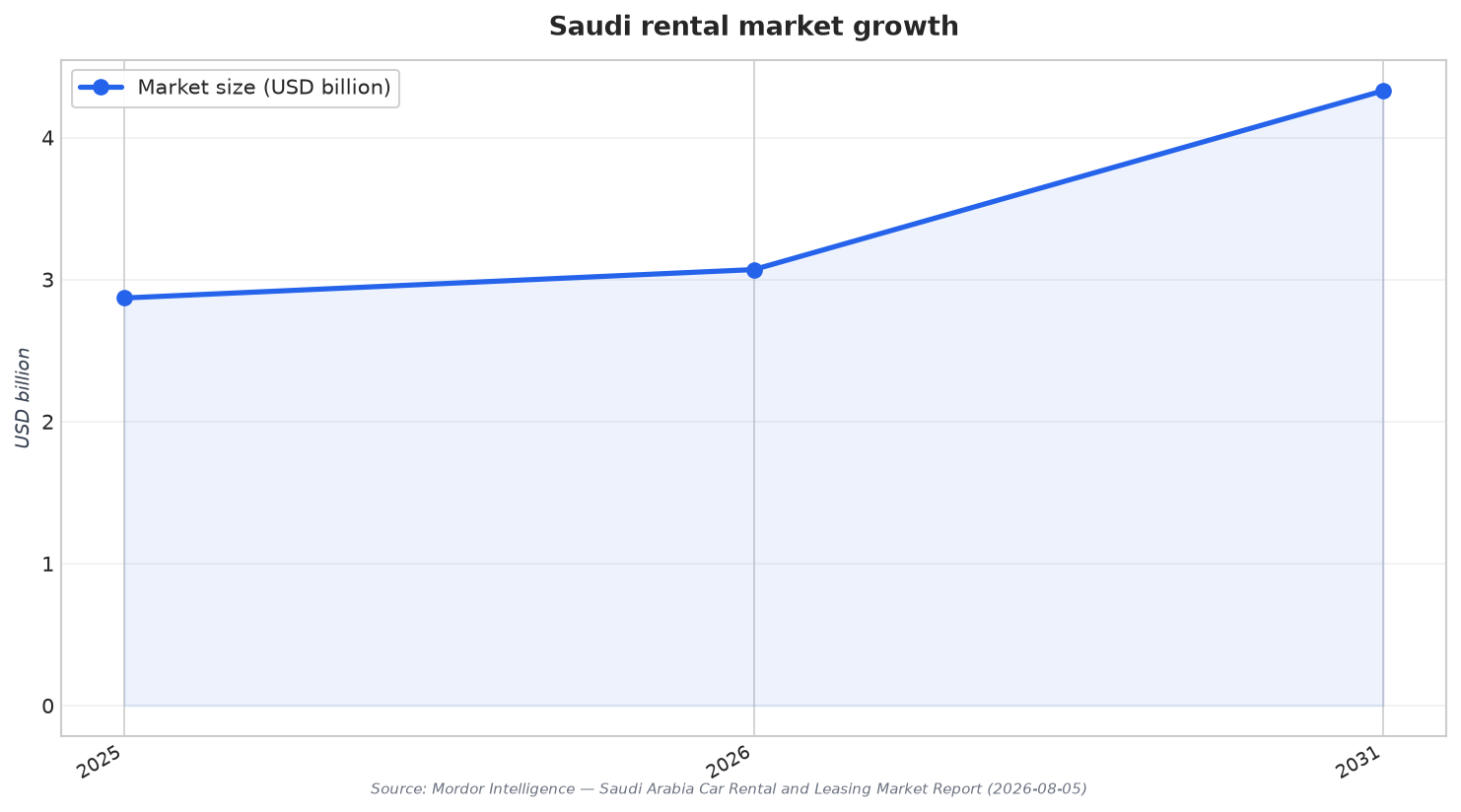
Saudi Arabia’s car rental and leasing market is expanding, and that growth is creating room for fleet experiments that can change unit economics. Mordor Intelligence estimates the market at USD 2.87 billion in 2025 and USD 3.07 billion in 2026, with projections reaching USD 4.33 billion by 2031 at a 7.09% CAGR (2026–2031). In the same report, short-term leasing held 50.68% share in 2025, while long-term leasing is expected to advance at a 7.22% CAGR through 2031. That mix matters for electrification because longer contracts can make fleet planning, utilization targets, and maintenance strategies easier to standardize across corporate accounts.
Fleet composition and buying behavior set the baseline economics that EVs must beat. Economy and budget cars commanded 62.85% share of the Saudi market in 2025, while sedans accounted for 45.12% and self-drive arrangements reached 76.98% share that year, according to Mordor Intelligence. Online channels captured 71.05% share in 2025, which supports faster rollout of new vehicle categories because pricing, availability, and policies can be updated centrally. Corporate accounts held 56.12% revenue share in 2025, and that is a key pressure point: MarkWide Research notes Saudi corporate clients demanding telematics-enabled vehicles, and it describes fleet management systems integrating GPS tracking, fuel monitoring, and automated scheduling to optimize utilization for corporate clients.
What Changes When Rentals Put EVs Into Daily Service
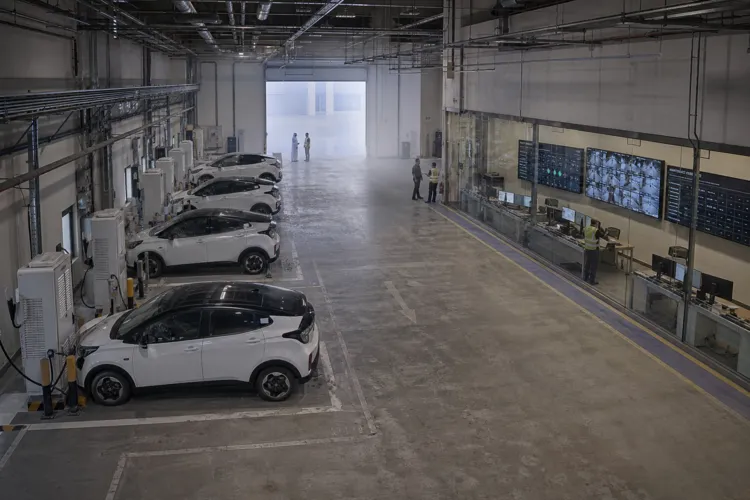
In Saudi Arabia, the EV transition in rental fleets is starting with pilots and partnerships rather than an overnight replacement cycle. Custom Market Insights reports that Yelo, one of the largest domestic operators, grew its fleet by over 3,000 vehicles during 2023–2024 and introduced a first batch of EVs to pilot integration as part of a green mobility plan. The same source says Yelo partnered with local EV charging infrastructure companies to measure customer readiness and practical viability for the transition. These steps reshape operating decisions around where cars are stationed, how quickly they turn, and how confidently operators can commit capital to new powertrains while staying sensitive to price, which the report calls a leading factor for many renters.
OEM-to-rental tie-ups can speed availability and influence fleet economics by improving access and reducing friction in procurement. Fortune Business Insights highlights that in November 2025, Al-Futtaim BYD Saudi Arabia and SIXT Rent a Car signed a memorandum of understanding to advance sustainable mobility in the Kingdom, including integrating BYD new-energy vehicles into SIXT’s rental fleet and collaborating on modern mobility solutions. The same report describes how collaborations between mobility platforms, automakers, and rental fleets are reshaping how EVs reach high-mileage users, noting bundled weekly rentals, financing support, and targeted programs for professional drivers. It also states that lower operating and maintenance costs can improve fleet economics, while charging network expansion and stricter emissions rules can add momentum.
Regional context shows how early the propulsion mix still is, even as growth expectations are building. Mordor Intelligence’s Middle East car rental analysis says internal-combustion engines retained 92.61% share in 2025, while electric and hybrid vehicles are expected to rise at a 12.45% CAGR over 2026–2031, supported by Saudi and UAE incentives. That same report also notes constraints such as supply-chain delays, limited EV insurance capacity, and fragmented regulatory regimes, which can widen the gap between well-capitalized multinationals and smaller local fleets. For operators navigating a Saudi car rental fleet EV transition, the near-term playbook becomes clear: pilot programs, charging partnerships, corporate-focused digital operations, and disciplined fleet allocation across cities such as Riyadh, Jeddah, and Dammam, which Custom Market Insights flags as key urban centers shaped by online travel booking and digital fleet management.
How big is Saudi Arabia’s car rental and leasing market, and what is it projected to reach?
Which demand segments matter most when planning electrification for rental fleets?
What real-world examples show Saudi rental operators testing EVs?
How does an OEM partnership support the Saudi car rental fleet EV transition?
How dominant are ICE vehicles in the wider regional rental market today?