Vehicle-to-grid models are moving from concept to commercial planning in Saudi Arabia as the EV base grows and charging networks expand. Saudi Ministry of Investment data cited in a market report shows EV registrations increased 425% between 2021 and 2023, rising from 375 EVs on the road in 2021 to over 12,000 by the end of 2023. Over the same period, the Kingdom’s charging footprint widened, with public charging stations growing from 150 in 2022 to over 1,000 by early 2024. For fleet owners, this matters because the economics of bidirectional charging depend on scale, predictable dwell time, and dependable access to chargers that can communicate with the grid.
Policy and capital are also shaping readiness for fleet V2G participation. One report cites a $20 billion government investment package targeted at EV infrastructure development through 2030. It also notes that the Saudi Electricity Company plans to install an additional 3,500 charging points across 1,000 locations by the end of 2025, with an investment of SAR 500 million ($133 million). Separately, a market analysis states Vision 2030 is compressing the adoption curve, and references a 10-year government purchase commitment for up to 100,000 Lucid units. For operators managing depots, ride-hailing, or service vehicles, these signals support longer-term planning for grid-interactive charging and contracts that reward flexible energy use.
What Makes V2G Revenue Realistic for Saudi Fleets
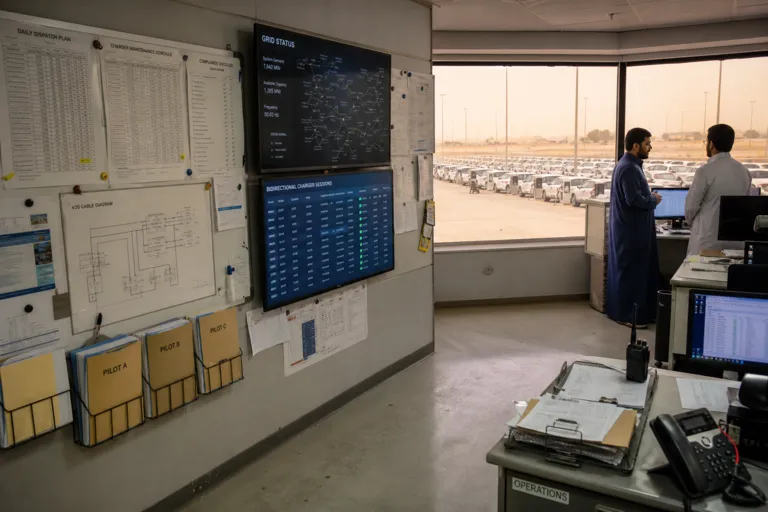
The most direct enabler is the bidirectional charger market itself. IndexBox projects the Saudi Arabia bi directional EV charger market will grow from an estimated USD 45–60 million in 2026 to approximately USD 620–850 million by 2035. It also expects DC bidirectional chargers (V2G-capable) to capture over 55% of market value by 2030, linking demand to utility-scale grid services and commercial fleet energy management. The same source says utility-backed energy service providers are launching V2G aggregation pilots in Riyadh, Jeddah, and Dammam, offering free or subsidized bidirectional chargers in exchange for rights to dispatch stored energy during peak demand events. This is the core trade: fleets provide controllable energy capacity, and aggregators package it for grid use.
Standards and interoperability are becoming more formal, which reduces operational risk for fleets. IndexBox notes adoption of ISO 15118-20 is accelerating and says Saudi Arabia’s Electricity & Cogeneration Regulatory Authority (ECRA) is mandating compliance for new grid-connected bidirectional chargers from 2027. The same report flags real constraints that fleet planners must budget for, including 12–18 months for charger-model grid interconnection certification under Saudi standards referencing IEEE 1547 and UL 1741-SA. It also estimates only 150–200 certified technicians nationwide in 2026 for installing bidirectional systems, particularly DC fast-charging infrastructure requiring high-voltage integration and anti-islanding protection. These constraints influence rollout schedules, vendor selection, and service-level agreements.
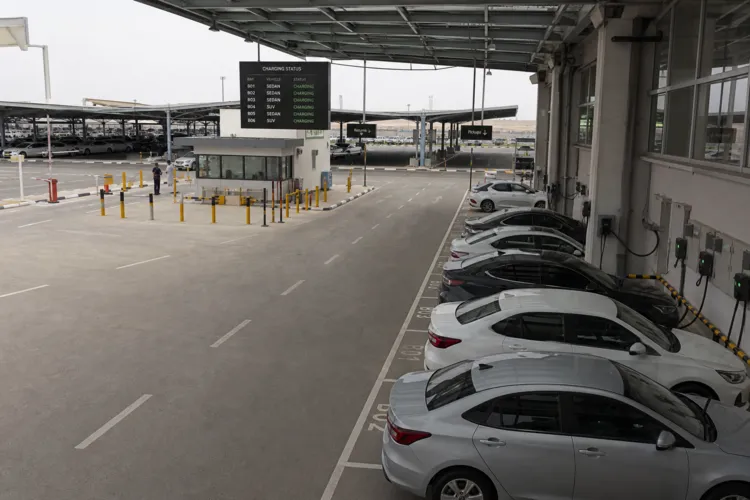
Saudi vehicle-to-grid V2G charging also sits inside a broader charging mix that affects where bidirectional deployments fit best. Grand View Research states the Saudi Arabia EV charging infrastructure market is expected to grow at a CAGR of 15.5% from 2026 to 2033, and that slow chargers were the largest revenue-generating charger type in 2025 with an 81.9% revenue share. That context suggests many sites still prioritize conventional charging economics, while fleets and utilities may concentrate V2G on higher-control environments like depots and managed parking. Meanwhile, Mordor Intelligence reports passenger cars held 76.81% of the Saudi EV market share in 2025, while commercial vehicles are forecast to expand at a 24.53% CAGR through 2031. As fleet electrification accelerates, operators can treat bidirectional capability as a procurement requirement and negotiate aggregation terms earlier, rather than retrofitting later into constrained installer capacity.
What signals show Saudi Arabia is getting ready for V2G-enabled fleets?
How large could the bidirectional EV charger market become in Saudi Arabia?
Where are V2G aggregation pilots happening in the Kingdom?
What compliance and timeline issues can delay bidirectional charger deployments?
How should fleet operators think about Saudi vehicle-to-grid V2G charging when planning depot upgrades?