Saudi Arabia’s EV transition is moving from targets to volume, and that matters for battery reuse. IndexBox estimates the Kingdom’s Battery EV market grows from roughly 8,000–12,000 units in 2026 to 180,000–250,000 units by 2035, supported by the Vision 2030 objective of a 30% EV share in Riyadh by 2030 and 300,000 annual domestic EV production capacity by 2030. In the near term, passenger cars dominate demand at about 85–90% of new Battery EV registrations in 2026, with fleets and government procurement acting as early adopters. More vehicles on the road eventually means more used packs available for structured second-life programs.
The economics hinge on batteries as the biggest cost driver and a major import exposure today. IndexBox puts battery pack costs at 35–45% of EV MSRP, with 2026 pack costs estimated at USD 115–135/kWh (pack level, CIF) in Saudi Arabia, declining to USD 70–90/kWh by 2035. At the same time, import dependence remains high: IndexBox estimates over 95% of Battery EVs sold in 2026 are imported, while its automobile batteries report notes over 90% of lithium-ion cells and packs are sourced from East Asian hubs. Those pressures strengthen the case for second-life storage value chains that stretch the productive life of imported assets while local gigafactory plans and pack assembly scale up.
Why Stationary Storage Is the Natural Landing Zone
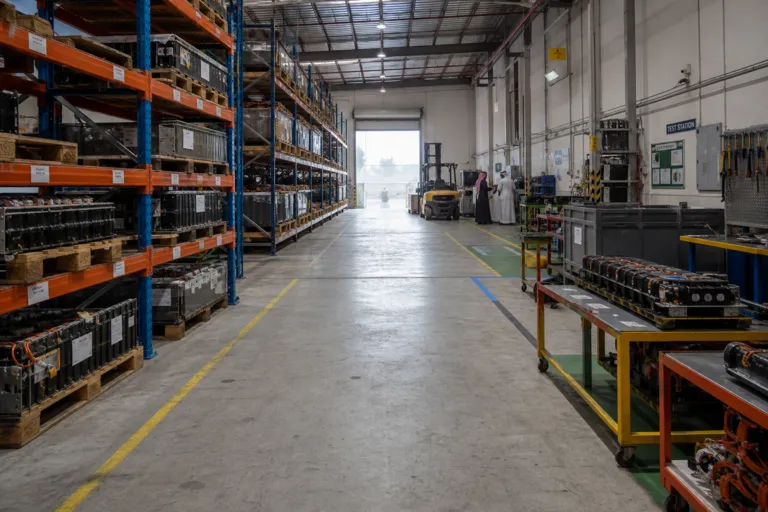
Energy storage demand is already visible in Saudi Arabia, and the sources provide a clear proof point. GM Insights reports that Saudi Arabia adopted a 500 MW/2000 MWh BESS fleet in 2024 using BYD LFP batteries for energy storage from renewable sources. That same report projects the global EV battery reuse industry from energy storage systems exceeds USD 15.7 billion by 2035, with Asia Pacific anticipated to grow over USD 22.2 billion by 2035 as policy and OEM programs scale. These global figures are not Saudi-specific, but they show how quickly second-life batteries can become an investable storage category once vehicles and collection systems reach scale.
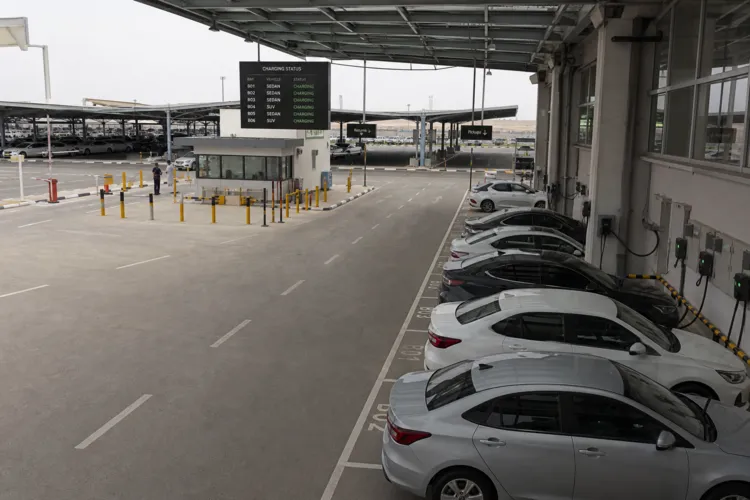
Saudi policy and infrastructure timelines also shape where second-life batteries can plug in. As of early 2026, IndexBox estimates about 1,200–1,500 public charging points (AC and DC combined), concentrated in Riyadh, Jeddah, and Dammam, with a target of 5,000 chargers by 2030. GM Insights adds that the EV charging application for reused batteries is anticipated to grow at a CAGR of over 60.5% by 2035 globally, describing how reused packs can support fast-charging stations and reduce grid dependency during peak hours. In Saudi Arabia, that framing connects charger expansion and peak management to a practical second-life use case.
Chemistry and supply chain direction can make second-life deployment simpler to standardize. IndexBox’s automobile batteries report says LFP is projected to capture about 45–55% of new EV battery demand by 2028 in Saudi Arabia, citing lower cost and thermal stability for extreme ambient temperatures. Futurism notes desert heat conditions exceeding 50°C and describes AI use cases like predictive battery health monitoring that can extend lifespan by up to 25% and intelligent charging optimization that can reduce charging time by 30% while minimizing stress on batteries. With battery recycling regulations (Extended Producer Responsibility) still under development per IndexBox, second-life storage can act as a bridge: extracting additional value while formal recycling and testing capacity mature through 2035.
What is driving Saudi Arabia’s second-life EV battery storage opportunity?
How big is Saudi Arabia’s public charging network today, and what is the 2030 target?
How much do EV battery packs cost in Saudi Arabia, and how do costs change by 2035?
Which EV battery chemistry is gaining traction in Saudi Arabia, and why does it matter for storage?