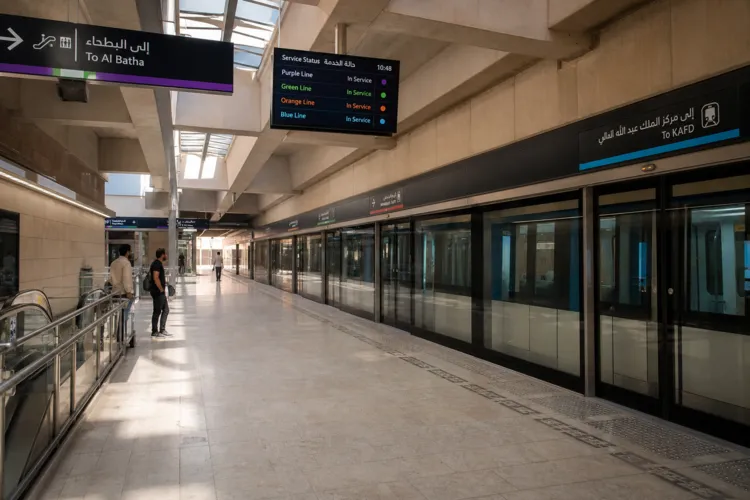
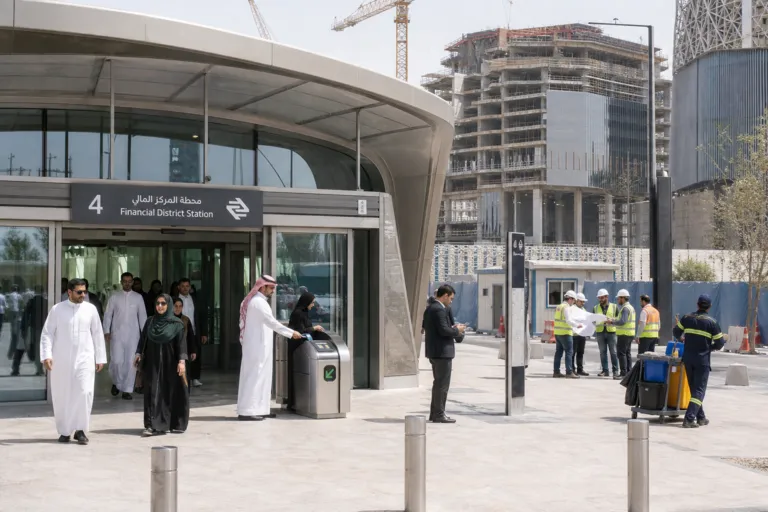
Riyadh’s metro has become a practical foundation for new investment models built around stations. Industry commentary described the Riyadh Metro as a US $22.5bn investment spanning 176km, with six lines and 84 stations, and coverage depth cited as 9.8km per 100 sqkm. Other project descriptions cite a 176.5km network with 85 transit stations and seven rail depots. These figures matter in 2026 because the monetization conversation is not only about transport usage. It is also about how public infrastructure can unlock private development value at station nodes and across corridors.
One near-term route is direct station monetization through branding. A 2026 report said Riyadh will monetise naming rights to five metro stations in the first phase: Al-Murooj, Al-Nuzha, King Fahd District 1, Al-Rabie, and Jarir District. The same report also cited operating performance signals that help underpin commercial confidence, stating the metro carried about 120 million passengers since its 2025 launch, with an on-time performance rate of 99.8% (as stated by the minister of media in December 2025). For developers and advertisers, that combination supports the idea that stations can be treated as high-footfall, high-reliability assets, not just transport infrastructure.
Turning Stations Into Real Estate Engines: TOD Premiums and Air Rights
In parallel, Riyadh’s next wave is real estate value creation anchored to transit. At a JLL event, transit-oriented development was highlighted as an emerging trend. JLL stated that this strategic metro investment presents substantial opportunities for development of transit-oriented developments, with properties potentially commanding a premium of 20-30%. In 2026, that premium logic supports a clear station-area strategy: concentrate mixed-use and higher-quality projects where metro access is most defensible, then use that accessibility to justify higher rents, stronger leasing, or differentiated “premium asset” positioning. It also elevates the importance of last-mile design, with JLL underscoring climate-responsive last-mile solutions to enhance accessibility in Riyadh’s hot climate.
Air rights can sit naturally inside this same logic, because the metro creates predictable nodes where land is scarce and access value is high. While the sources do not quantify air-rights revenue, they do show Riyadh is moving toward structured commercialisation, starting with naming rights for specific stations. Developers can use the station box, entrances, and adjacent parcels as the core of a development “stack”: station retail, integrated office or hospitality components, and above-station development concepts where feasible. The focus should remain on deliverability and stakeholder coordination, which a project partner noted is critical given the number of contractors and the impact on residential and commercial areas.
In 2026, the opportunity set is also shaped by the wider growth narrative around Riyadh. One market outlook projected Riyadh’s population could reach 15-20 million by 2030, increasing demand for metro systems and public transit infrastructure. Even where projections vary by source, the direction of travel supports a station-first planning approach: monetise early with naming rights, then scale into deeper development models as ridership patterns mature. This is where a Riyadh Metro transit-oriented development strategy becomes practical: treat stations as investable “district seeds,” and align last-mile comfort, premium asset delivery, and structured commercial rights into one integrated roadmap.
What does the Riyadh Metro project include in terms of scale?
Which stations are in the first phase of naming-rights monetisation?
What performance figures were cited for the metro’s operations?
How can Riyadh Metro transit-oriented development support higher property values?
Why is last-mile planning emphasized in station-area development?