Saudi Arabia’s ports sit at the center of the Kingdom’s trade flows, and the pressure to clear cargo efficiently rises as volumes grow. The Saudi Ports Authority (Mawani) oversees a network of nine commercial ports that collectively handle over 300 million tonnes of cargo annually. This includes gateways on both the Red Sea and the Arabian Gulf, supporting imports and exports that range from consumer goods to petrochemical products and minerals. Within Vision 2030, the sector’s transformation is framed around privatisation, capacity expansion, and technology modernisation, with Saudi ports positioned to connect Asia, Europe, and Africa.
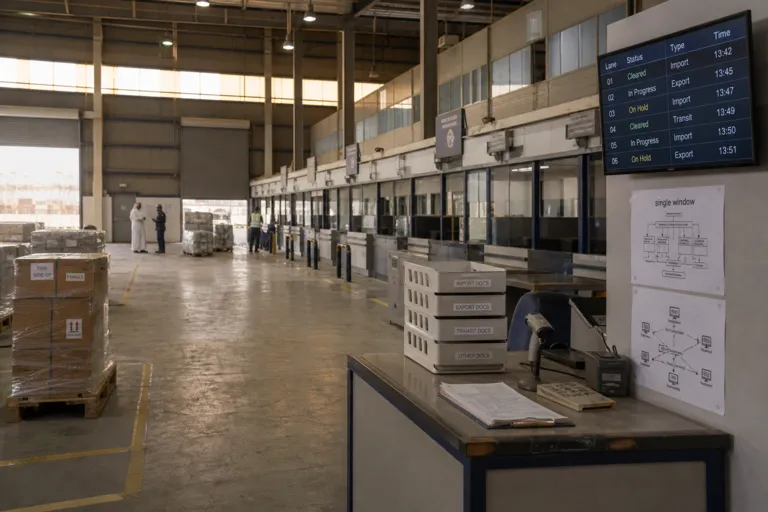
Against that backdrop, port community system digitalization is being used as a “one window” approach to reduce paper-based steps in cargo clearance and communication. Arab News cited the implementation of a Port Community System offering more than 250 digital services, describing how it enhances coordination between port authorities, customs, operators, and cargo stakeholders. The same source links these services to reduced administrative friction and improved supply chain transparency. In practical terms, a single digital platform can replace fragmented workflows and help keep decision-making aligned across parties that touch every shipment.
Why a Single Digital Window Matters When Throughput Surges
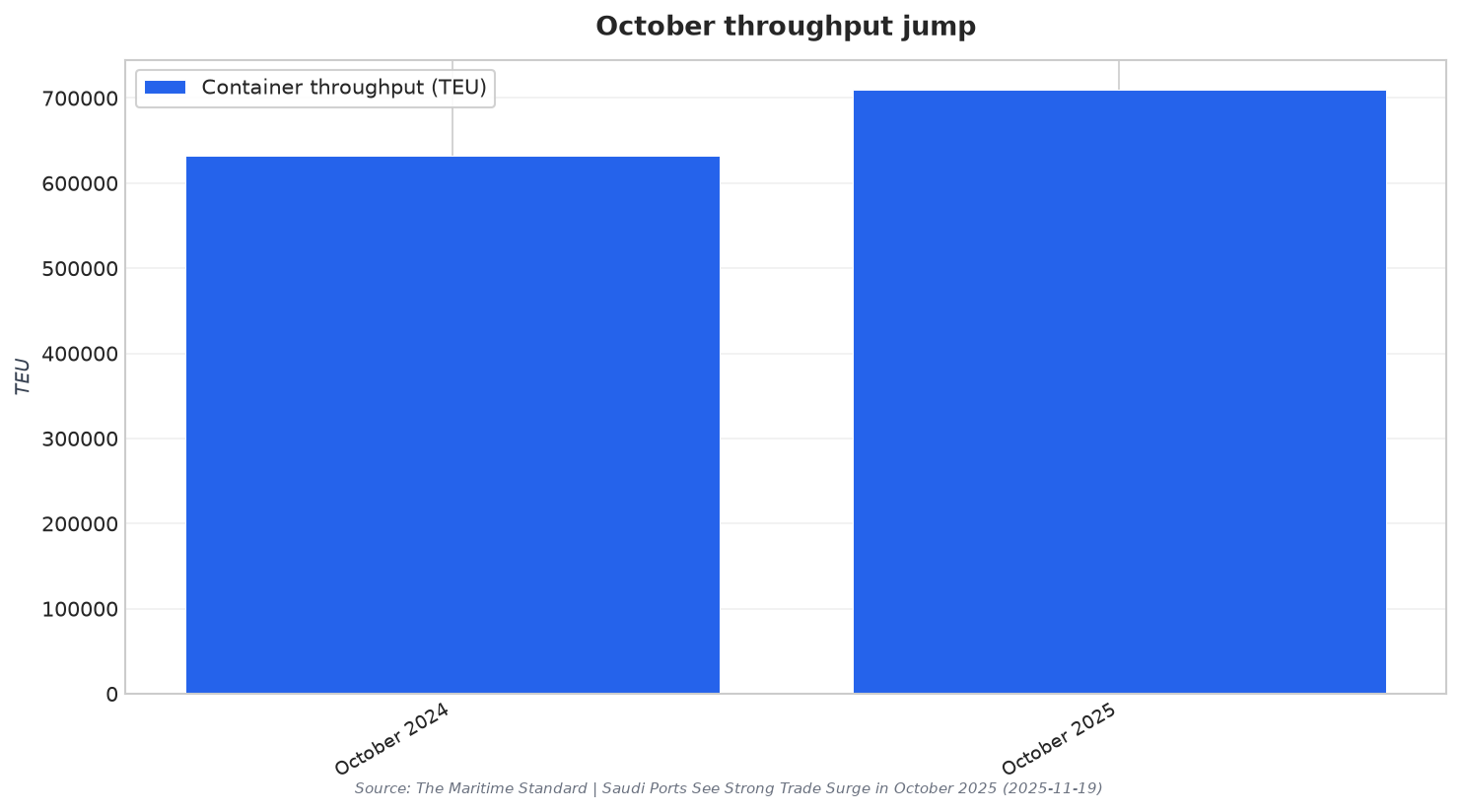
Recent trade figures show why smoother clearance matters. Ports supervised by Mawani recorded a 12.19% increase in container throughput during October 2025, handling 709,393 TEU compared to 632,323 TEU in the same month last year. Transshipment container movements rose 38.68% to 179,283 TEU from 129,274 TEU year-on-year, while import containers increased to 273,751 TEU and export containers climbed to 127,844 TEU. Over the same month, total cargo tonnage handled across Mawani’s network rose 6.93%, reaching 21.8 million tons compared to 20.39 million tons, alongside vessel traffic growth to 1,035 ships from 980.
Annual totals reinforce the direction of travel. WorldCargo News reported that Saudi ports operated by Mawani saw a 10.6% rise in 2025 container throughput to 8.3 million TEU. At the port level, Jeddah Islamic Port is described as handling approximately 5 million TEUs annually and operating across 62 berths with total quay length exceeding 11 kilometres. Its largest container terminal, run by the Red Sea Gateway Terminal, has an annual capacity exceeding 6 million TEUs. As throughput and capacity expand, the case for Mawani port community system digitalization becomes less about experimentation and more about keeping cargo clearance and stakeholder coordination consistent at scale.
Digital operations sit alongside investment and corridor-building. Arab News reported more than SR2.2 billion ($586.6 million) in private-sector investment directed toward multipurpose cargo terminals at eight Saudi ports. IMARC also cited Mawani investing $79 million in April 2025 to develop a major logistics zone at King Abdulaziz Port in Dammam, within a broader SR10 billion plan to establish 20 logistics hubs, and noted a new $800 million South Container Terminal unveiled at Jeddah Islamic Port in March 2025 by DP World and Mawani. At the same time, April 2026 saw Saudi Arabia Railways launch five new freight logistics corridors spanning more than 2,500 kilometers, connecting key gateways including Jeddah Islamic Port, King Abdulaziz Port, and King Abdullah Port to inland logistics nodes—creating more demand for fast, standardised, and transparent port-to-inland processes.
What is Mawani’s Port Community System designed to change in cargo clearance?
What figures show rising pressure on Saudi ports to process containers faster?
How large is Jeddah Islamic Port’s container activity and infrastructure footprint?
How does Mawani’s port community system digitalization connect to wider investment plans?