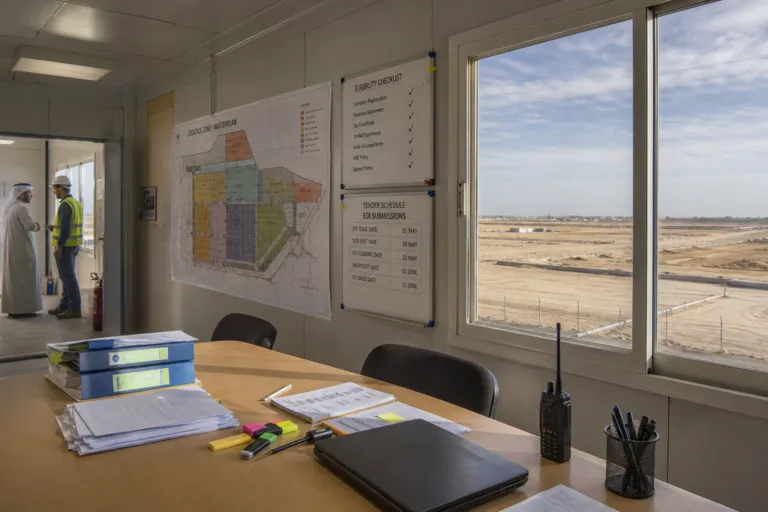
Saudi Ports Authority (Mawani) is inviting local and international companies to submit expressions of interest to develop and operate the Al Khumra Integrated Logistics Zone (KILZ) in Jeddah. The site spans 2.4 million square metres and is positioned near Jeddah Islamic Port on Saudi Arabia’s western coast. Mawani has said the zone is designed to support warehousing, container handling, and logistics operations, while also strengthening logistics infrastructure and supporting international trade and re-export activities. Submissions are handled through a dedicated online platform, and the EOI deadline is 20 November 2026.
For Jeddah Al Khumra logistics zone investors, the commercial logic is closely tied to port connectivity and time-to-transit. Mawani states the development will link to seven major ports on the western coast, including Jeddah Islamic Port and King Abdullah Port. It will also connect to Jeddah Islamic Port through a dedicated logistics corridor with an approximate transit time of 20 minutes. Sources also describe the location as serving markets across Europe, Africa, and the Middle East, and note its proximity to King Abdulaziz International Airport. The project is also referenced alongside the proposed Saudi Landbridge project intended to connect the Kingdom’s eastern and western regions by rail.
What Will Be Built: Warehousing, Cold Chain, and Container Yards
Mawani’s published scope includes a substantial warehousing component and dedicated container capacity. The development is planned to include 1.26 million square metres of dedicated warehousing space, comprising frozen, chilled, and dry storage facilities serving the food, pharmaceutical, and e-commerce sectors. It will also feature container yards with an annual handling capacity of up to 500,000 containers. In addition, the plan includes offices for logistics companies, shipping operators, customs clearance providers, and supply chain management firms, as well as internal roads, fuel stations, rest areas, and support centres. This mix signals a full-service logistics district rather than a single-purpose depot.
Eligibility requirements are explicit, and they raise the bar for bidders. Applicants must demonstrate a minimum financial capacity of 3 billion Saudi riyals ($800 million). They must also hold a valid commercial registration in Saudi Arabia. Mawani requires evidence of previous experience developing a logistics zone that has reached commercial operation, plus experience delivering projects in the Kingdom. These conditions suggest Mawani is screening for partners that can both finance and execute, and that can prove operational maturity in logistics-zone development rather than only construction capability.
Investors should also map the opportunity against the nearby port ecosystem referenced in the sources. Jeddah Islamic Port is described as having 62 multipurpose berths, a logistics zone for storage and re-exports, facilities supporting direct truck movements, and several specialised terminals and marine service berths. The port has an annual handling capacity of up to 10.2 million containers. Separately, Mawani’s wider logistics programme is cited as including seven agreements signed in July 2026 worth nearly SAR1 billion, covering more than 384,000 square metres of space for storage, consolidation, and re-export activities at Jeddah Islamic Port and the Al Khumra logistics zone.
What is Mawani asking companies to submit, and by when?
How large is the Al Khumra Integrated Logistics Zone in Jeddah?
What core facilities and capacities are planned for the zone?
What do Jeddah Al Khumra logistics zone investors need to qualify for the EOI?
How is the site connected to Jeddah Islamic Port?