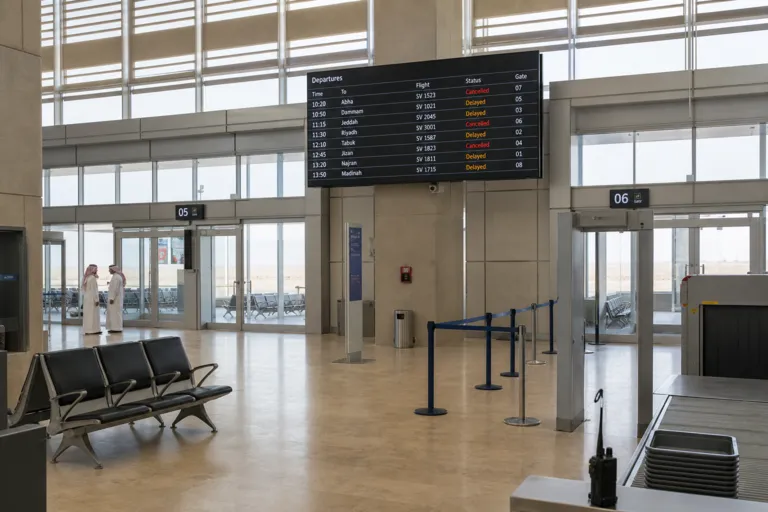
Abha, Jazan, and Najran sit at the heart of Saudi Arabia’s southern civilian aviation corridor, and recent reporting shows how quickly these links can be pulled offline. OPSGROUP’s July 2026 flight-safety bulletin logged a coordinated closure sequence for four airports—OEAB Abha International, OEGN Jizan (King Abdullah bin Abdulaziz Airport), OENG Najran, and OESH Sharurah—under NOTAMs stamped between 17:10 and 17:14 UTC on July 13. Industry observers read the four-minute administrative window as evidence of a single command-level decision pushed simultaneously rather than airport by airport. The four fields span roughly 500 kilometres west-to-east, meaning a broad stretch of southern air connectivity can be disrupted in one stroke.
The July sequence followed a barrage described as six ballistic missiles and drones targeting Abha and King Khalid Air Base at Khamis Mushait, with closures later extended through at least 1500Z on July 16, according to OPSGROUP’s rolling advisory. The extension carried no public reasoning from GACA in the cited reporting, while official messaging focused on interception claims and general assurances about the “security situation.” The same source noted that a Badr precision rocket in a CSIS inventory ranges approximately 95 miles (about 153 kilometres), placing the four closed airports within reach. For airlines and planners, the lesson is operational: a southern airport issue can become a corridor-wide availability problem, not a single-station delay.
Why The Threat Feels Like A Network Problem, Not A Single-Airport Problem
That network effect reappeared in open-source reporting on 6 August. An alert cited monitoring channels that reported Abha, Jazan, and Najran airports were closed between 23:27 and 23:29 UTC, with surrounding civilian airspace cleared as Saudi forces went on heightened alert for a possible Iran-origin threat. The same alert framed the operational move as more than rhetoric, even as it noted there was no confirmation yet of incoming fire or impacts at that time. It also stated these southern airports sit within range of both Iranian ballistic and cruise missiles and Houthi-launched projectiles from Yemen. For Saudi domestic air capacity at southern airports, security decisions can therefore include not just closures, but broad airspace management actions that force rapid reroutes and cancellations.
By early October, the risk picture sharpened from precautionary closures to confirmed damage. A separate alert reported that Saudi civil aviation officials at 10:21 UTC confirmed strikes on Jizan and Najran airports, causing material damage and minor injuries, extending an earlier reported hit on Abha. It described the clustering of attacks against multiple southern airports in a short window as pointing to a coordinated campaign, with immediate stakes including diversions, cancellations, and heightened safety restrictions across southern airspace. The same alert highlighted likely knock-on effects: crews may demand hazard pay or route changes, and insurers may scrutinize war-risk exclusions, meaning cost and schedule pressure can compound the direct operational disruption.
Two additional sources underline why planners increasingly treat this as an accumulation risk across a shared system. An India Today report cited a study finding Asir, Jazan, and Najran accounted for more than 80% of attacks inside Saudi Arabia, noting proximity to Yemen “limits the reaction time of Saudi air defense systems,” based on data from January 2016 to October 2021. Separately, Noah Intelligence analyzed attacks on Jizan, Najran, Abha, and King Khalid International Airport in Riyadh over 5 to 7 October, arguing an aviation-war file can no longer treat each Saudi airport as a self-contained dot because airports share aircraft, crews, airspace, diversion choices, and recovery capacity. Noah reported the confirmed attacks killed three people and injured 39, reinforcing that security planning has human stakes as well as capacity and continuity stakes.
What happened in July 2026 to Abha, Jizan, and Najran airports?
How wide was the July closure corridor across southern Saudi Arabia?
Were there confirmed strikes on Jizan and Najran airports in October 2026?
What does the reporting suggest about Saudi domestic air capacity at southern airports and security risk?