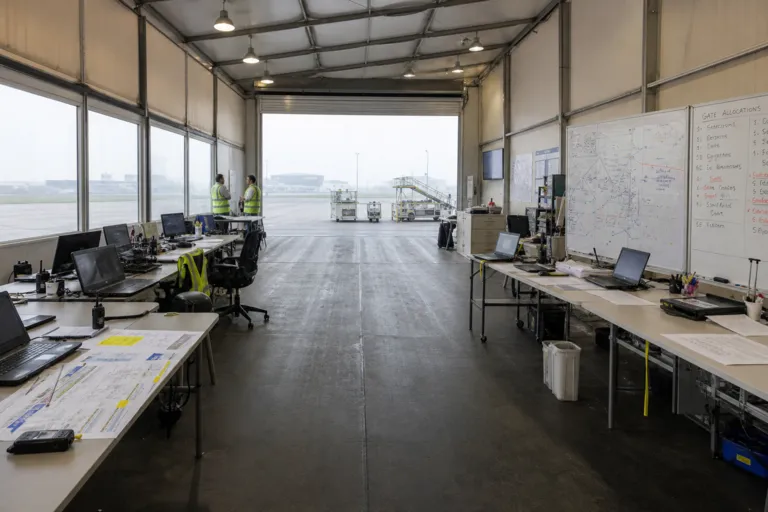
Riyadh Air has been forced to run an improvised network after attacks disrupted its base at King Khalid International Airport (RUH). Multiple reports say the carrier has temporarily moved flight operations to Prince Naif bin Abdulaziz International Airport, known as Al Qassim Airport (ELQ), in Buraidah. Riyadh Air also states on its website that, from Oct. 25 “until further notice,” its flights will operate from Al Qassim. The shift follows repeated Houthi attacks on RUH in October, even as the Riyadh facility partially reopened to passengers while repairs continue. In practice, this has created a temporary, regional hub located hours away from the airline’s home market.
The operational change is not subtle for passengers. Riyadh Air says travelers can go directly to Al Qassim or board a complimentary coach in Riyadh. Reported travel time between Riyadh and Al Qassim is between three and a half and four and a half hours, and Skift describes the distance as 434 kilometers (270 miles). Skift also notes free coach transfers to and from the InterContinental Durrat Al Riyadh hotel, and that check-in opens eight hours and 15 minutes before departure at a Riyadh hotel. This is the core of Riyadh Air Al Qassim temporary hub operations: keeping aircraft moving while shifting much of the customer journey onto the road.
What the Reduced Network Looks Like From Al Qassim
Riyadh Air has restarted flights from Al Qassim with a reduced schedule that is repeatedly listed as six routes: Cairo, Dhaka, Jeddah, London Heathrow, Lahore, and Islamabad. Air Data News adds that the temporary arrangement began on October 25 and describes the move as relocating part of the operation about 250 miles (400 km) north of Riyadh. The airline’s website messaging, as cited across outlets, frames the change as temporary and “until further notice.” This limited map reflects a carrier protecting continuity on key city pairs while accepting a smaller footprint than it had been building from RUH.
The constraint is not just about where Riyadh Air can fly, but what it must pause. AirlineGeeks reports that the slimmed-down schedule temporarily cuts international routes such as Madrid, Manchester, Bangkok, and Dubai. Air Data News similarly says services to destinations including Dubai, Madrid, Manchester, Mumbai, Bangkok, Kuala Lumpur, and Manila have been affected by cancellations from Riyadh. The disruption hit only months after the airline began full commercial operations on June 10, according to Air Data News, and as the carrier was working to add connections and build demand in foreign markets, including the U.S., according to AirlineGeeks and Yahoo’s republished version.
Moving to Al Qassim also does not eliminate the security risk. Air Data News notes that Al Qassim is not immune to the regional threat and that its location does not prevent it from being reached by long-range weapons, but disperses operations away from an airport that has become a recurring target. The human toll in Riyadh has been severe. AirlineGeeks reports that missile strikes have killed a total of 18 people and injured over 300, and that Riyadh Air suspended operations after an Oct. 10 attack killed 13 at King Khalid before restarting from Al Qassim. For a young airline created around a hub-and-spoke model at RUH, and with plans to serve more than 100 destinations by 2030 (Air Data News), the temporary hub is a test of resilience under pressure.
Why did Riyadh Air shift operations from RUH to Al Qassim?
Which routes is Riyadh Air operating from Al Qassim during the temporary setup?
How long is the ground transfer between Riyadh and Al Qassim for passengers?
How do Riyadh Air Al Qassim temporary hub operations work for check-in and transfers?
Which destinations have been cut or affected while the airline operates from Al Qassim?