After the October strikes, the core continuity question for Saudi airports is not only physical repair. It is whether travellers, airlines, executives, specialist contractors, and time-sensitive cargo can plan around a predictable operating day. A Saudi-led coalition spokesperson said Riyadh’s King Khalid International Airport had been targeted 20 times during the month, as reported by the Associated Press on October 15. In the same period of escalation, a Saudi diplomat put deaths across the recent escalation at at least 19, but those figures carry different geographic scopes and should not be combined into an airport-specific total. Continuity planning starts by separating what is known, what is attributed, and what is still uncertain.
Operational continuity also has to respect how rapidly risk turns into decisions. Britain’s travel advice, updated on October 15, cautioned against all but essential travel to Saudi airports except Medina International Airport. The United States issued a Level 3 advisory on October 12. Neither advisory, by itself, establishes a national airport closure. But both affect how employers, travellers, and insurers evaluate a trip. That shift matters even if flights technically resume, because uncertainty about the next interruption can be as commercially disruptive as a single incident, especially for corporate travel and event schedules.
A Business-Continuity Playbook: From Incident Record to Operating Rhythm
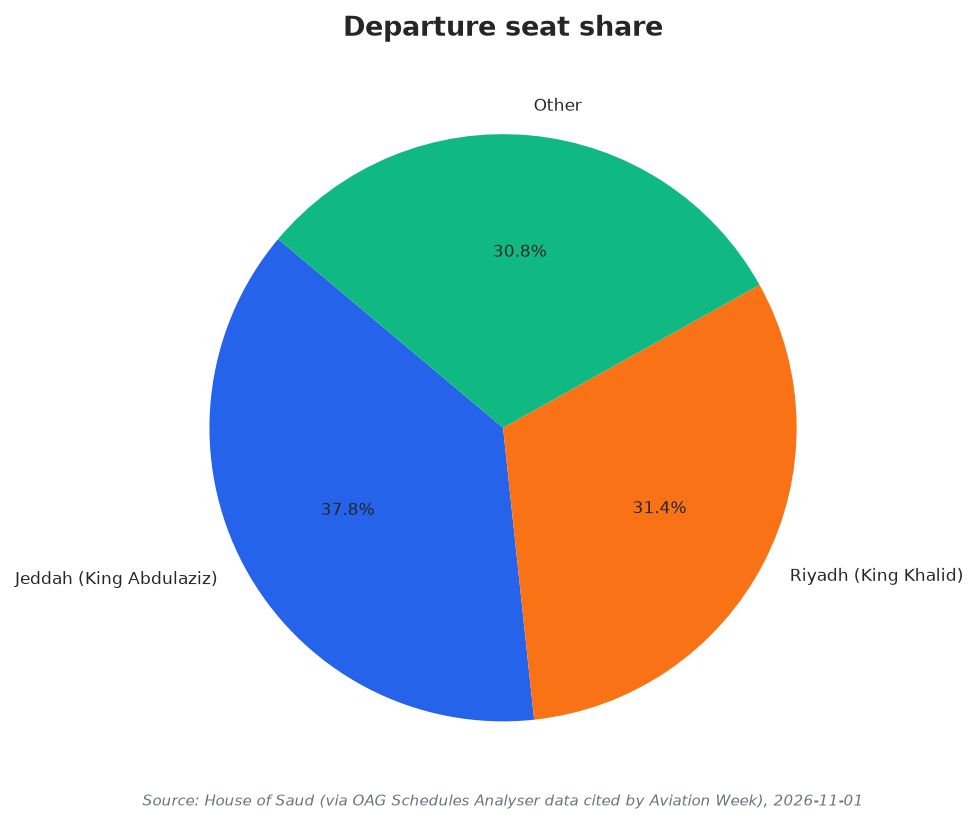
Start with schedule integrity. For the week of October 12, OAG Schedules Analyser data cited by Aviation Week put King Khalid International Airport at 31.4% of the kingdom’s departure seats, behind Jeddah’s King Abdulaziz International Airport at 37.8%. That concentration means disruption in Riyadh can quickly become a national planning problem. In the broader October 8–25 window, more than 7,800 Saudi flights were cancelled, described as 45% of all scheduled departures, per Reuters citing the same aviation analytics firm. On October 12, 632 of 1,048 Saudi flights were cancelled, a 60.31% rate, per Khaleej Times citing Cirium data. On that day, OAG data cited by Aviation Week showed 665 departures and arrivals scheduled at KKIA, and the airport was closed.
Second, plan for stop-start operations, not a single reopening moment. A NOTAM initially covered closure until October 17, per Khaleej Times, and a US security alert suspended operations again around October 19, according to Republic World. Build a continuity cycle around these realities: rapid status verification, clear thresholds for scaling down operations, and pre-approved reroute options when an intercepted missile still triggers emergency response, falling debris risk, or temporary closures. In parallel, keep communications disciplined. Reporting can differ between attacker claims, defending authorities, facility operators, and independent witnesses, and those accounts are not interchangeable.
Third, protect business travel and events with decision rules that match cancellation volatility. Reporting on October 22 said corporate travel to Saudi Arabia had effectively frozen this October as Riyadh’s main airport faced severe restrictions following reported regional missile strikes. Multinationals and event organizers reportedly postponed or relocated conferences into 2027. Airlines also faced sharp disruption. Between October 8 and 13, Riyadh Air recorded 80 of 113 flights cancelled, a 70.8% cancellation rate, per Khaleej Times citing Cirium. A practical King Khalid Airport missile attack aviation continuity posture therefore includes: contractual flexibility for events, alternative gateway routing aligned with travel advisories, and internal travel approval gates that can tighten or relax as scheduled flights normalize rather than merely “reopen.”
What do the October figures suggest about the scale of disruption affecting Saudi aviation schedules?
Why does schedule reliability matter as much as physical damage for airport continuity?
How concentrated is Saudi departure capacity at King Khalid International Airport compared with Jeddah?
What does a continuity playbook need to account for after the King Khalid Airport missile attack and related disruptions?