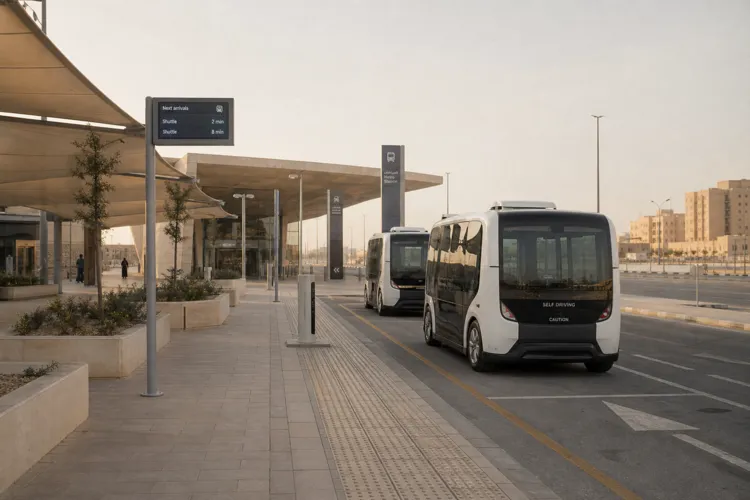
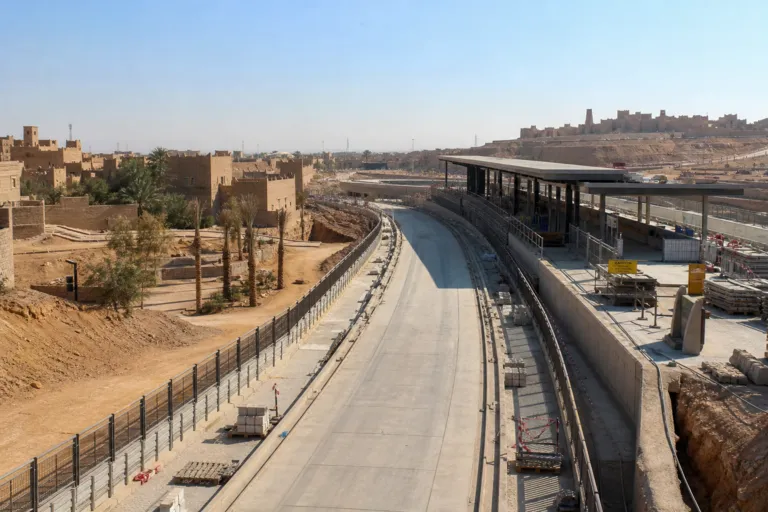
Diriyah Gate is positioned as a large, heritage-first destination on the edge of Riyadh, built around the UNESCO-listed At-Turaif district. The development is described as a $63 billion transformation into a cultural, entertainment, and hospitality district, with the Diriyah Gate Development Authority (DGDA) responsible for turning a historically significant area into a living, vibrant place. The programme’s masterplan area is 14 km², and its zoning approach separates the heritage core around At-Turaif from hospitality, retail and entertainment, and residential communities. In that context, a Diriyah Gate people-mover tram is best understood as a practical blueprint for moving guests between zones while keeping the heritage core legible, protected, and easy to experience on foot where it matters.
People movement is not an abstract idea here. It is a daily operating challenge created by real-world activity. Bujairi Terrace, described as the programme’s dining and cultural precinct, opened with over 20 restaurant and retail concepts and established Diriyah as a destination dining location for Riyadh residents. The district has also hosted Diriyah Season, an annual cultural and entertainment festival that drew significant attendance and strengthened Diriyah’s role inside the Riyadh entertainment ecosystem. Even while much of the destination remains under construction, this mix of dining, events, and heritage visitation means the guest journey needs clear, repeatable circulation patterns between arrival points, active precincts, and the UNESCO-linked heritage experience.
Why the Visitor Ambition Forces a Transport-First Mindset
Multiple sources frame Diriyah Gate with very large visitor ambitions. One analysis cites PIF positioning of 50 million anticipated annual visitors by 2030, alongside 40-plus hotels, 18,000 residential units, and a projected 100,000 population. The same analysis notes newer, search-visible PIF annual-report material that uses lower figures of 47 million annual visitors and 80,000 future residents, and it advises treating these headline numbers as official ambition rather than guaranteed operating demand until reconciled. Separately, a travel industry report states that millions of international visitors are estimated to be attracted annually. Taken together, the credible takeaway is not a single precise forecast. It is that high-volume circulation is central, and a people-mover concept needs to work under different demand cases.
The delivery machine also signals why a district-scale circulation plan matters. A 2026 intelligence brief describes a daily construction workforce of 20,000 people and reports a safety record of 50 million work hours without injuries. In parallel, infrastructure works including road networks, utility corridors, and public realm landscaping have progressed across the 14 km² masterplan area to enable vertical construction. Hospitality delivery is being sequenced too, with The Langham Diriyah and The Chedi Wadi Safar scheduled to welcome first guests in 2026, followed by Rosewood Diriyah and Orient Express Diriyah Gate in 2027. As openings stack up, a people-mover blueprint becomes a way to connect hotels, dining, events, and heritage interpretation without forcing every trip into private-car patterns.
What makes Diriyah Gate distinct is that circulation must respect preservation constraints, not just convenience. The progress tracker highlights a first phase completed for the At-Turaif UNESCO World Heritage Site conservation and adaptive reuse programme, stabilising and restoring mudbrick palaces and mosques dating to the 18th-century First Saudi State. The programme must balance commercial-scale development with preservation imperatives tied to UNESCO inscription, and it mandates a Najdi architectural language across development for visual coherence. In that frame, the Diriyah Gate people-mover tram concept reads as an integration tool: it can support access across distinct zones while reinforcing a calm, curated heritage arrival at At-Turaif, rather than turning the core into a traffic problem.
What is the role of a Diriyah Gate people-mover tram in the district plan?
How big is the Diriyah Gate masterplan area?
What visitor targets are associated with Diriyah Gate, and how consistent are they?
What is already open that affects people flow today?
What near-term hotel openings could increase movement demand?