
Qiddiya City is being built outside Riyadh as a Vision 2030 entertainment megacity with theme parks, motorsport, gaming, culture, and resort districts. One source describes a 334-square-kilometre development under construction about 45 kilometres southwest of Riyadh, while another frames it as a 366 square kilometre giga-project southwest of the capital. It is backed by the Public Investment Fund and developed by Qiddiya Investment Company (QIC). With destinations spread across multiple pillars and districts, the practical question is how people move across the site quickly and safely, without turning a leisure day into a long walk between venues.
That is why Qiddiya City intra-park mobility matters. The city’s early anchors already create reasons to travel across the site. Six Flags Qiddiya City opened on 31 December 2025, and Aquarabia followed in April 2026. Qiddiya’s own site also describes Six Flags Qiddiya City as offering 28 rides and attractions, with five record-breaking rides including Falcons Flight, positioned as the world’s longest, tallest, and fastest roller coaster. Aquarabia is described as a first-of-its-kind water theme park in Saudi Arabia, with 22 rides and experiences across eight themed zones and 91 private luxury cabanas. Those numbers hint at high guest circulation needs between entrances, parking, hotels, and multiple activity hubs.
Why Cable Cars Fit a Multi-District Leisure City
Cable cars are increasingly discussed worldwide as both transport and attraction, which aligns with a play-first destination. A global cable cars market report values the market at USD 8.2 billion in 2025 and projects USD 13.7 billion by 2034, a 6.8% CAGR. The same report notes technology improvements in safety systems, automated control modules, and energy-efficient drive mechanisms that reduced operational costs by about 22% over the past five years. Another market source projects cable cars and ropeways growing from USD 3.75 billion in 2025 to USD 6.22 billion by 2033 at a 6.52% CAGR. In practice, ropeways’ small footprint and point-to-point nature can help connect separated districts while also adding a scenic, destination-like ride.
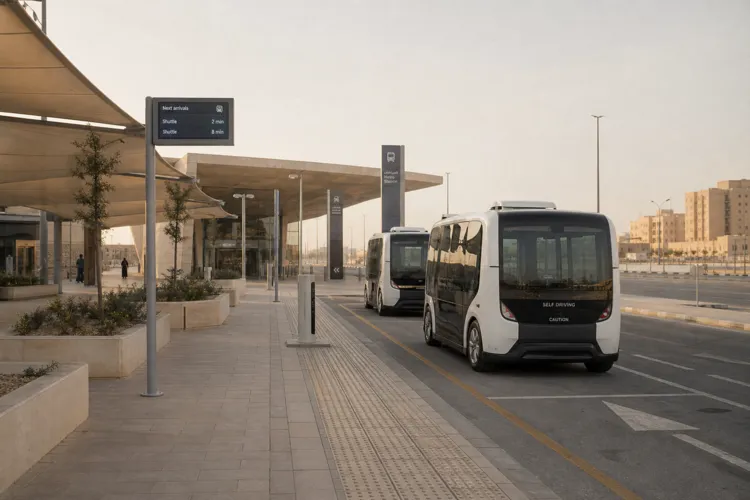
Shuttles remain a familiar backbone for large venues, especially when staged delivery means some districts open earlier than others. One overview notes Qiddiya’s delivery is staged through 2030, with the Speed Park Formula 1 circuit targeted for 2027 and the Prince Mohammed bin Salman Stadium targeted for 2029. Another source describes a 45,000-seat stadium complex and a Formula One-grade circuit designed to host international racing events, alongside theme parks and hospitality. In that kind of phased environment, flexible shuttle routing can link operating anchors to new openings as they come online. It also supports event peaks, where guest flows are uneven and timed around show schedules and race-day arrivals.
Autonomous loops are best understood as an operations concept as much as a vehicle type. In the broader ropeways industry, one source points to AI-driven command centers that enable adaptive speed regulation and even fully autonomous transit, matching capacity with real-time passenger demand. For Qiddiya, the relevance is the idea of “loops” that adjust to visitor surges between attractions, sports venues, and hospitality zones. The city is designed to serve Riyadh’s population of over eight million residents and also targets visitors beyond the capital. With official 2030 targets calling for 600,000 residents and tens of millions of annual visitors, the need for reliable intra-park circulation is clear, even as the project is still expanding and most master-planned districts remain under development.
What does Qiddiya City’s intra-park mobility aim to solve?
Which Qiddiya anchor attractions are already operating?
Why are cable cars considered for large entertainment districts?
What role do shuttles play as Qiddiya expands in phases?
How can autonomous-style loops improve guest movement inside leisure cities?