Decarbonizing road freight is often framed as a technology challenge. Yet multiple sources point to economics as the real unlock. Carbon Tracker argues that improving total cost of ownership (TCO) will dictate the speed of the trucking EV transition, and that battery-electric trucks are expected to reach or surpass diesel on TCO across major markets by the early 2030s. The same analysis warns that adoption is unlikely to be gradual once parity is reached, describing a non-linear S-curve that can rapidly shift market shares. For Saudi Arabia, this matters because freight electrification will likely hinge on whether fleets can see a clear operating-economics story, alongside infrastructure and policy follow-through.
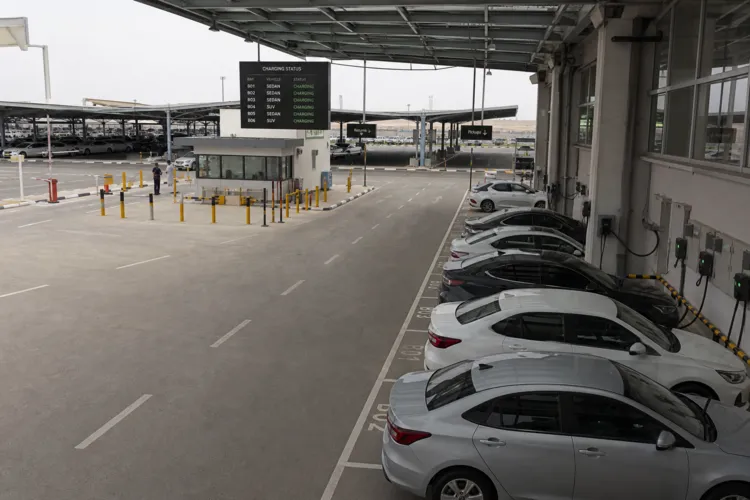
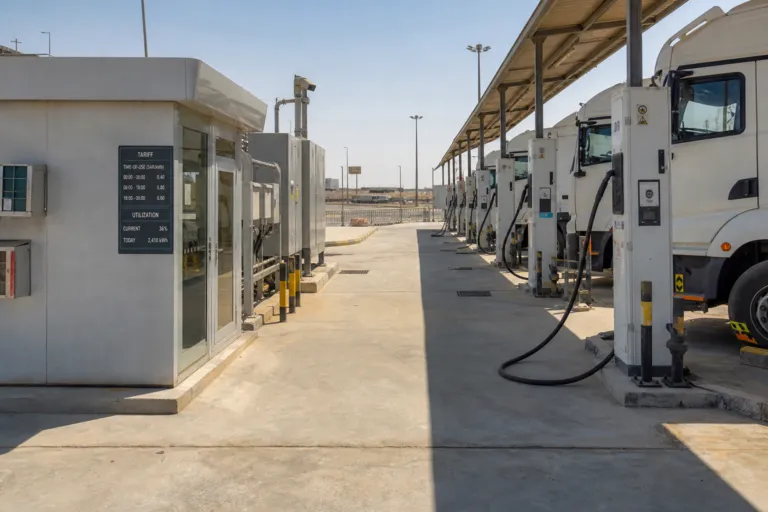
Saudi market signals are already forming around the commercial-vehicle electrification stack. A market study published via Yahoo Finance says the Saudi Arabia Commercial Vehicle Electrification (Trucks & Buses) Market is currently valued at USD 1.2 billion. It also states that the Saudi government is investing SAR 1.5 billion in electric vehicle infrastructure by 2025, and highlights a practical constraint: limited charging infrastructure, with only 1,200 public stations. The same source links demand to government support, rising fuel prices, and battery advancements, and notes that key cities such as Riyadh, Jeddah, and Dammam lead due to urbanization and infrastructure investments. These are the kinds of ingredients that can shift the Saudi electric truck total cost of ownership conversation from theory into procurement decisions.
Why TCO Parity Can Flip Markets Faster Than Most Plans Assume
Global context shows how quickly a trucking market can change when economics turn. Carbon Tracker points to China as an early indicator: battery-electric trucks accounted for more than 30% of Chinese heavy-duty truck sales in 2025, up from around 1% in 2021. That speed is the core risk and opportunity: once TCO tips, fleet purchasing can accelerate and pressure incumbent diesel-heavy strategies. Separate global commentary from GM Insights adds that BEV TCO advantages appear first in light/medium duty, and that battery costs for commercial vehicles have dropped about 30% since 2020. GM Insights also notes that electricity per-kilometer energy costs already undercut diesel by roughly 65% in select Chinese use cases—useful as comparative context, but not a Saudi-specific cost claim.
Saudi freight demand itself is not standing still, which raises the stakes for getting the transition economics right. Mordor Intelligence states that the Saudi Arabia Cross-Border Road Freight Transport Market is worth USD 2.65 billion in 2026 and is growing at a CAGR of 5.96% to reach USD 3.54 billion by 2031. The report also describes how digital brokers such as TruKKer aggregate small consignments across 60,000 trucks and help shrink empty backhaul ratios. That kind of utilization improvement can interact with electrification decisions because duty cycles, routing reliability, and turnaround time all influence fleet TCO calculations—whether for diesel or electric. Meanwhile, the Saudi electrification market study says Freight and Logistics is growing as companies aim to cut costs and reduce carbon footprints.
Policy and assessment methods can help Saudi fleets quantify when electrification makes sense by application. The Saudi electrification study says a regulation was implemented in 2023 mandating that all new public transport vehicles must be electric by 2030, aligning with Vision 2030 goals, and it describes segmentation across BEVs, PHEVs, and FCEVs with BEVs leading due to zero-emission capabilities and incentives. For fleet decision-makers, a ScienceDirect review emphasizes that distance is the most common functional unit in non-USA TCO studies, typically measured in kilometers, while only one reviewed study adopted ton-kilometers. The same review provides a European context point: two European-market studies indicate the price of green hydrogen at the pump ranged from 8.1 to 11.2 € per kilogram in 2022, underscoring that technology pathways and cost metrics vary widely by region and should be localized for Saudi conditions.
What is the biggest lever behind the Saudi electric truck total cost of ownership tipping point?
How large is Saudi Arabia’s commercial vehicle electrification market right now?
What infrastructure constraint is highlighted for Saudi commercial EV adoption?
What does China’s electric truck adoption suggest about how fast markets can shift?
How fast is Saudi Arabia’s cross-border road freight market expected to grow?