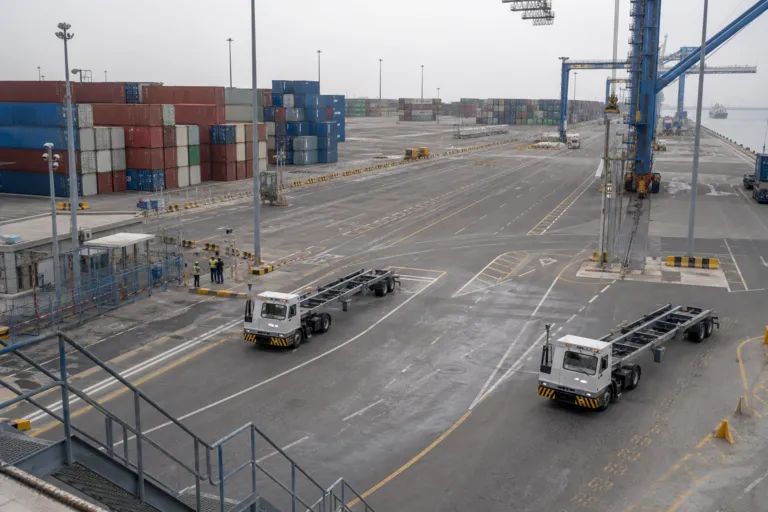
Autonomous yard trucks are becoming a practical next step in terminal automation because they target a specific bottleneck: repetitive container and trailer moves inside the gate. Globally, this segment is already tracked as a standalone market. One market report estimates the global autonomous yard trucks market reached USD 1.8 billion in 2025 and projects USD 8.4 billion by 2034, reflecting an 18.5% CAGR over the forecast period. The same source links adoption to labor shortages and cost pressure, stating autonomous operations can reduce per-move costs by 30% to 40% versus manual operations and improve safety metrics by 60% to 75%. For Saudi stakeholders considering a Saudi autonomous yard truck port terminal roadmap, these benchmarks help frame what “good” can look like elsewhere, while remaining careful not to treat them as Saudi-specific results.
Saudi Arabia’s own logistics narrative is already leaning into technology disruption. A Saudi freight and logistics forecast notes that autonomous-truck pilots are “over the horizon” alongside other shifts that could change cost curves. The same source highlights the Special Integrated Logistics Zone at King Khalid International Airport, spanning 32 million ft², and says duty-deferred storage plus automated clearance has reduced average e-parcel customs release times to below two hours. While that example is airport-led, it still signals appetite for automation and process redesign inside controlled perimeters—similar conditions to port yards. It also shows why yard autonomy is discussed as an infrastructure program, not just a vehicle purchase.
Why This Is a Terminal-Automation Frontier in the Region
Terminal automation is also accelerating at a regional level, which matters for how quickly capabilities and standards can propagate. A terminal automation report projects the Middle East and Africa region at a 5.12% CAGR through 2030 and cites Saudi Aramco’s Ras Tanura upgrade as an example that “weaves digital twins, SIL-3 safety loops, and autonomous yard vehicles.” It also states that in October 2024, Honeywell won a USD 180 million contract for Ras Tanura, aiming to embed digital twins and advanced process control to boost throughput without expanding footprint. For Saudi ports, the implication is that autonomous yard vehicles can be planned as part of a wider safety and controls stack rather than a standalone pilot.
Global volume pressure is a second driver that keeps autonomous yard trucks on the agenda. An autonomous trucks market report cites UNCTAD shipping metrics indicating global container port traffic reached 920.3 million TEUs, and it ties rising volumes to terminal operators integrating autonomous yard trucks to compress turnaround times. In parallel, a separate market study on autonomous terminal tractors values that global market at USD 4.8 billion in 2025 and projects USD 13.2 billion by 2034, a CAGR of 11.9% from 2026 to 2034. It also notes that, in 2025, major port authorities in the United States, China, the Netherlands, and Singapore collectively announced over USD 3.4 billion in capital expenditure earmarked for terminal automation upgrades.
Execution depends on connectivity and orchestration, not just autonomy software. The autonomous terminal tractor report says 5G connectivity and edge computing can support real-time autonomy, citing select smart-port deployments in Busan, Rotterdam, and Los Angeles with round-trip latency dropping below 10 milliseconds. Another example comes from Hamburg Port, where a dedicated 3.7 GHz band reduced crane response latency tenfold and supported autonomous vehicle orchestration that raised berth productivity by 22% during 2024 trials. None of these metrics are Saudi results, but they show what operational data leaders are using when building the business case—and what a Saudi port terminal could ask vendors to demonstrate during trials.
What market benchmarks are commonly cited for autonomous yard trucks?
What signals point to Saudi Arabia’s readiness for a Saudi port terminal yard-autonomy roadmap?
Which regional trends support terminal automation around Saudi ports?
How do smart-port networks relate to autonomous yard operations?
How should stakeholders frame the Saudi autonomous yard truck port terminal business case without overstating local facts?