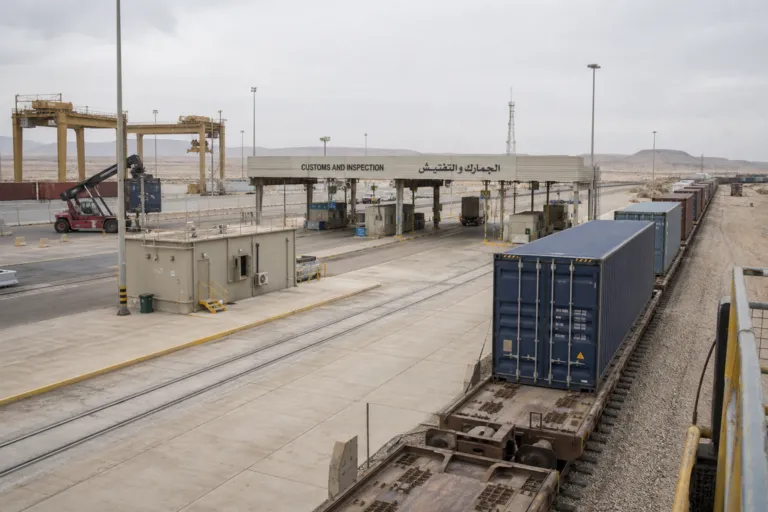
Saudi Arabia has launched a new international rail logistics corridor that links its Eastern Province ports with the Al-Haditha border crossing, aiming to boost trade flows and improve supply chain efficiency. According to SAR, the route connects King Abdulaziz Port in Dammam, Al-Jubail Commercial Port, and King Fahd Industrial Port in Jubail to Jordan and neighboring northern countries. In official comments posted on X, Transport Minister Saleh Al-Jasser described the launch via freight trains as a “practical model for integrating modes of transportation,” with a focus on diversifying routes, improving asset utilization, and reducing reliance on long-distance trucking within the Kingdom’s transport and logistics services system.
The corridor arrives as regional trade routes face disruption following the US-Israel conflict with Iran, which has pushed up energy prices and affected shipping flows across key Gulf corridors. In that context, a rail-to-border service creates an alternative path for cargo that previously depended on maritime channels. Reporting on the launch notes that goods that once sailed through the Gulf and around the Arabian Peninsula can now move by rail to the Jordanian border and then continue by truck to Aqaba’s port on the Red Sea, or overland into the Levant. The same reporting also notes that shipping lines have begun offering trucking services out of Aqaba as a gateway to Gulf markets, with Mediterranean Shipping Company and Maersk establishing Aqaba transhipment options for Gulf-bound cargo.
What the Corridor Connects—and Why the Numbers Matter
The new international freight service runs along SAR’s existing North-South Railway, described as a 2,750-kilometre network connecting Riyadh to the Jordanian border at Al-Haditha, and the international corridor uses the eastern segment to link Gulf-facing ports to the northern frontier. SAR also stated the service reduces shipping time by half compared to other land transport methods, reinforcing the corridor’s role as a time-saving option inside a multimodal chain. For operators and shippers tracking the SAR Gulf Jordan logistics corridor topic, those connections matter because they link seaports directly into a cross-border lane, rather than treating the border leg as a standalone trucking operation.
Freight scale is part of the corridor’s credibility. According to Arab News as cited in reporting, SAR moved 30 million tonnes of freight by rail in 2025, up from 24 million tonnes in 2023, and that volume removed an estimated two million truck journeys from Saudi roads. Separately, an analysis summarizing official 2024 railway statistics reports more than 15.6 million tons of goods moved, 6,807 SAR freight trips, and about 887,900 standard containers transported on East Train. Together, these figures frame the corridor as an extension of an already active freight system, now directed toward cross-border trade that had been served “almost entirely by trucking.”
The corridor also sits within a broader logistics push that emphasizes integration and multiple routing choices. Arab News reports SAR has announced five new logistics corridors forming an integrated logistics system that links Arabian Gulf ports with central and northern Saudi Arabia, extending to Red Sea ports and the Kingdom’s northern regions through a multimodal network combining road and rail. Those operations are managed through a system that includes the Riyadh Dry Port and freight yards in Dammam, Jubail, Ras Al-Khair, Al-Kharj, and Hail, plus Qurayyat. This package approach aligns with SAR’s positioning that the corridor “reinforces connectivity between Saudi Arabia’s seaports and northern and eastern land crossings,” while targeting improved cargo flow efficiency across routes.
Which ports does Saudi Arabia’s new rail corridor link to the Jordan border?
How much faster is the corridor compared with other land transport methods?
What rail-freight volumes has SAR reported in recent years?
How does the SAR Gulf-Jordan logistics corridor connect to Aqaba and the Levant?