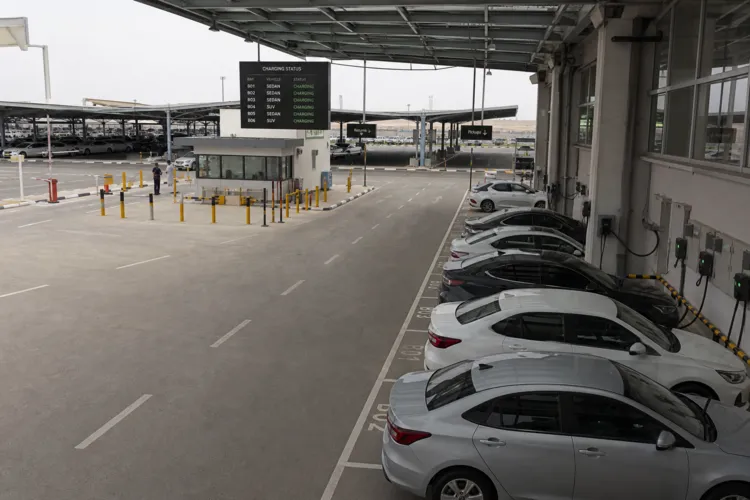
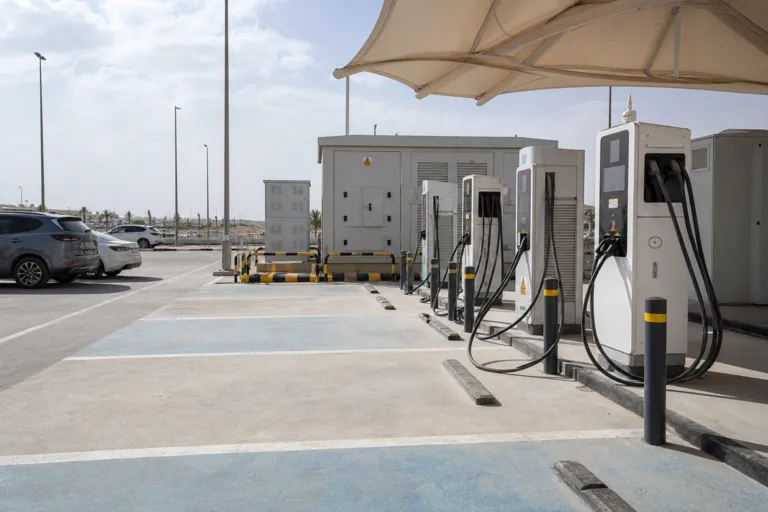
Saudi Arabia’s EV adoption story is moving fast enough that charging coverage has become an execution issue, not a distant ambition. EV registrations rose by 425% between 2021 and 2023, growing from 375 vehicles in 2021 to over 12,000 by the end of 2023. Public charging counts are also changing quickly, but reported totals differ: one source says public charging stations grew from 150 in 2022 to over 1,000 by early 2024, while another says Saudi Arabia had only 101 public chargers in 2024. Either way, the direction points to demand rising faster than confidence.
The core infrastructure response is EVIQ’s nationwide fast-charging plan. EVIQ is a joint venture between the Public Investment Fund (PIF) and the Saudi Electricity Company (SEC), and it plans to install over 5,000 fast chargers across cities and highways. Its inter-city plan also states a 2030 scale goal of 5,000 chargers and 1,000 hubs nationwide, linking Riyadh, Dammam, Mecca, and Madinah. This build aligns with policy benchmarks that include a national-scale push for electrification and Riyadh’s goal to make 30% of its vehicles electric by 2030.
Where the Money and Build Targets Concentrate
The investment map behind rollout is defined by overlapping targets and funding signals rather than a single program. Saudi Arabia’s Ministry of Investment data points to a $20 billion government investment package targeted at EV infrastructure development through 2030. A separate source describes a government commitment of over USD 50 billion toward EV manufacturing and infrastructure through 2030, with PIF leading landmark investments. Alongside EVIQ’s plan, SEC has announced plans to install an additional 3,500 charging points across 1,000 locations by end-2025, described as an investment of SAR 500 million (USD 133 million). These figures are often cited together as the practical yardstick for speed, coverage, and consistency.
Placement logic matters as much as totals. EVIQ signed an MoU with Remat Al-Riyadh Development to deploy a city-wide charging network, with planned placement in high-traffic zones, residential hubs, and public parking. For long-distance reliability, the strategy prioritizes “desert highways” such as the H-40 Riyadh–Jeddah corridor. Ultra-fast chargers rated between 150 and 350 kW are planned at key highway stops including Afif and Al Quwayiyah. By end-2025, EVIQ plans to complete 60 charging stations across major cities and highways such as Riyadh–Qassim and Jeddah–Madinah, making corridor uptime a visible test of the rollout.
Riyadh’s market gravity increases the stakes for execution. One analysis states Riyadh accounted for 38.73% of 2025 sales and targets 30% electric-vehicle penetration by 2030. Network builders beyond EVIQ also appear in public signals: Lucid reported it has surpassed 100 EV chargers across Saudi Arabia, and Foxconn Interconnect Technology (FIT), through its joint venture Smart Mobility, is expected to start production in 2026 at its first EV charger manufacturing facility in Saudi Arabia. The investment gap highlighted in operator commentary is not only money; it is also speed, coverage, and trust, which is why the EVIQ fast charger network rollout is judged most harshly where people actually drive.
What is EVIQ targeting for fast-charger deployment by 2030?
How does the rollout connect to Riyadh’s 2030 electrification goal?
What other charging build targets are cited alongside EVIQ’s plan?
Where are ultra-fast chargers planned, and what power levels are mentioned?
How fast is EV adoption growing in Saudi Arabia, based on reported registrations?