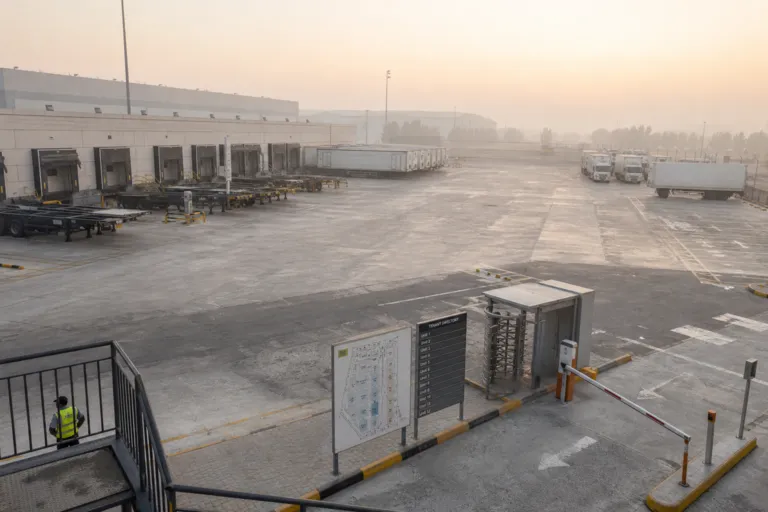
As 25 of 42 hubs move into the “live” column, the conversation around Saudi Arabia’s logistics park rollout is shifting from announcements to absorption, throughput, and funding structure. The market context is supportive. IMARC forecasts the Saudi Arabia logistics market will expand from USD 55.29 billion in 2025 to USD 83.41 billion by 2034, at a CAGR of 4.67%. Within that trajectory, categories tied to outsourced operations matter for hub economics: IMARC cites 3PL growth at about 5.1% CAGR, and roadways at about 4.8% CAGR. Those growth paths help explain why the next tranche of hubs still needs credible private operators and long-lease tenants, not only state-led construction.
Capital needs are also explicit in the deal flow and pipeline figures. Makreo puts the approved investment pipeline at about USD 133 billion, with around 80% of funding expected from the private sector. Mordor Intelligence similarly states private-sector participation is expected to cover 80% of logistics capital outlays, translating into SAR 240 billion (USD 64 billion) of opportunities for third-party providers. That expectation creates a clear test for the live hubs: they must prove bankable demand, stable regulations, and scalable operating models. Otherwise, the burden shifts back to public balance sheets, which is not how the funding plan is framed in these sources.
Where the Next Wave Still Needs Private Capital
The strongest private-capital case is where concession frameworks and “ready-to-operate” nodes reduce execution risk. Mordor’s freight and logistics analysis describes a PPP pipeline for dry ports and inland container depots, anchored by 59 inland logistics centers covering 100 million m², with private investment encouraged via 30-year concessions, tax holidays, and utility rebates. It also notes Riyadh Dry Port processes 950,000 TEUs annually and uses on-site bonded storage to cut gateway dwell time and free quayside capacity. These are the types of assets that can anchor hub utilization, but they still require private builders, operators, and service integrators to turn land and permits into contracted cash flows.
Tenant-led mega-project logistics is another area where “live hubs” must translate into real, specialized capacity. Mordor values the Saudi Arabia project logistics market at USD 2.13 billion in 2025 and forecasts growth from USD 2.27 billion in 2026 to USD 3.04 billion by 2031, a 6.13% CAGR. Transportation accounts for 64.32% of that market in 2025, while value-added services are forecast to grow at a 7.06% CAGR through 2031. Oversized cargo represents 30.91% of the 2025 market size, and oil and gas plus mining and quarrying account for 36.55% of 2025 share. Those mixes favor hubs that can attract specialist handling, permits, and multimodal planning—capabilities that private operators often bring faster than greenfield public builds.
In practice, the private-capital story shows up in named projects and measurable facilities. IMARC reports that in November 2025, DHL Supply Chain announced a EUR 130 million investment for a 78,000 square meter regional logistics hub at the Special Integrated Logistics Zone (SILZ) under a 26-year lease. IMARC also notes SAL Saudi Logistics Services working with Mawani to develop a 54,000-square-meter logistics park at the Islamic Port of Jeddah. Makreo adds that DP World opened its first multi-client 3PL warehouse in Saudi Arabia on 30 July 2026: a 15,250-square-metre site with more than 17,000 pallet positions at Riyadh’s Al Mashael Logistics Hub. Together, these deals show what the Saudi national logistics hubs network needs next: more long leases, more multi-client occupancy, and more operator capital that turns “live” hubs into reliably utilized platforms.
Why does private capital matter for Saudi Arabia’s national logistics hubs network?
What PPP structure is referenced for inland logistics hubs and dry ports?
Which recent investments show how operators fund hub capacity?
How big is Saudi Arabia’s project logistics market in the sources?