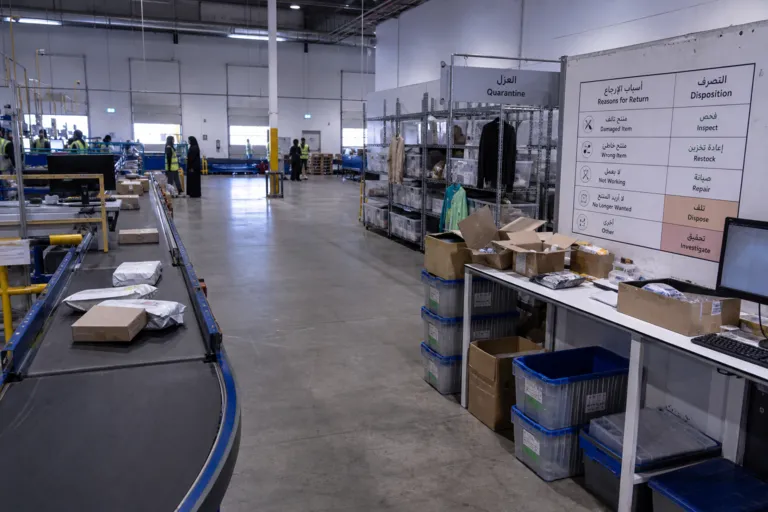
Saudi Arabia’s e-commerce expansion is creating a parallel “returns economy” that many operators still treat as a back-office problem. Yet the market signals point to returns becoming central to performance. Mordor Intelligence estimates Saudi Arabia’s e-commerce market size at USD 27.96 billion in 2025 and USD 31.29 billion in 2026, with projections of USD 54.87 billion by 2031 and an 11.92% CAGR over 2026–2031. The same report highlights the always-connected environment behind that growth, citing 99% internet penetration and 78% 5G coverage. As orders rise, reverse flows rise too, pushing brands and marketplaces to operationalize returns instead of handling them as exceptions.
Consumer behavior and channel structure increase the returns challenge. In 2025, B2C held 73.54% of Saudi Arabia’s e-commerce market share, while smartphones delivered 77.98% revenue share, according to Mordor Intelligence. In a mobile-first environment, shoppers move quickly from discovery to purchase, and expectations for service follow the same pattern. A global lens helps frame the competitive stakes: Locus notes that 92% of consumers value easy returns. That number is not Saudi-specific, but it clarifies why returns policies can become a retention tool. Operationally, any delay in inspection, triage, or restocking can turn into markdown risk and lost resale time.
Why Reverse Logistics Software Is Becoming the Strategic Layer
As returns volume increases, software is emerging as the control plane that links customer experience to cost containment. Ken Research values the Saudi Arabia reverse logistics software market at approximately USD 6.3 billion, tying growth to e-commerce expansion, increased product returns, and sustainability focus. The same source outlines the solution stack companies are adopting: return management software, inventory management, transportation management systems, repair and refurbishment tools, analytics and reporting, and circular economy and sustainability platforms. End users span retail and e-commerce, manufacturing, consumer electronics, automotive, healthcare, and 3PL providers, reflecting that returns are no longer isolated inside retail operations.
Technology is also shifting what “good” looks like in daily execution. Locus describes AI-optimized reverse logistics as scalable across regions, fleets, nodes, and return volumes, and reports that AI-driven warehouse returns management increased throughput by over 30% without physical expansion. While that figure is not Saudi-specific, it illustrates the operational upside Saudi operators seek as capacity constraints tighten. The same source emphasizes reducing unnecessary miles and routing items into reuse, resale, refurbishment, donation, or recycling paths, aligning operational optimization with sustainability outcomes rather than treating them as trade-offs.
On-the-ground in the Kingdom, service providers are positioning returns operations as a differentiator. MFS Logistics notes that, as purchasing shifts online, product returns continue to rise, and companies in Saudi Arabia are actively seeking advanced solutions to manage both forward and reverse supply chains efficiently. It also argues that efficient returns management will separate market leaders from competitors as expectations rise. The sustainability angle is explicit: governments and corporations are prioritizing environmental responsibility, waste reduction, and circular economy practices, and reverse logistics enables recycling, refurbishment, and responsible disposal. For Saudi reverse logistics e-commerce returns teams, that shifts returns from a pure cost center into a managed opportunity for recovered value and brand trust.
How fast is Saudi Arabia’s e-commerce market growing, and why does it matter for returns?
What is the size of the Saudi Arabia reverse logistics software market?
Which software capabilities matter most for managing returns?
What evidence suggests AI can improve reverse logistics performance?
What are the biggest operational stakes in Saudi reverse logistics for e-commerce returns?