

Saudi Arabia is moving to a stricter “no address, no delivery” operating reality. The Transport General Authority (TGA) announced that a national address will be mandatory for serving parcel shipments by delivery companies effective from 1 January 2026, and it urged individuals and businesses to provide their national addresses before enforcement. The stated logic is operational, not cosmetic. The TGA framed the measure as a strategic step supporting the National Transport and Logistics Strategy, focused on enhancing location accuracy and service efficiency, improving delivery accuracy and logistics efficiency, and supporting the growth of e-commerce and government services. In practice, it turns addressing into a hard gate in the parcel workflow, not an optional field that can be “fixed by phone call.”
For merchants and platforms, the rule changes what “ready to ship” means. A Salasa FAQ guide says that beginning January 2026, every shipment delivered in Saudi Arabia must include the official National Address, described as an eight-character alphanumeric code that identifies each residential and commercial location in the Kingdom. The same guide says couriers cannot complete delivery without it starting January 1, 2026, and that non-compliant shipments may be rejected, delayed or held, returned to sender at merchant cost, or marked as non-deliverable. It also lists possible extra courier fees, address correction surcharges, and operational penalties depending on the carrier, plus full RTO costs charged to the merchant. The mandate applies across COD and prepaid, domestic shipments, and international shipments into Saudi Arabia, and it also affects reverse logistics workflows, including returns and pickups.
Why 2026 Address Compliance Becomes a Growth Lever
The timing matters because the broader market is already scaling and optimizing for speed. Mordor Intelligence expects the Saudi Arabia e-commerce logistics market to grow from USD 2.20 billion in 2025 to USD 2.38 billion in 2026, and forecasts USD 3.66 billion by 2031 at an 8.96% CAGR over 2026–2031. In that same report, domestic flows accounted for 81.14% of market size in 2025, while cross-border shipments are expected to climb at a 13.90% CAGR between 2026 and 2031. Standard 3-to-5-day services held a 57.43% share in 2025, while same-day fulfillment is advancing at a 19.70% CAGR over 2026–2031. The national address requirement is presented as removing a key last-mile bottleneck, which aligns with a market that is already paying for faster, more predictable delivery performance.
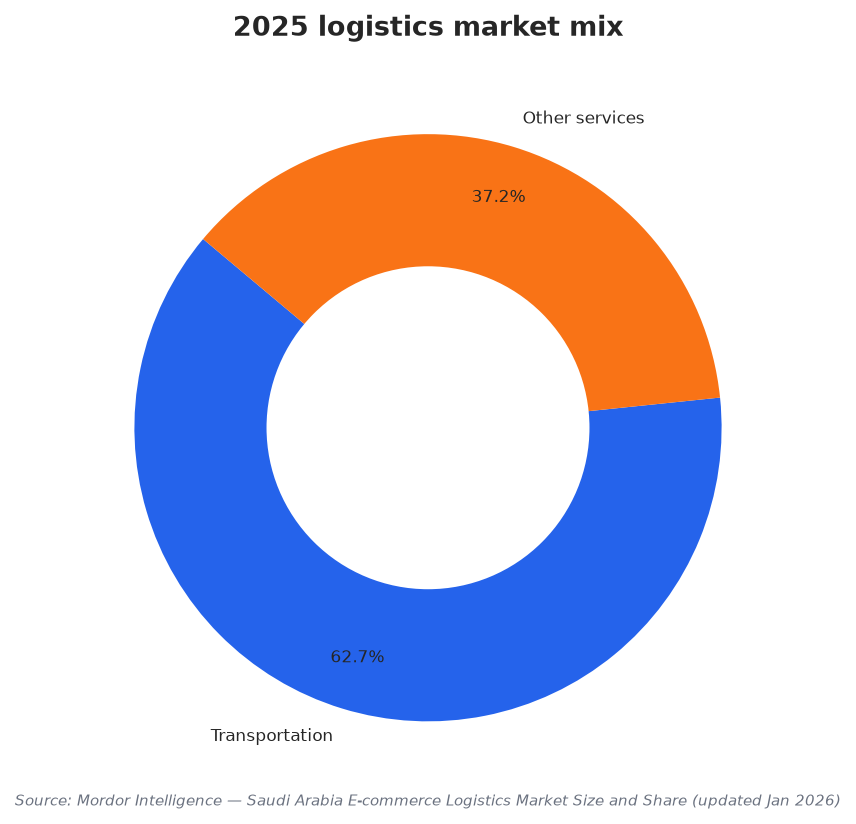
Operationally, the Saudi national address parcel delivery mandate pushes the industry toward cleaner data, tighter routing, and fewer manual workarounds. The Mordor Intelligence report links momentum to Vision 2030 reforms, SAR 280 billion (USD 74.6 billion) of logistics infrastructure commitments, and notes that AI-enabled routing is part of the efficiency story. It also says digital payments reached 79% of all transactions in 2024, reshaping how merchants manage delivery and customer contact. Meanwhile, the Salasa merchant readiness note describes the old delivery reality as relying on landmarks, descriptive instructions, phone calls, and written directions, and argues that rapid e-commerce growth makes that approach unsustainable. With the 2026 enforcement date, merchants will need checkout, OMS, and carrier integrations that capture and validate the National Address before label generation, rather than attempting correction after a parcel is already in motion.
Implementation will not be uniform across storefront stacks, and that is where many failures will originate. Salasa says Salla supports the national address natively, and Zid supports it as well, while Shopify does not support it natively and may require a custom field through the Checkout Editor, validation, and mapping the field to logistics flows via API. WooCommerce also does not support it natively and may require a mandatory custom field, validation, and mapping to order metadata synced via 3PL integrations. For carriers, the operational instruction is clear from the TGA announcements covered by Saudi Gazette and Zawya: parcel delivery companies must refuse shipments that do not include a national address. For merchants, the practical takeaway is equally clear: treat address capture as compliance-critical, because the cost of exceptions can appear as rejection, delay, or return-to-sender at merchant expense.
When does Saudi Arabia start requiring a national address for parcel deliveries?
What happens if a merchant ships without the National Address after 1 January 2026?
What is the National Address format described in merchant FAQs?
How does the Saudi national address parcel delivery mandate affect returns and pickups?
How big is Saudi Arabia’s e-commerce logistics market around the 2026 change?