
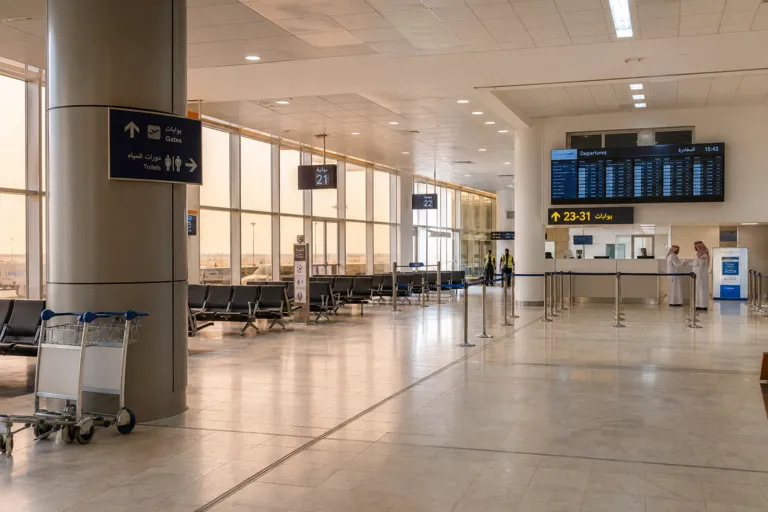
Flynas has become a focal point for Saudi low-cost growth as air travel expands around Vision 2030 tourism priorities. In May 2025, it became Saudi Arabia’s first publicly listed airline after completing a SAR 4.1 billion ($1.1 billion) IPO that implied a market capitalization of SAR 13.7 billion at listing, with an oversubscribed institutional book priced at SAR 80 per share. Operationally, the carrier ended FY 2025 with 15.8 million passengers and SAR 7.8 billion in total revenue. It also reported an adjusted net profit of SAR 556 million, up 28% year-on-year, while statutory results showed a net loss of SAR 527 million due to one-off IPO-related expenses.
The center of the scaling story is capacity, and the keyword topic is the Flynas fleet expansion toward an Airbus orderbook of 280 aircraft. As of May 2026, Flynas operated 67 active aircraft: 61 Airbus A320neo, 4 A320ceo, and 2 A330neo wide-bodies. The same sources describe a cumulative orderbook of 280 Airbus aircraft, including 30 A330neos intended for long-haul widebody growth from 2027. That combination supports a model that can add seats in the domestic and regional market while also building the ability to serve longer routes as the airline’s network grows.
How Network Scale Links Domestic Demand With Pilgrimage Lift
Flynas is building reach through a broad route map and a multi-hub approach. Its network spans more than 156 routes and over 80 destinations across 38+ countries, operated from four Saudi hubs in Riyadh, Jeddah, Dammam, and Madinah. A fifth base is also launching at Abha, adding another layer to domestic connectivity. Religious travel is an explicit growth layer. Flynas has a major Hajj 2026 airlift planned to carry over 147,000 pilgrims from 18 countries, which ties seasonal international demand directly into Saudi airport throughput and the wider travel ecosystem around Makkah and Madinah.
This expansion is happening inside a Saudi market that is already handling large volumes and pushing toward higher targets. Saudi airports handled about 140.9 million passengers in 2025, including 76 million international and 65 million domestic travelers, alongside roughly 980,400 flights and 1.18 million tons of cargo. In the same 2025 context, King Abdulaziz International Airport in Jeddah accounted for 38% of Saudi airport passenger traffic, while King Khalid International Airport in Riyadh accounted for 29%. Those airport shares matter because Flynas operates from both cities, letting it align low-cost supply with the Kingdom’s biggest passenger gateways.
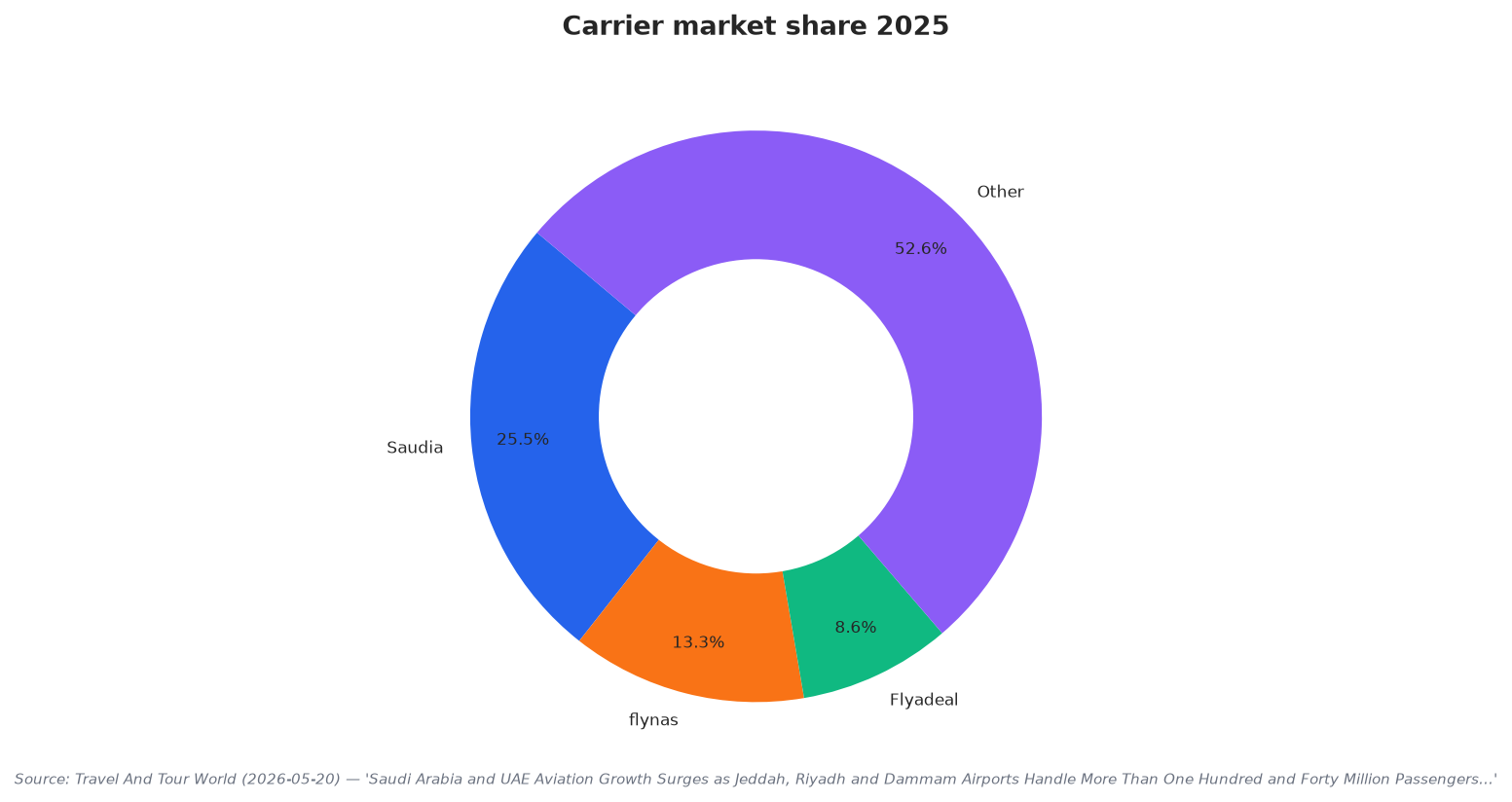
Competitive dynamics also show why Saudi low-cost carriers are central to scaling domestic and religious-tourism flying. One report states Saudia held 25.5% market share of Saudi airspace operations in 2025, while Flynas captured 13.3% and Flyadeal held 8.6%. Another analysis adds that low-cost carriers held approximately a 39% share of Saudi domestic aviation in 2023, with Vision 2030 targeting 44%. For Flynas specifically, revenue is described in three segments: core LCC operations at 90.4%, Hajj and Umrah services at 7.5%, and General Aviation at 2.2%. That mix highlights how a large orderbook and expanding hubs can serve both everyday domestic mobility and recurring pilgrimage demand at scale.
What does Flynas’s fleet expansion toward 280 aircraft refer to?
How large is Flynas’s network today?
What is Flynas planning for Hajj 2026?
What were Flynas’s FY 2025 passenger and revenue results?
How do low-cost carriers fit into Saudi domestic aviation targets?