
Road traffic injuries remain a major public health concern in Saudi Arabia, even as national indicators improve. A WHO EMRO review reported that between 2013 and 2023 serious road traffic accidents fell by 46%, fatalities by 44%, and injuries by 40%, linked to stricter traffic monitoring and public awareness campaigns. Progress, however, does not erase the economic drag of the crashes that still occur. One multi-country economic assessment on SSRN estimates the combined welfare and economic burden of road traffic injuries in Saudi Arabia at approximately 3% of GDP, and notes that human costs accounted for nearly 80% of total losses across study settings while medical costs were less than 3%. This framing is why the Saudi road crash economic cost post-crash response conversation increasingly matters to planners: reducing deaths and disability also reduces the largest share of losses.
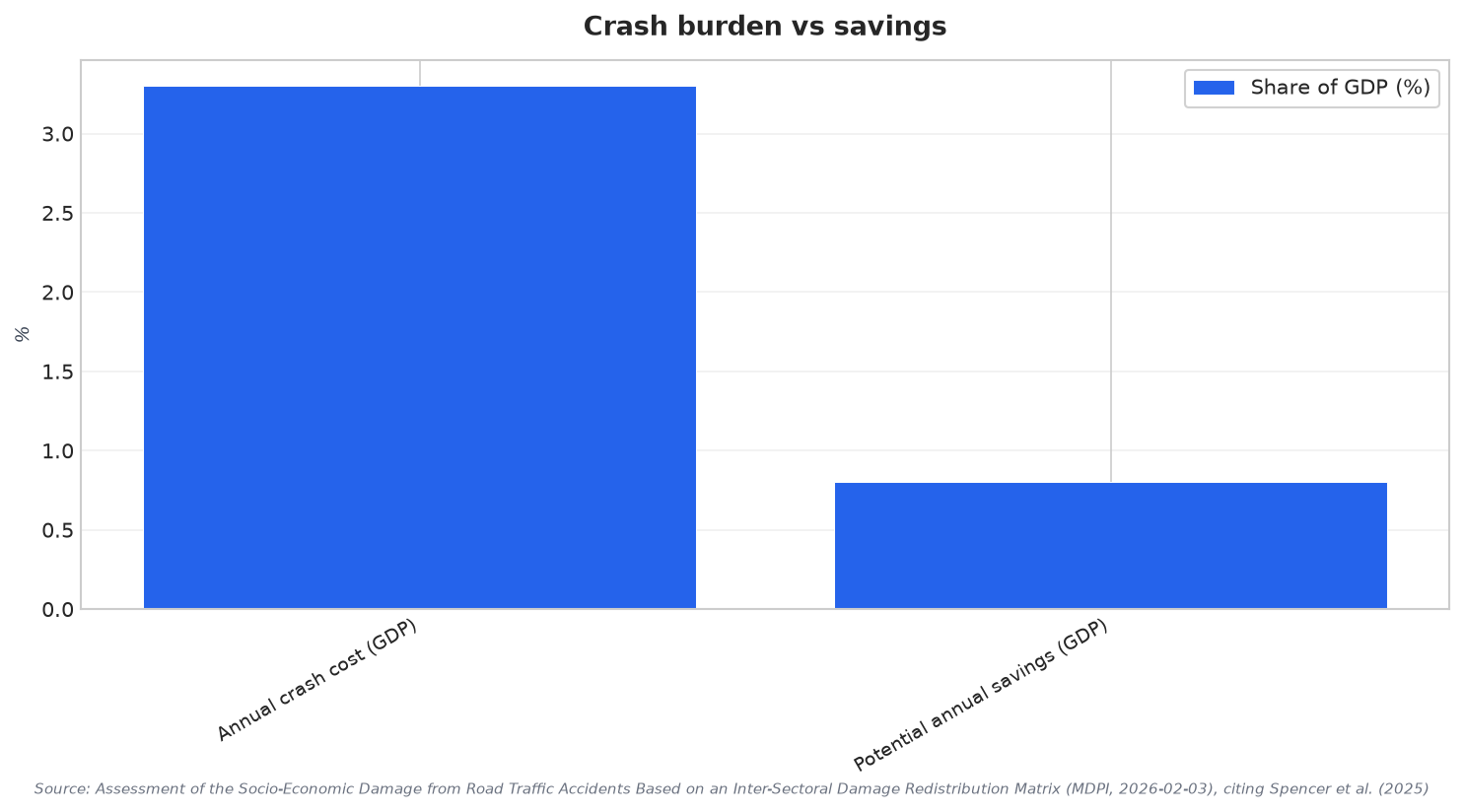
Saudi-focused estimates also place the burden in a similar macro range. An MDPI paper cites Spencer et al. (2025), estimating that road traffic crashes cost Saudi Arabia approximately 3.3% of GDP and that scaling up selected interventions could yield annual savings of 0.35–0.8% of GDP. The same paper describes how government expenditures can sit inside crash costs, including emergency response services, medical care, public insurance programs, road infrastructure expenditures, and rehabilitation programs. This matters because post-crash systems are not only a health function. They are also a channel through which losses are either contained quickly or allowed to cascade into longer hospital stays, deeper disability, and wider impacts on households, businesses, and public budgets.
Why Post-crash Emergency Response Is the Next Economic Lever
Recent Saudi reporting provides concrete signals that response capability is already part of the national safety story, and that improving it can be measured. Arab News reported that hospitals treated 65,577 traffic injury cases during 2025, including 1,288 critical cases transported by emergency teams. In the same report, the Saudi Red Crescent Authority reduced average emergency response times to nine minutes, 11 seconds, trained 4,980 individuals in first aid, and delivered awareness programs to more than 2.2 million people. These figures help translate post-crash response from a vague concept into a trackable investment area. When the economic burden is dominated by human costs, faster care, better triage, and earlier stabilization become practical tools to reduce the severity and long tail of injury outcomes.
Economic data in Saudi Arabia’s public narrative also reinforces why policymakers look for the next marginal gains. Arab News stated that the costs of road accidents increased by SR2.2 billion ($585 million) between 2024 and 2025. Yet it also reported estimated savings of SR83.6 billion from road safety interventions implemented between 2016 and 2025, excluding the pandemic years of 2020 and 2021. Enforcement and infrastructure actions are still essential, and the same report described more than 4,100 automated monitoring systems and a 98.75 percent compliance rate with roadwork and traffic diversion safety standards. Post-crash response complements these upstream measures by targeting what happens after the collision, when minutes can shape outcomes and economic losses can compound.
The strategic case is to treat post-crash response as part of a full cost picture rather than a standalone health service. The SSRN assessment highlights the need for improved national surveillance systems, and the WHO EMRO review concludes that reaching Vision 2030 road safety targets requires sustained enforcement, safer infrastructure, stronger education, and wider use of data-driven technologies. Arab News described how the Saudi Data and AI Authority used advanced analytics to identify accident hotspots and risk patterns, showing how data can connect prevention to response planning. In practice, the next safety investment is not only fewer crashes. It is better outcomes when crashes happen, using response-time performance, critical transport capacity, and stronger data linkages to reduce avoidable loss.
What do studies estimate for the economic burden of road traffic injuries in Saudi Arabia?
How much have Saudi road crash outcomes improved in recent years?
What do Saudi 2025 figures show about post-crash emergency response activity?
What is the year-over-year crash cost signal Saudi Arabia reported from 2024 to 2025?
Why does the Saudi road crash economic cost and post-crash response topic matter for investment decisions?