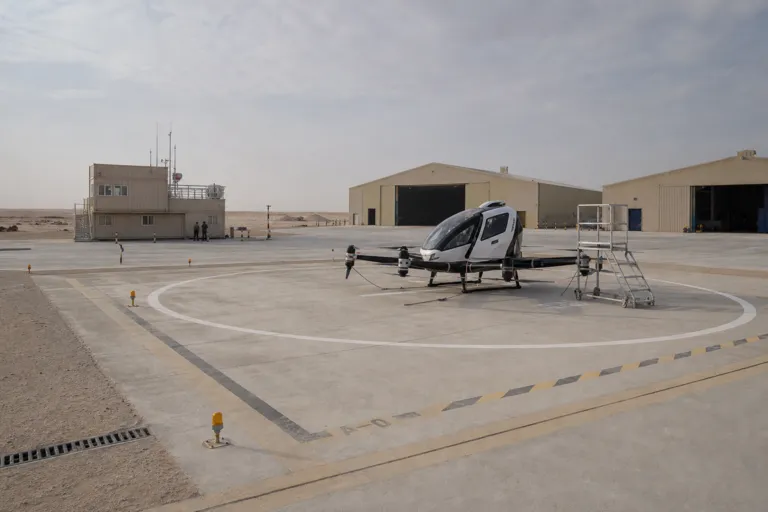
Desert trials matter because they concentrate the practical risks regulators and operators worry about: environmental exposure, operational repeatability, and real-world mission fit. In Saudi Arabia, air-taxi flight activity has already been linked to the national regulator. King’s Research reports flights carried out in collaboration with Saudi Arabia’s General Authority of Civil Aviation (GACA) and describes them as “a significant milestone” for urban air mobility adoption in the country. That framing matters for anyone tracking Joby and Archer desert trial results as a proxy for what Saudi certification could demand next, because it ties flight activity to the authority responsible for local operational rules and approvals.
Certification and operations do not move in a straight line. King’s Research also flags that regulatory hurdles and airspace integration remain significant challenges for the air taxi market, requiring coordination with aviation authorities, while rules for eVTOL certification, pilot training, and urban airspace management are still evolving. Mordor Intelligence similarly points to clearer pathways in major jurisdictions, citing FAA Special Federal Aviation Regulation No. 120 and EASA’s expanded Special Condition for VTOL aircraft, both published in 2024, as frameworks that outline airworthiness criteria, crew licensing, and operational limitations. The implication for Saudi evaluation is not that FAA or EASA rules automatically apply, but that global programs increasingly structure test evidence to satisfy defined powered-lift and VTOL expectations.
What Heat, Dust, and Range Evidence Changes in a Saudi Context
“Heat, dust, and range” is often shorthand for whether an air-taxi concept can sustain regular service and not just fly a demo. Market data shows that most early missions skew short, which shapes what operators and regulators expect to see in flight-test evidence. Mordor Intelligence reports that aircraft certified for less than 50 km captured 48.62% of eVTOL market size in 2025, while the intracity band is also highlighted by Grand View Research, which notes the “intracity (20km-100km)” range segment as the largest in 2025. At the same time, Mordor Intelligence forecasts platforms greater than 150 km to expand at a 29.95% CAGR through 2031, a reminder that developers also need credible data for longer missions as programs mature.
Heat-and-dust trials also connect to the economics of building confidence in the overall ecosystem, not only the aircraft. Future Markets Inc frames advanced air mobility through a “5As” ecosystem: Aircraft, Ancillary services (MRO), Airlines (operators), Airports (vertiport infrastructure), and Airspace (air traffic management). That systems view aligns with why regulators focus on operational stability and maintainability as much as raw flight performance. It also fits the commercial reality described by Mordor Intelligence’s air-taxi market report, which defines air taxis as on-demand, short-range passenger services sold as a service, and estimates the air taxi market at USD 4.47 billion in 2026, growing at a CAGR of 18.79% to reach USD 10.56 billion by 2031. This growth narrative increases pressure to produce standardized environmental and operational data that can survive certification scrutiny.
Finally, the “desert trial results” conversation sits inside an industry that is still calibrating what scaled deployment looks like, including infrastructure readiness. Business Research Insights cites an FAA report that only 10% of U.S. cities had started building the necessary infrastructure for eVTOL operations in 2023, which it notes could delay commercial air taxi rollouts in major urban areas. That statistic is U.S.-specific, but it illustrates why Saudi stakeholders may want flight evidence that ties aircraft performance to ground handling, turnaround, and operational constraints. The same source also says more than 300,000 aircraft reservations and letters of intent have been announced globally by operators, underscoring why developers, including Joby and Archer, are incentivized to translate harsh-environment flight learnings into certification-ready documentation and repeatable operational procedures.
What do Joby and Archer desert trial results imply for Saudi eVTOL certification discussions?
Which eVTOL mission ranges dominate today, and why does that matter for desert operations?
Are certification pathways becoming clearer for eVTOLs globally?
How big is the air taxi market, and why does that affect trial data quality?
What’s a useful framework for understanding what desert trials need to prove beyond the aircraft itself?