Airport taxis sit at the intersection of policy pressure and daily-utilization economics. In Saudi Arabia, EV registrations increased by 425% between 2021 and 2023, rising from 375 vehicles in 2021 to over 12,000 by the end of 2023, based on Saudi Ministry of Investment data cited in a market overview. Vision 2030 frames fleet action most clearly in Riyadh, where the Saudi Green Initiative sets a target for 30% of vehicles to be electric by 2030. For operators serving airports, that mix of demand growth and targets turns electrification into an execution problem: vehicles, charging access, and procurement timelines that do not break the budget.
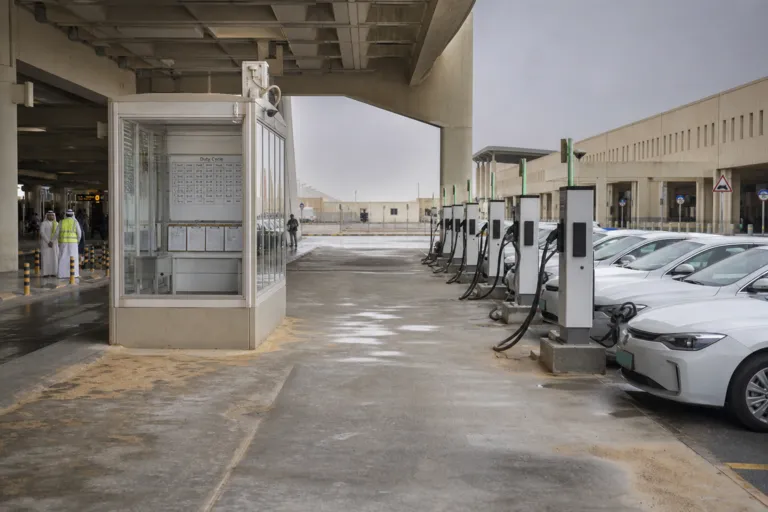
Charging access is the operational make-or-break factor for airport duty cycles. Public charging stations reportedly grew from around 150 in 2022 to over 1,000 by early 2024, reflecting government-backed scale-up. The Saudi Electricity Company (SEC) also announced plans to install an additional 3,500 charging points across 1,000 locations by the end of 2025, tied to an investment of SAR 500 million (USD 133 million). In parallel, EVIQ, a joint venture between PIF and SEC, targets 5,000 fast chargers across 1,000+ locations by 2030. For airport taxis, these milestones support hub planning: a mix of urban top-up charging and depot-style charging that aligns with shift patterns.
Fleet Mandates, Charging Hubs, and Why Jeddah’s Growth Matters
Mandates and market structure influence how quickly airport taxi fleets can switch. Mordor Intelligence describes Vision 2030 drivers alongside “fleet electrification quotas for ride-hailing and state entities” that accelerate uptake, while also noting Riyadh commanded 38.73% of 2025 sales and that Jeddah is projected to post the highest 24.57% CAGR through 2031. Charging deployment is also regionally concentrated: a separate release reports the Northern and Central Region held a 44.7% share in 2025, while the Western Region followed at 27.3% on commercial charging demand. For Riyadh and Jeddah airport corridors, this points to different rollout rhythms, even as inter-city routes between Riyadh and Jeddah are described as underserved by DC fast-charging.
Operator economics increasingly depend on procurement models and battery cost trends, not just sticker price. A Saudi corporate fleet electrification analysis notes that fleet electrification services—financing, leasing, charging-as-a-service, and telematics—are underserved, even as fleets seek bundled solutions that include vehicles, charging hardware, software, and maintenance. The same analysis cites IndexBox reporting battery pack costs in Saudi Arabia declining by 8–12% year-on-year, with LFP chemistries gaining preference for fleet applications due to lower TCO and improved thermal performance. For airport taxi operators, leasing can help manage residual-value uncertainty and translate changing battery economics into clearer monthly costs, while TCO models help match vehicle choice to the specific airport-to-city duty cycle.
Electrified operations around airports also connect to the next wave of fleet requirements: secure depots and high-availability charging. In autonomous mobility forecasts, Marqstats expects the robotaxi fleet to pass 650 vehicles in 2028 and reach 4,200 by 2030, with Riyadh the largest market and Makkah Province, including Jeddah, second. The same source states that battery-buffered fast charging, secure depots, sensor cleaning and calibration facilities, and remote supervision centres will be needed in Riyadh and Jeddah as fleets grow. Even without autonomy, those facility concepts map well to airport taxi electrification: centralized staging, predictable turnaround, and infrastructure that protects uptime while the national charging network expands.
What policy targets shape electric fleet planning in Riyadh?
How fast is public charging scaling in Saudi Arabia?
Why does Jeddah matter for airport taxi electrification economics?
What cost trends support Saudi airport taxi fleet electrification?
What infrastructure features beyond chargers may airport fleets need?