Aviation needs practical ways to cut emissions without stopping flights. Sustainable aviation fuel (SAF) is one of the main options being developed to help decarbonize air transport. One source notes that air transport currently accounts for more than 2% of global emissions, which explains why SAF is getting so much attention.
SAF can be produced from renewable raw materials such as biomass, or from waste and residues from the circular economy. Companies are building partnerships and changing refinery assets to support SAF production and supply for airlines. This matters for Sustainable aviation fuel Saudi Arabia too, because aviation is an important part of the Kingdom’s global connections and economic plans.
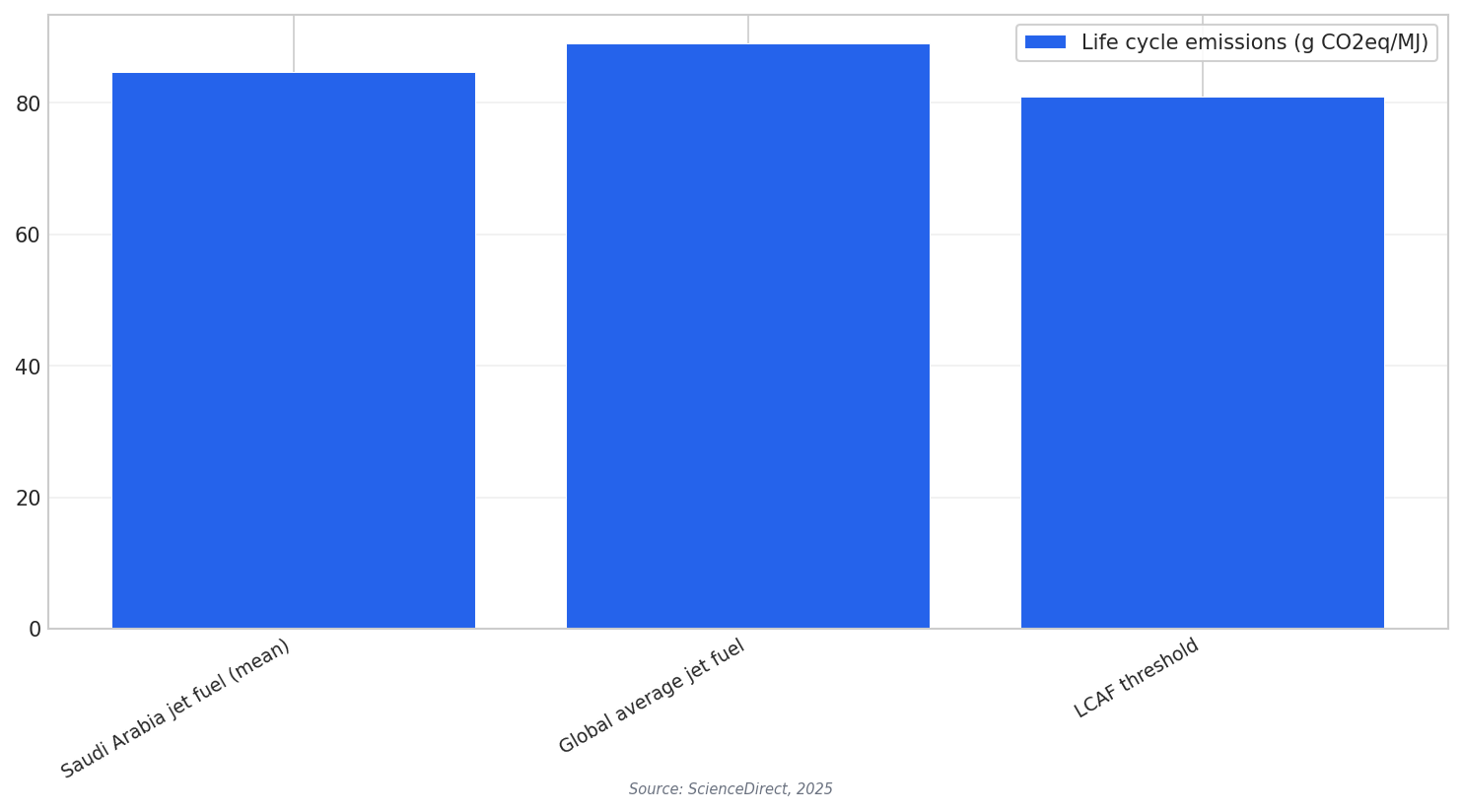
To understand why change is urgent, it helps to look at today’s jet fuel footprint in the Kingdom. A life cycle assessment study estimated the mean life cycle greenhouse gas emissions of jet fuel in Saudi Arabia at 84.74 g CO2eq/MJ. The same study reports a global average of 89 g CO2eq/MJ, and a Lower-Carbon Aviation Fuel (LCAF) threshold of 80.9 g CO2eq/MJ.
What Must Happen for SAF to Scale in the Kingdom
The same Saudi jet fuel study also shows where improvements could come from. It states that Well-To-Tank activities contribute 13.8% of total emissions. It adds that incorporating decarbonization measures in Well-To-Tank activities, such as better managing co-extracted natural gas during oil extraction or including Carbon Capture Systems, could bring emissions below 80.9 g CO2eq/MJ.
But fuel change is not only a technical topic. A regional study focused on Gulf aviation says that, despite uncertainties around costs and technology scalability, targeted investments and collaboration can support the GCC in establishing a competitive SAF industry. It also highlights practical policy pathways that align SAF with broader energy transition and decarbonization goals in the region.
Recent legal and geopolitical shifts can also push or slow progress. A 2026 overview notes blending mandates introduced in the EU and the United Kingdom, and says geopolitical tensions and energy security concerns highlight SAF’s potential role as a strategic hedge for airlines against commodity price shocks. The same source also says the UAE and Saudi Arabia are at an earlier stage in domestic SAF production, and that ongoing regional geopolitical events may affect SAF infrastructure investment in the Gulf.
Airlines can still act while the fuel supply grows. Saudia, founded in 1945 and based in Jeddah, serves more than 100 destinations across Africa, Asia, Europe, and North America. It has also made operational changes like reducing single-use plastics and cutting aircraft weight to improve fuel efficiency, and it launched the Green Points programme to encourage choices like pre-selecting meals to cut food waste, reducing baggage to lower fuel burn, and opting out of amenity kits to reduce plastic waste.
What is Sustainable aviation fuel Saudi Arabia trying to achieve?
What can SAF be made from?
How does Saudi jet fuel emissions compare with key benchmarks?
What part of emissions comes from Well-To-Tank activities in Saudi jet fuel?
What is Saudia doing now while SAF supply scales?