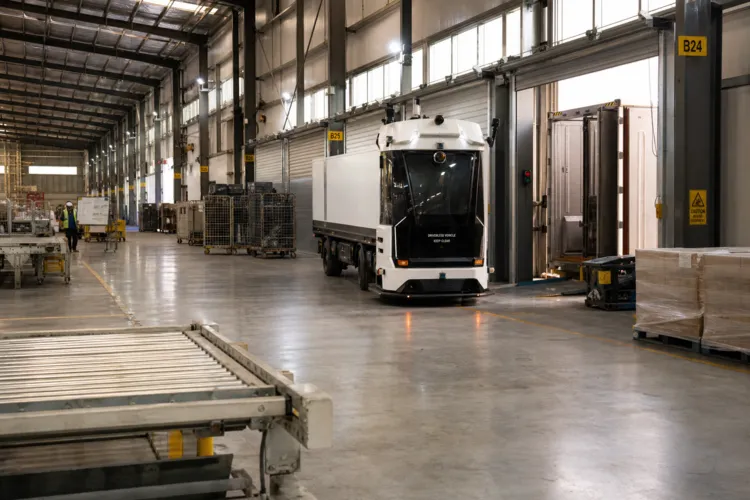
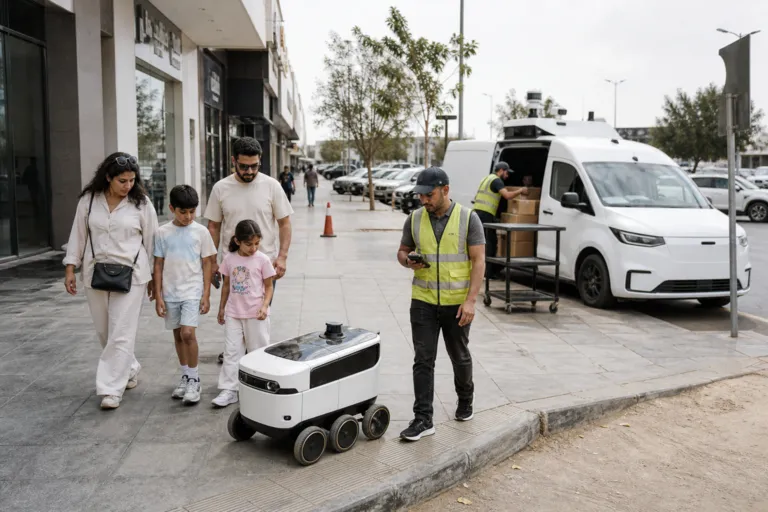
Autonomous delivery is being shaped by two complementary platforms: sidewalk robots for short, dense routes and autonomous vans for heavier, consolidated drops. Global market research frames this shift as a broad move toward self-driving delivery modes, including aerial drones, ground delivery bots, and self-driving trucks and vans. Amazon’s Scout is cited as a compact sidewalk robot designed to drop packages at customers’ homes. Elsewhere, JD.com and FedEx are noted as testing self-driving vans and drones to improve delivery accuracy and scalability. These examples matter for Saudi Arabia because the same platform choices will define how operators balance neighborhood coverage, payload needs, and route economics as automation matures.
On the market signal side, one global forecast values the autonomous last-mile delivery market at USD 30.55 billion in 2024 and projects growth from USD 37.92 billion in 2025 to USD 213.31 billion by 2033, at a 24.1% CAGR for 2026–2033. Another estimate puts the autonomous last-mile delivery market size at USD 1.3 billion in 2025 with expected 24.5% CAGR from 2026 to 2035. These are global figures, not Saudi-specific. Still, they explain why multiple vehicle types are being pursued at once, with segmentation commonly splitting the space into ground delivery vehicles such as self-driving vans and trucks, plus sidewalk robots and delivery bots.
Why Saudi Arabia’s 2026 Competition Is About Use Cases, Not One Vehicle
Within the Middle East and Africa context, one market report states the UAE leads with a 35% share of MEA deliveries, while Saudi Arabia follows with a 25% share, described as focusing on autonomous ground vehicles for industrial logistics. That framing helps explain why autonomous vans can be positioned as a practical first step where routes are repeatable and delivery points are controlled. The same report also cites “Others (Autonomous Vans and Hybrid Systems)” holding an 8% share as a category used for bulk deliveries. For sidewalk robots, the advantage is different: they are typically discussed as efficient, high-frequency, short-distance delivery tools that can improve route consistency and provide real-time fleet visibility.
Global robot-specific metrics also show why sidewalk deployments are a visible battleground. One forecast says the autonomous delivery robots market is expected to grow from USD 1.11 billion in 2025 to USD 1.33 billion in 2026, reaching USD 3.27 billion by 2031 at a 19.74% CAGR over 2026–2031. In 2025, outdoor models held 57.20% share, and battery-electric systems captured 93.10% share. Application mix matters too: food delivery led with 42.10% revenue share in 2025, while retail and e-commerce logistics held 48.60% share. These global splits help clarify the “race” dynamic in 2026: operators must pick the right first deployments by route type and demand pattern, not just by novelty.
Sidewalk robot services are also forecast as a distinct global segment. One outlook projects the global sidewalk robot last-mile delivery services market at USD 1.9 billion in 2026, rising to USD 12.6 billion by 2036 at a 20.8% CAGR, and states autonomous delivery robots account for approximately 46.1% of global demand in that context. Meanwhile, scaled operations are already described internationally: Starship is said to operate in more than 80 cities worldwide with six-wheeled sidewalk robots, and in February 2025 Avride launched sidewalk delivery bots on Uber Eats in Jersey City. For Saudi last-mile delivery robots, these global deployments act as reference points for what scaled fleets can look like, while Saudi Arabia’s stated emphasis on autonomous ground vehicles signals where early momentum may concentrate.
What is driving the 2026 push toward autonomous last-mile delivery?
How does Saudi Arabia compare within MEA adoption in the sources?
What do the sources say about market growth for autonomous delivery robots globally?
Which use cases lead autonomous delivery robots in the available data?
What is the “race” for Saudi last-mile delivery robots really about in 2026?