Saudi Arabia’s EV shift is accelerating, and the service system must keep pace. Saudi Ministry of Investment data cited in one market report shows EV registrations rising 425% between 2021 and 2023, moving from 375 EVs on the road in 2021 to over 12,000 by the end of 2023. That same report describes a $20 billion government investment package targeted at EV infrastructure development through 2030. As adoption rises, the aftersales question becomes more urgent: who repairs, diagnoses, inspects, and supports EVs at scale once vehicles are out of the showroom and into daily use?
Aftersales pressure is already visible in the local market dynamic. An EV aftermarket analysis focused on Saudi Arabia states that EV models are launching faster than dealer service capacity can keep up, and that the first wave of imports (2018–2021) is now leaving its standard warranty period. The same source adds that Chinese EVs are flooding the Saudi market, but that many arrive without local warranty coverage. Together, these conditions push more owners toward independent workshops, body shops, and parts channels, and they raise the stakes for consistent standards, tooling, and technician training across the Kingdom.
What a Scalable Maintenance Ecosystem Needs in Saudi Arabia
A Saudi EV aftersales service network has to be built as an integrated system, not as isolated service bays. A logistics and supply-chain analysis argues that the next phase depends on connecting ports, industrial clusters, suppliers, charging networks, and aftersales services into a unified system. It also frames “stronger handling and servicing of core EV components” as one of four development priorities alongside deeper local manufacturing, supplier localisation, and charging infrastructure that scales with fleet and intercity demand. This matters because EV service is parts-and-software heavy, and it depends on fast access to components, qualified people, and repeatable diagnostic processes.
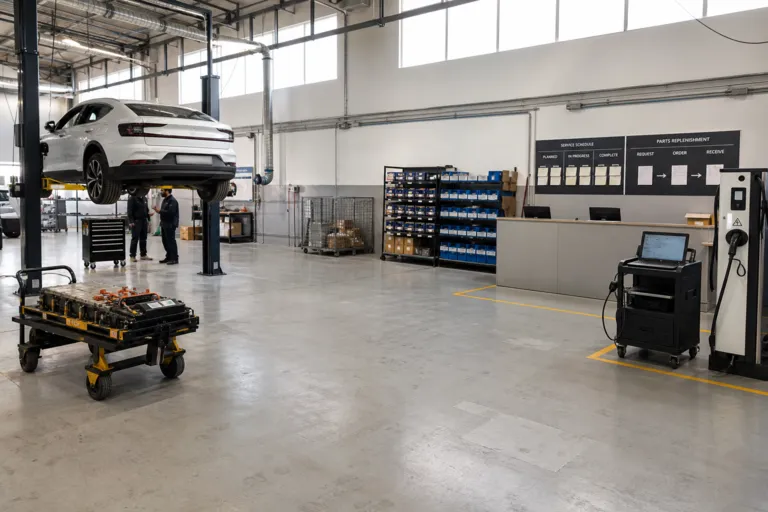
Saudi aftermarket activity is already shifting toward EV-specific work while still supporting conventional vehicles. A 2026 aftermarket guide says the sector is moving toward battery diagnostics, repair, maintenance, refurbishment, training, and recycling, while noting that EV sales remain just over 1% of overall car sales. It also states that Saudi Arabia has a target to transition 30% of vehicles in Riyadh to electric by 2030 as part of a strategy to reduce emissions in the capital by 50%. On the service side, the same guide reports that CATL opened a 7,000 square metre service centre in Riyadh offering full-lifecycle services including battery diagnostics, repair, maintenance, refurbishment, training, and recycling.
Charging growth is another force shaping service planning, because it expands where EVs can operate and therefore where support must exist. One market report says public charging stations grew from 150 in 2022 to over 1,000 by early 2024, and adds that the Saudi Electricity Company plans an additional 3,500 charging points across 1,000 locations by the end of 2025, tied to SAR 500 million ($133 million) of investment. Separately, MarketsandMarkets values the Saudi Arabia EV charging station market at $3 million in 2026 and projects it to reach $17 million by 2031 at a 25.6% CAGR. Service coverage should expand in parallel with these corridors and urban nodes so maintenance access does not become the bottleneck.
Why is EV aftersales demand rising in Saudi Arabia now?
What is one concrete example of EV service capability already in the Kingdom?
How does charging expansion affect maintenance planning?
What does “unified system” mean for Saudi Arabia’s EV ecosystem?
How can a Saudi EV aftersales service network reduce owner risk for newer imports?