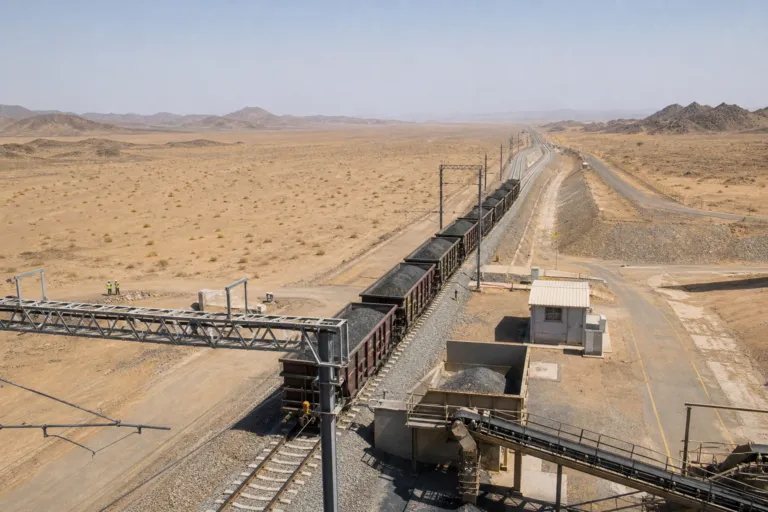
Saudi Arabia’s rail logistics story is increasingly defined by mineral flows and the policy goal of tighter integration across mines, industrial cities, and ports. Saudi Arabia Railways (SAR), described as a PIF-owned national operator, runs a system that includes the North Train and an industrial freight layer built to reduce logistics friction between remote mineral assets and processing or export infrastructure. SAR describes a freight line of about 1,550 km running from Al Jalamid mine through Jouf and Hail to Al Baithah Junction, then east to Ras Al Khair on the Arabian Gulf. In parallel, reporting on the wider corridor describes the North-South Railway as a 2,750-kilometre network connecting Riyadh to the Jordanian border at Al-Haditha, underscoring how the same backbone can support multiple freight missions.
Operationally, the North-South Railway primarily handles mineral transport for Ma’aden’s mining operations. It carries phosphate, bauxite, magnesite, and manganese from northern deposits to coastal processing facilities. That mineral baseline is now being complemented by new freight services that aim to add containerised general cargo, widening the line’s use-case beyond bulk commodities. The same reporting notes the mining sector is already a major rail user and is expected to drive further demand as Ma’aden scales phosphate and aluminium production at Ras al-Khair and other sites along the route. For planners, this is the core question behind Saudi mineral rail freight on the North-South line: how to protect the bulk-mineral advantage while growing repeatable capacity for additional cargo types.
From Mineral Backbone to Multicargo Corridor
Recent corridor developments also emphasize international connectivity, not just domestic mine-to-port moves. Saudi Arabia has opened a rail freight corridor to the Jordan border that runs along SAR’s existing North-South Railway network and uses the eastern segment to link three major Gulf-facing ports to the Kingdom’s northern frontier. The line already operates freight services using the European Train Control System Level 2, which supports precise scheduling and capacity management across the 2,750-kilometre network described in the same source. The corridor is being framed as part of a broader logistics transformation, with government disclosures citing total planned investment in freight transport and logistics infrastructure at approximately USD 133 billion.
This rail pivot sits inside wider market signals that favor mining-linked rail demand. In a separate global rail freight view, mining and minerals shipped the highest tonnage, contributing 31.77% of 2025 volumes to the rail freight transport market. Saudi Arabia’s own logistics plans are also being described in terms of integration, with rail positioned as a practical lever because it can move bulk commodities while improving intermodal handoffs and reliability when freight density is present. The narrative around the North Train is explicit: it provides a dedicated route between remote mineral assets and processing or export infrastructure, which is the enabling layer for scaling mineral output without relying only on road.
Mining ambition is also being discussed through the scale of the resource base and the policy shift toward non-hydrocarbon sectors. Geological surveys referenced for the Arabian Shield describe it as covering approximately 650,000 square kilometres, with exploration campaigns identifying promising zones for copper, gold, zinc, and rare earth elements. In parallel, an investment-focused overview describes a “USD 110 Billion plan” associated with Saudi Arabia mining investment. Put together, these points explain why expanding and stabilizing mineral logistics capacity matters: the more diversified the minerals pipeline becomes, the more valuable a corridor is that can connect northern deposits to coastal industrial infrastructure, and also support additional freight types that make the network more resilient.
What commodities does the North-South Railway carry for mining?
How long is Saudi Arabia’s North-South rail network as described in the sources?
How is Saudi mineral rail freight on the North-South line being diversified?
What technology is cited for managing freight capacity on the North-South Railway?
What level of investment is planned for Saudi freight transport and logistics infrastructure?