“Buying spree” headlines are easy to write and hard to interpret. The better way to decode SAR’s 2026 rolling-stock moves is to place them inside the market signals the sources quantify: market size, growth rates, and where rail buyers tend to spend first. One global report puts the rolling stock market at $64.82 billion in 2025 and projects $69.5 billion in 2026, with expected growth to $92.21 billion by 2030 at a 7.3% CAGR (and 7.2% from 2025 to 2026). Another source estimates $59.68 billion in 2025, rising to $61.38 billion in 2026 and $84.07 billion by 2035 at a 3.56% CAGR. A third estimates a 2026 valuation of US$ 65.32 billion, reaching US$ 102.7 billion by 2035 at a 5.1% CAGR. Those ranges do not describe Saudi Arabia specifically, but they do frame the procurement environment SAR is navigating.
For freight-focused procurement, the product mix matters as much as the headline totals. The sources consistently break rolling stock into locomotives and rail vehicles such as wagons/railcars. One study says the global market is divided into locomotive, rapid transport, and wagon, and adds that the wagon category dominated revenue share in 2023, describing wagons as essential for freight transportation because they move heavy loads over great distances. That matters when reading Saudi freight rolling stock procurement because it indicates what global buyers have been prioritizing in revenue terms. Another report segments by end user into passenger transit and cargo train, reinforcing that suppliers and buyers often build separate business cases depending on whether the assets serve freight or passenger operations.
What the Global Data Says About Where the Pressure Is
The market sources also point to a tug-of-war between passenger-led volume and freight-led functionality. Fortune Business Insights states that passenger carriages are expected to hold a majority share of 60.18% in 2026, and elsewhere in the same source the passenger segment is anticipated to dominate 2026 with a 63.91% share. Those are global segment-share figures, not Saudi ones, but they help explain why freight buyers often need to be explicit about requirements and delivery priorities when competing for supplier capacity. Meanwhile, The Business Research Company describes growth drivers such as demand for energy-efficient transport systems and trends like advancements in diesel-battery-electric hybrid locomotives for sustainable railway transportation. It also notes Asia-Pacific as the largest and fastest-growing region, again as global context rather than a claim about SAR.
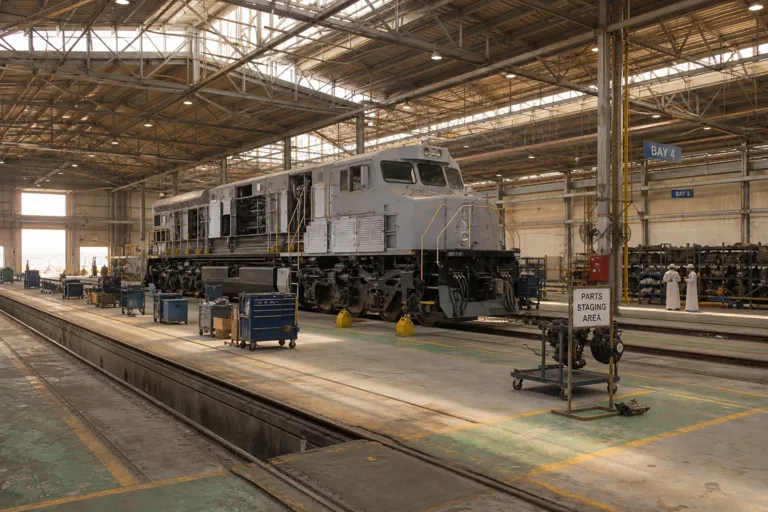
Procurement constraints, not just ambition, often decide what gets ordered and when. One locomotives-focused market source says high capital costs affect nearly 51% of railway procurement decisions, infrastructure compatibility issues impact around 39% of locomotive deployment projects, and maintenance costs influence approximately 33% of railway operators planning fleet upgrades. Read alongside the global market expansion figures, these constraints help decode why a buyer might bundle locomotives with wagons/railcars, or phase acquisitions to match infrastructure readiness and maintenance planning. The same source places the Locomotives (Rolling Stock) market value at USD 93.25 billion in 2026, which is distinct from the broader rolling stock totals reported elsewhere and should be treated as a separate market estimate, not a directly comparable subset.
Finally, keep the “spree” narrative grounded in what the sources actually support. The documents provided do not state SAR’s specific order values, delivery timelines, or local fleet totals. What they do provide is a structured lens for interpreting any 2026 SAR purchase: global rolling stock growth expectations into 2030 and 2035, a freight-relevant emphasis on wagons’ role in moving heavy loads, and a quantified view of what typically restrains procurement and deployment decisions. If you treat those as the decoding key, SAR’s 2026 actions read less like a one-off headline and more like a buyer responding to technology trends, segment competition, and well-known cost and compatibility trade-offs.
How can Saudi Arabia’s freight rolling stock procurement be decoded using these sources?
What do the sources say about rolling stock market growth in 2026 and beyond?
Which segment is expected to dominate in 2026, according to the sources?
What procurement obstacles do the sources quantify for locomotive buying decisions?