Saudi Arabia’s micromobility businesses are entering a stricter compliance era as SASO continues to refine technical regulations and the way products demonstrate conformity before they are placed on the market. SASO is the Kingdom’s national authority for standards and technical regulations, responsible for setting national standards for products, testing methods, safety measures, and environmental testing requirements. It also operates the SABER electronic conformity platform under the SALEEM Saudi Product Safety Programme. For e-scooter operators that import fleets, and for distributors that bring devices into the country, this matters because SASO compliance is not optional in practice: non-compliant products can face rejection at Saudi customs, and port-of-entry quality control laboratories may reject goods that violate existing standards and laws.
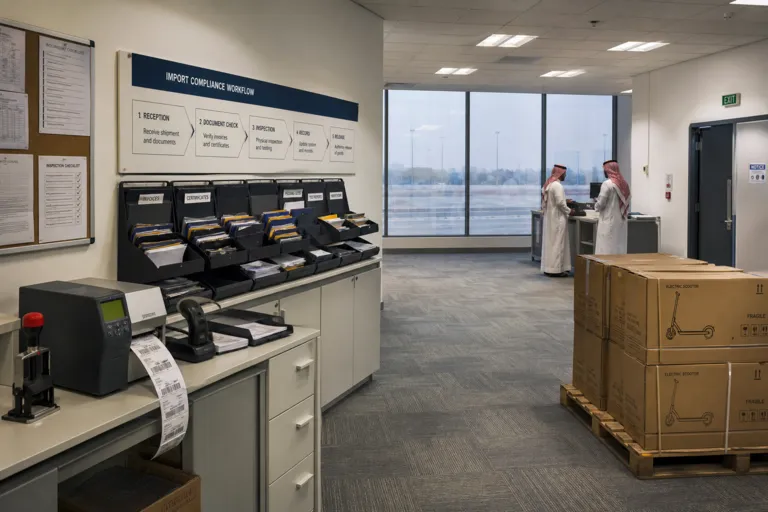
In day-to-day terms, a Saudi e-scooter technical regulation environment means you need a repeatable market-access workflow. SABER is described as an online verification tool connecting importers, SASO-approved certification bodies, and Saudi customs and related trade authorities in one system. The stated purpose is to accelerate clearance of upcoming shipments, reduce counterfeit consumer products, more easily track products, and raise the number of SASO-standard-conforming products in the Saudi market. SABER covers both regulated and unregulated products. For unregulated products, the importer can self-declare that the product meets a voluntary standard by entering product details into SABER, attaching technical files and documents, and receiving a Requester Declaration (S-DoC), which then enables issuance of a shipment certificate for customs processing.
What Operators and Importers Should Prepare for in Practice
Technical regulations typically bring specific expectations around risk control, documentation, and local-facing instructions. A recent SASO regulation example in a different product category—Machinery Safety – Part 3: Lifting Equipment—shows the compliance pattern SASO expects: suppliers must demonstrate conformity before products are placed on the market, conduct iterative risk analysis to minimize hazards, and provide safety instructions, warnings, and labels in Arabic. While that lifting-equipment rule is not about scooters, it signals the direction of travel for regulated products: a technical file, clear risk reasoning, and Arabic labeling are central to proving conformity. For micromobility businesses, that means aligning OEM documentation, after-sales materials, and fleet operating instructions with what certification bodies and regulators will look for.
Operators also need to anticipate knock-on impacts of “certification friction” across the broader light electric mobility space. In Saudi Arabia’s e-bike market context, one report notes that electrical-safety recertification requirements for redesigned battery-management systems can delay customs clearance by 8–12 weeks for non-compliant imports. E-bikes are not e-scooters, but both sit within micromobility supply chains that rely on batteries, chargers, and control electronics. The operational lesson is straightforward: if a supplier changes a battery-management system or related components, importers should assume technical files and certificates may need updating, or shipments may stall. Planning inventory, fleet expansion schedules, and spare parts availability around those lead times becomes a commercial necessity, not a paperwork detail.
Finally, micromobility compliance sits inside wider national policy and regulatory momentum. Saudi Vision 2030 frames industrial localization ambitions, including targets to establish three to four leading vehicle manufacturers by 2030, with annual output of 400,000 vehicles and 40% local content. In parallel, SASO continues refining technical-regulatory frameworks for electric vehicles, and ZATCA updates import-control rules. For e-scooter importers and fleet operators, the implication is to treat compliance as a continuous program: build SABER readiness into sourcing, maintain Arabic labeling and user documentation as standard, and select accredited conformity assessment partners early. In Saudi Arabia, products that do not meet established SASO standards may be re-exported or destroyed at the importer’s expense, so the cost of delay or rejection can be far higher than getting the file right upfront.
What is SASO and why does it matter for e-scooters?
How does SABER affect micromobility imports into Saudi Arabia?
What can happen if shipments do not meet SASO standards at the port?
What does a Saudi e-scooter technical regulation program typically require from suppliers?
How can certification delays affect fleet operators planning deployments?