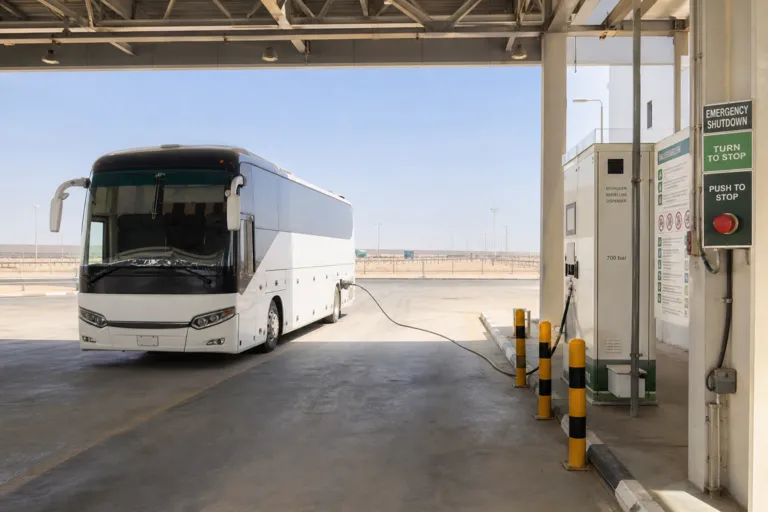
Saudi Arabia’s first hydrogen intercity coach on the 359 km Dammam–Al Ahsa corridor matters less as a headline and more as an operating proof point. Long-distance ground transport sits inside a global emissions problem: transportation contributed to approximately 24% of global CO2 output as of 2020, according to a Saudi-focused rail decarbonization paper that frames the urgency of shifting energy and operations together. A hydrogen coach is also an “operations” story. It needs a repeatable route, predictable dwell times, and a way to compete with established intercity options in the Eastern Province. This is why the Dammam-to-Al Ahsa geography is instructive, even before anyone claims a quantified CO2 result for buses or coaches on that specific corridor.
Saudi transport planning already shows how quickly intercity demand can scale, and why that matters for clean technology. On the rail side, the Dammam–Riyadh passenger line is described as a major route operated by Saudi Arabia Railways (SAR), spanning approximately 449 km and serving stations that include Dammam, Hofuf, and Riyadh. One reference also states Saudi Arabia’s intercity rail traffic totaled 11.6 million passengers in 2024, a 40.9% increase from 2023, attributed to expanded services on lines like Dammam–Riyadh. That surge is a reminder that decarbonization hinges on real-world utilization. A hydrogen coach running Dammam–Al Ahsa is not just a vehicle choice; it is an attempt to deliver a service that can win riders consistently.
What the Route Can Prove: Utilization and Energy Sourcing Matter
Saudi research on the Haramain High-Speed Railway (HHR) offers a disciplined way to think about what a hydrogen coach route should prove: operational thresholds can dominate climate outcomes. For the 450 km Makkah–Madinah corridor, the study modeled train energy efficiency at 0.03–0.07 kWh/pkm, grid emission factors at 0.65–0.10 kgCO2/kWh, renewable energy adoption from 0–100%, and occupancy rates from 25–100%, including a 15% system efficiency adjustment for real-world losses. In worst-case conditions, the HHR could result in a net increase of 187 kT of CO2 annually compared to buses; in best-case conditions, it could save 285 kT of CO2 per year, equating to 11.93 kg saved per passenger for the full 450 km journey. The same paper identifies climate-positive thresholds: net CO2 savings occur when occupancy exceeds 70–75% under the current grid mix, or 45–50% when renewable adoption reaches 50%. Those figures are rail-specific, but they underline what any clean intercity coach must demonstrate: high occupancy and credible energy sourcing are decisive.
Hydrogen is also being positioned in Saudi Arabia as a long-distance, fast-turnaround tool for road transport, which supports the logic of trying it on an intercity coach route. One Saudi-based report describes a heavy-duty hydrogen-powered truck capable of traveling about 1,500 kilometers on a single tank, and explains the fuel-cell concept as generating electricity onboard while releasing only water vapor through the exhaust. In parallel, a market report notes that larger carriers are rolling out hydrogen and LNG prototypes, and that domestic corridors linking Riyadh, Dammam, and Jeddah accounted for roughly 70% of 2025 road tonnage. It also states that DHL Group and Saudi Aramco’s Advanced Sustainable Mobility Organization formed a USD 570 million joint venture in February 2024 to pilot hydrogen-powered trucks in the Kingdom. Against this backdrop, a Saudi hydrogen intercity coach trial on Dammam–Al Ahsa reads as part of a broader pattern: focus clean tech where demand is concentrated and operations are repeatable.
What the 359 km Dammam–Al Ahsa route ultimately proves is not a single universal emissions number, because no source here quantifies CO2 for that coach corridor. Instead, it can prove the operational ingredients Saudi decarbonization studies already emphasize: occupancy discipline, realistic efficiency accounting, and energy alignment that avoids shifting emissions upstream. It can also prove integration potential with existing intercity mobility across the Eastern Province, where established corridors and hubs already exist. If the service design can sustain high load factors and dependable cycles, it will strengthen the case that hydrogen is not only a freight experiment, but a workable option for cleaner long-distance passenger transit in Saudi Arabia.
What does the Dammam–Al Ahsa hydrogen coach route aim to prove for long-distance transit?
What do Saudi rail decarbonization scenarios suggest about the importance of occupancy?
What range of outcomes did the Haramain High-Speed Railway study model versus buses?
What Saudi indicators show hydrogen is being tested for long-distance road transport?
How big is Saudi intercity rail demand, based on the cited sources?