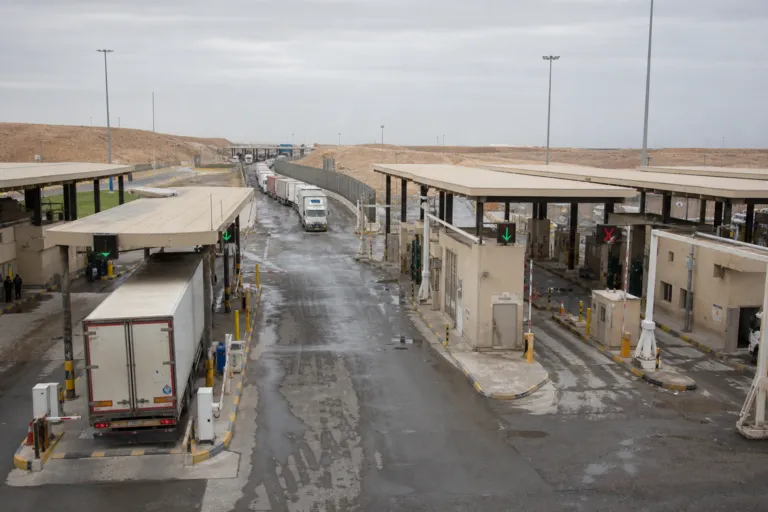
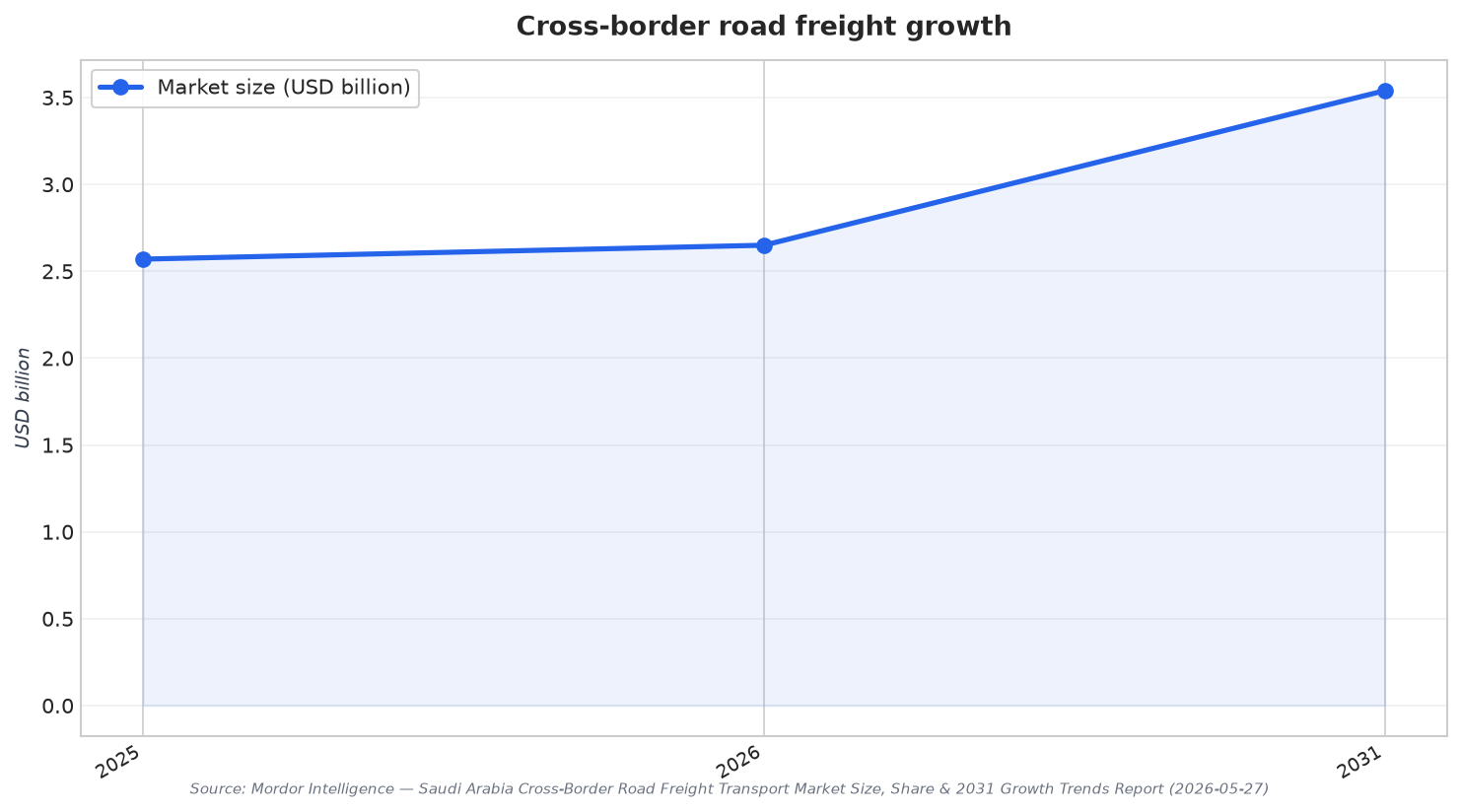
Saudi Arabia’s land crossings sit at the center of a wider push to make truck movements more predictable. In cross-border road freight, Mordor Intelligence valued the Saudi Arabia market at USD 2.57 billion in 2025. It is estimated to grow from USD 2.65 billion in 2026 to USD 3.54 billion by 2031, at a CAGR of 5.96% (2026-2031). That growth case is tied to operational fixes at the border, including the FASAH system, described as delivering near-universal two-hour electronic customs clearance, and corridor upgrades such as the four-laning of the Batha–Al Ghuwaifat route. Together, these steps target the same pain point: queues that waste driver hours and disrupt delivery schedules.
The value of digitized border processing becomes clearer when you look at the structure of cross-border trucking demand. Full-truck-load accounted for 73.11% of Saudi Arabia’s cross-border road freight transport market in 2025. Long-haul routes represented 67.72% in the same year, and non-containerized cargo held 74.3%. These mixes favor speed and certainty at land ports, because the shipment often moves as a single load and cannot easily be split or re-staged. The same data shows non-refrigerated freight held 89.07% share in 2025, but temperature-controlled freight is advancing at a 9.57% CAGR, raising the stakes for time at the border where delays can threaten service quality.
From Paper Checks to Pre-Clearance at Key Crossings
A practical example of land-border digitization is the Saudi–Kuwaiti customs data linkage at the Al Khafji and Al Ruqai crossings. IndexBox reports the linkage enables pre-clearance and faster truck movement by securely transferring customs data directly from the exporting country. That allows clearance procedures to start before the shipment reaches the border. The same report says authorities expect less duplicate data entry, shorter customs clearance times, and better risk management. This is the operational heart of the topic of Saudi land border crossing digital customs trucks: shifting time-consuming checks away from the physical gate and into a connected, standardized data flow.
Digital customs is also being pulled forward by e-commerce and parcel flows that need consistent release times. In Saudi Arabia’s e-commerce logistics market, domestic shipments represented 81.14% of revenue in 2025, while cross-border volumes are set for a 13.90% CAGR from 2026-2031, according to Mordor Intelligence. The same source states Fasah automation trims clearance to sub-24 hours for 87% of parcels. At the air gateway level, Mordor Intelligence also describes the Special Integrated Logistics Zone at King Khalid International Airport as spanning 32 million ft² and “slashing average e-parcel customs release times below two hours,” supported by the LOGISTI single window. Even when those examples are not land borders, they set a standard that shippers will expect at truck crossings too.
As the system improves, cross-border lanes can carry a broader mix of industries and partners. Oil and gas, mining, and quarrying led with 33.83% of Saudi Arabia’s cross-border road freight transport market share in 2025, while wholesale and retail trade is projected to expand at a 7.61% CAGR through 2031. By country, the UAE held 47.47% share of Saudi Arabia’s cross-border road freight transport market in 2025, while Qatar is forecast at a 7.79% CAGR. These patterns help explain why Saudi Arabia is investing in automated border ports, digital freight platforms, and integrated road corridors: the growth is multi-lane, and the border is the choke point that determines whether trucks move smoothly or sit in line.
What is driving faster processing for Saudi land border crossing digital customs trucks?
Which Saudi–Kuwait land crossings are using digital customs data exchange?
How large is Saudi Arabia’s cross-border road freight transport market?
What shipment types dominate Saudi cross-border road freight?
How fast are cross-border e-commerce volumes expected to grow in Saudi Arabia?