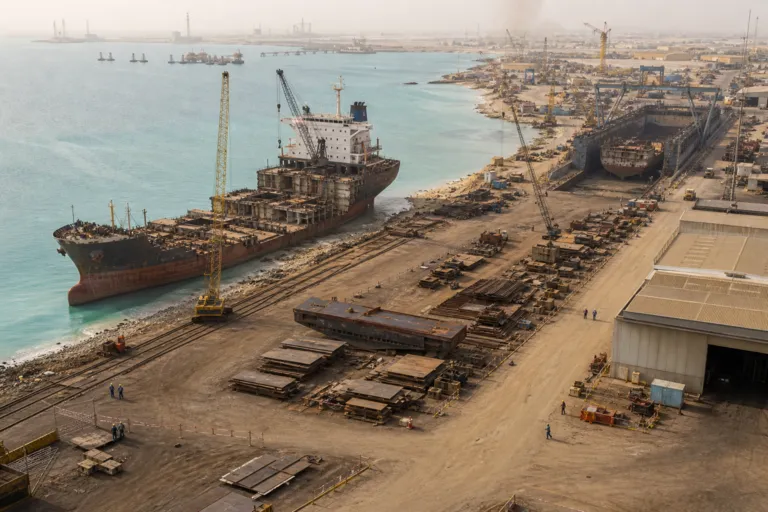
Ras Al-Khair is already described as a planned mining and metals hub on Saudi Arabia’s eastern coast along the Arabian Gulf, and it is being positioned to host major maritime activity as well. By the end of 2025, total investments in Ras Al-Khair City for Mining Industries reached around SR165 billion, with the private sector accounting for more than 90 percent of the total, according to reporting cited by Arab News and other 2026 guides. The same reporting also notes investments in the zone reaching around SR27 billion, including SR12 billion in foreign direct investment by the end of 2025. This capital base matters for any emerging ship-recycling ambition because it indicates broad industrial momentum, not a stand-alone project.
The anchor for a circular maritime pathway is the King Salman Global Maritime Industries Complex in Ras Al-Khair, a shipyard described as under construction and expected to be the largest shipyard in the world when completed. Wikipedia states the complex is planned to open in stages from late 2018 through 2022 when it reaches full capacity, and it lists an estimated total construction cost of about US$4.3 billion. The same source says Saudi Aramco awarded China Power Construction Group a US$3 billion contract in November 2017 to build shipyard facilities. Another description puts the facility at about 4.96 square kilometers with several dry docks and at least 15 separate piers. Those physical assets are the kinds of enabling infrastructure that can support multiple vessel life-cycle services in one location.
From Heavy Infrastructure to End-of-Life Vessel Pathways
Ras Al-Khair’s industrial design leans toward integration, which is relevant to the Ras Al-Khair ship recycling industry narrative because end-of-life vessels require reliable energy, water, logistics, and nearby fabrication capacity. A 2026 Ras Al-Khair Industrial City guide describes extensive networks for gas and electricity, stormwater drainage, potable water and seawater cooling systems, wastewater treatment, road and railway links, and telecommunications. Power is supplied by the 2,400 MW Ras Al-Khair Power and Desalination Plant, a figure also echoed in another 2026 overview that describes it as a hybrid plant. On the metals side, the Ras Al-Khair Aluminum Smelter is described as Saudi Arabia’s first greenfield aluminum production site, with a capacity of 780,000 metric tons per year. Together, these assets support industrial processing and manufacturing linkages that can absorb recovered materials and components.
Within the maritime complex, activity is defined across multiple workstreams. Wikipedia lists four major areas of operation: shipbuilding, ship repair, oil rig construction, and oil rig support. It also states that International Maritime Industries was incorporated in January 2018 with orders for at least 20 oil rigs and 50 ships, anchoring a pipeline that builds workforce and supplier depth over time. Separately, Hyundai Heavy Industries signed an MoU in July 2017 to jointly develop, with Saudi Aramco and Dussur, a US$400 million factory to build medium speed marine diesel engines at the complex. A Grokipedia entry adds a facility description of approximately 12 million square meters with quay walls totaling 5.63 kilometers and infrastructure for handling large-scale vessels and offshore rigs. These details point to a site being engineered for high-throughput maritime industrial work.
Policy and investment structures also shape whether end-of-life vessel activity becomes a durable local industry. A 2026 brief on the Ras Al-Khair Special Economic Zone states the zone supports 100% foreign ownership, and it describes an approach that merges mining industries with maritime construction to reduce logistical burdens for investors. Grokipedia further notes targeted incentives including tax exemptions, streamlined customs procedures, and access to specialized infrastructure for maritime and offshore industries. It also states that in July 2025 NMDC Energy launched a fabrication yard within the Ras Al-Khair SEZ covering 400,000 square meters, built at a cost of AED 200 million. With strong investment momentum and large-scale maritime facilities under development, Ras Al-Khair is building the industrial conditions where ship-reuse, dismantling support services, and downstream manufacturing can plausibly cluster.
What is driving Ras Al-Khair’s ship-recycling ambition alongside shipbuilding?
What are the key features of the King Salman Global Maritime Industries Complex in Ras Al-Khair?
How much investment has been reported in Ras Al-Khair by the end of 2025?
What infrastructure supports large-scale maritime industrial activity in Ras Al-Khair?