Riyadh Air has moved to scale its long-haul platform by exercising options for 28 more Boeing 787 Dreamliners from its 2023 order. The agreement, announced on July 20, 2026 at the Farnborough International Airshow, includes converting 20 of those airplanes to the larger 787-10, a step that introduces the type into the airline’s future fleet plan. Boeing also said the announcement includes a previously unidentified purchase of 11 of the widebody jets. Once the remaining 17 airplanes are finalized, Riyadh Air’s firm order count is expected to grow to 67 787 Dreamliners, giving the carrier a much bigger base for network economics.
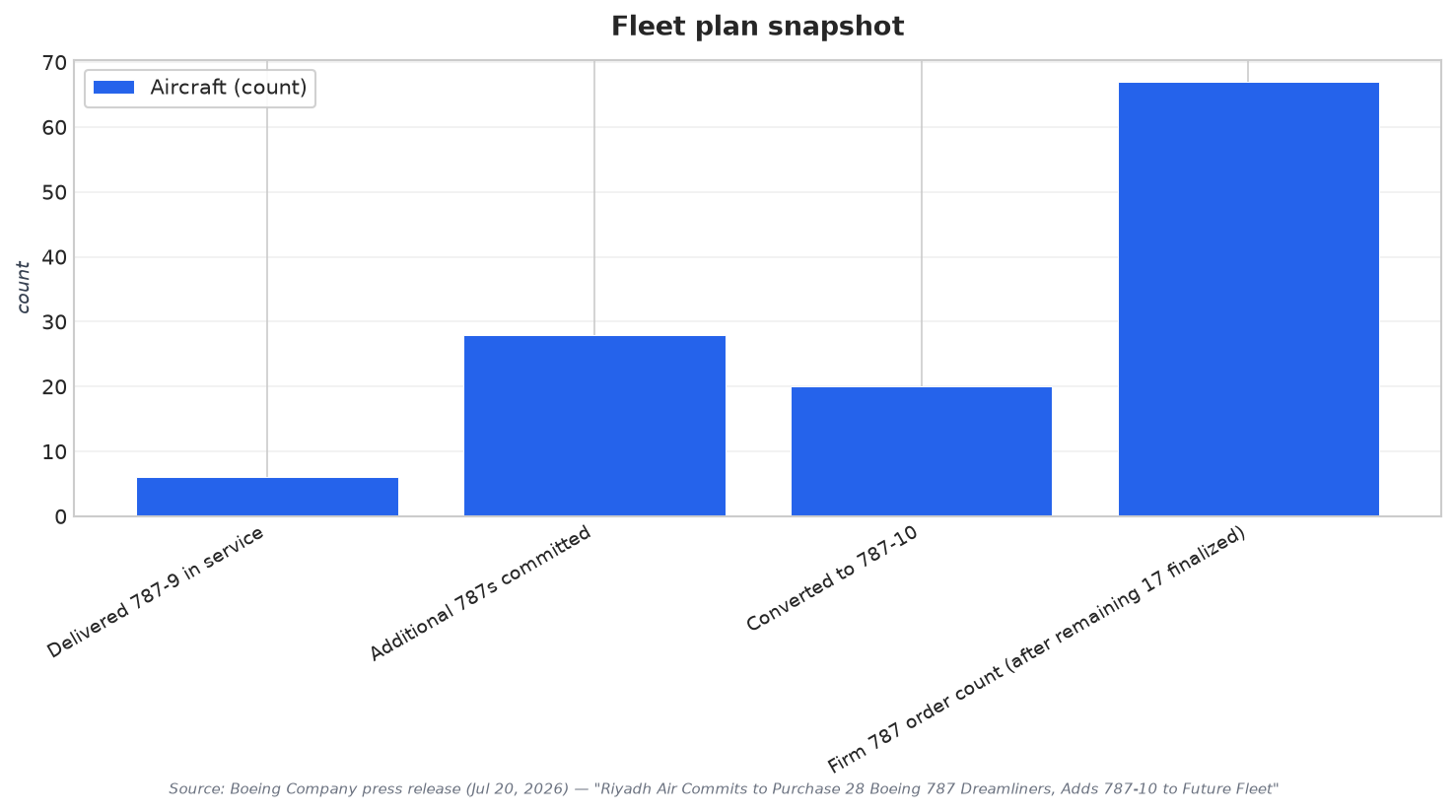
The timing matters because Riyadh Air is already in commercial service. Boeing stated the airline has taken delivery of six 787-9 jets and currently serves six cities, and Riyadh Air leadership pointed to guest response “following the recent launch of full operations.” For a new hub builder, adding aircraft is not only about growth. It is also about matching gauge to route maturity. The airline framed the 787-10 addition as a way to accommodate growing passenger and cargo demand while keeping the operational flexibility needed for ambitious network plans.
Why the 787-10 Changes the Capacity-and-Cost Math
The 787-10 is positioned as a capacity lever inside a single aircraft family. Boeing said the 787-10 will boost Riyadh Air’s capacity with 50 more seats than the 787-9, while reducing fuel use and emissions by 25% compared to the airplanes it replaces. Other coverage of the deal echoed the seat delta as “roughly fifty more seats per aircraft,” and described how a dual-variant approach can separate missions: the 787-9 for longer or thinner routes, and the 787-10 for markets where higher traffic volumes justify the extra seats. This is the heart of Riyadh Air’s 787-10 widebody fleet strategy: use one family to cover multiple long-haul demand profiles while keeping the product consistent.
Fleet commonality is the other economic lever. Boeing said that by operating the 787-9 and 787-10, Riyadh Air will benefit from shared flight deck systems, maintenance procedures, and pilot training. That matters for hub operations where utilization and scheduling resilience can determine unit economics. A common platform can simplify how the airline scales as it grows beyond today’s six served cities, because the carrier can add capacity without introducing an entirely separate widebody cockpit, maintenance playbook, and training pipeline.
Strategically, the order also ties directly to network ambition. Boeing said the agreement reaffirms Riyadh Air’s plan to operate to over 100 global destinations by 2030, a goal linked to the Kingdom’s Vision 2030 ambitions. The 28-aircraft commitment is structured with milestones: 11 aircraft were already in Boeing’s system as an unidentified purchase, while the remaining 17 still require finalization before the firm total reaches 67. That structure highlights how fleet growth, financing discipline, and network rollout can be sequenced, even as Riyadh Air expands its long-haul hub model with a standardized Dreamliner backbone.
What exactly did Riyadh Air commit to in the new Dreamliner announcement?
How does the 787-10 affect capacity versus the 787-9 in Riyadh Air’s plan?
How many 787s could Riyadh Air have on firm order after finalization?
What is the core idea behind Riyadh Air’s 787-10 widebody fleet strategy?
What does Riyadh Air’s current operation look like today, based on the sources?