Pilgrim mobility in and around Makkah is being shaped by a layered rail approach. One layer is intercity. The Haramain High-Speed Railway links Makkah and Madinah via Jeddah and King Abdulaziz International Airport, and industry coverage says its daily capacity exceeds 60,000 passengers. Seasonal operations are also scaled: one report says capacity for the season exceeds 2.21 million seats across routes connecting Makkah, Madinah, and Jeddah, supported by more than 5,300 scheduled journeys. The other layer is local. The Al Mashaaer Al Mugaddassah Metro, designed around ritual movement, focuses on the sacred-sites geography rather than daily commuting.
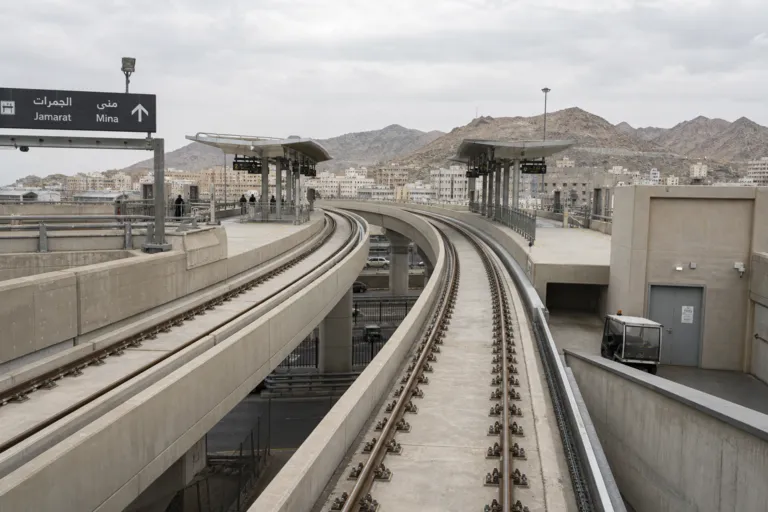
Inside the holy sites, the Sacred Sites Metro operates as a shuttle train for pilgrims between Mina, Mount Arafat, and Muzdalifah to reduce congestion from buses and cars. Wikipedia describes it as a line used exclusively for pilgrims, opened on 13 November 2010 in time for Hajj 1431, and built separately from a future Mecca Metro network. Operational details underline why it can move large crowds quickly: each 12-car train carries 3,000 passengers, and headway is 150 seconds, which equals 24 trains per hour. It also uses a special group shuttle schedule in peak periods to fill and move multiple trains together, coordinating departures and arrivals across stations at each holy site.
Where the “Grand Metro” Idea Fits: From Seasonal Shuttle to City Grid
For year-round mobility, the broader Mecca Metro plan is the missing grid that can complement the Hajj-only shuttle. Wikipedia notes that the Sacred Sites line will not be physically linked to the future Mecca Metro network, but planning for additional metro capacity is repeatedly referenced across sources. Grokipedia describes a larger network of four lines totaling approximately 182 kilometers under development, and another source notes Phase 1 covering two metro lines totaling 45.1 km and 22 stations, with commissioning scheduled by 2019. A separate business-focused report frames the wider Mecca Metro project as four lines with 150+ stations under phased construction. Together, these references show how the “Grand Metro” concept aims to spread rail access beyond the sacred-sites corridor.
What makes the complementarity practical is that each system is optimized for a different problem. Travel And Tour World describes the model clearly: long-distance intercity transport delivers pilgrims into the region, while Al Mashaaer manages movement inside the sacred geography itself. That same source emphasizes that the system’s value is not only speed but environmental efficiency, describing the Sacred Sites Metro as an electric-powered transport network that supports efforts to reduce congestion-related emissions during major gatherings. Ridership reporting also signals continued dependence on this layer: The Traveler says SAR summaries for the 1445 AH season state that this line alone moved more than two million pilgrims, reducing strain on roads and buses.
For planners thinking about the Makkah Grand Metro pilgrim rail topic, the key is coordination across arrival and ritual movement rather than a single silver-bullet line. The sources show a specialized metro that operates almost exclusively during the Hajj season, alongside intercity rail that expands access into Makkah and onward to other cities. As Hajj volumes change, reported counts provide context: one business report states Hajj hosted 1.8 million pilgrims in 2024, 2.1 million in 2025, and was on track for approximately 2.3 million in 2026. The same report also cites a 2019 target of 30 million Umrah pilgrims per year by 2030, combined with 6 million Hajj pilgrims, highlighting why year-round and seasonal rail layers are both being pursued.
How does Makkah’s Grand Metro concept complement pilgrim rail in the holy sites?
What is the capacity and operating pattern of the Sacred Sites Metro trains?
What do the sources report about Haramain High-Speed Railway scale for pilgrims?
How many pilgrims did the Sacred Sites Metro move in a recent season?
What metro expansion figures are mentioned for the broader Mecca Metro program?