NEOM is a planned, futuristic development in northwestern Saudi Arabia spanning 10,200 square miles (26,500 square km) and bordering the Red Sea and the Gulf of Aqaba. Britannica describes five distinct regions: Sindalah, The Line, Oxagon, Trojena, and Magna. In early visions, The Line was framed as a carbon-neutral, car-free smart city concept with high-speed rail and amenities within a 5-minute walk. Other descriptions emphasize NEOM as a technology- and sustainability-driven effort designed to diversify an oil-dependent economy, positioned as part of Saudi Arabia’s Vision 2030 agenda.
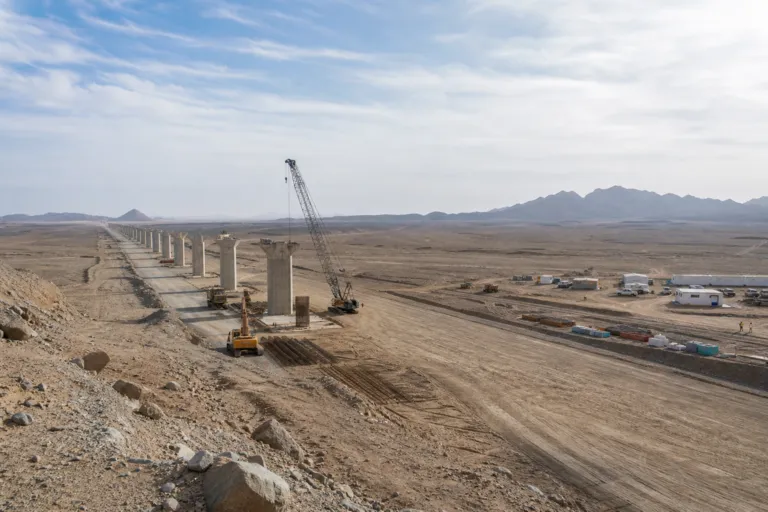
Within that wider plan, the mobility link often referred to as “The Spine” appears in project documentation as a 57 km passenger-and-freight railway designed for speeds up to 230 km/h. SEMP describes the NEOM Spine Railway as intended to provide regional and urban passenger transit and freight transport, connecting key areas and facilities including The Line linear city, Oxagon industrial city, airports, and logistics transfer stations. The same source says SEMP was contracted into NEOM Land Mobility to provide Systems Engineering and System Assurance services, deploying 27 specialized resources and building a framework spanning systems integration, safety, verification and validation, operations, and human factors.
What the Corridor Was Meant to Connect—and What Changed
The Spine concept is most visible in reporting on a “Connector High-Speed Rail” package: a 57-kilometre link between Oxagon and The Line. House of Saud reports that on May 21, Italian contractor Webuild announced NEOM had exercised contractual termination rights on the EUR 1.4 billion ($1.6 billion) connector rail contract. Work was reported as 20 per cent complete at termination, leaving a residual backlog of EUR 1 billion. The article frames the link as the physical connection between NEOM’s industrial core and its residential megastructure, and argues that ending this package removes the infrastructure that would connect any future Line construction to NEOM’s operational core.
These contract developments sit alongside broader “reality check” narratives about what is progressing inside NEOM. Vision2030.ai states that Oxagon’s port is operational and handling cargo, and that the NEOM Green Hydrogen complex is roughly 90 percent complete with first export shipments targeted for late 2026. The same source says NEOM directly secured a SAR 10 billion (approximately USD 2.7 billion) revolving credit facility in 2024 to support short-term working capital across The Line, Trojena, Oxagon, and Sindalah. It also presents a “more realistic figure” of USD 15-25 billion in NEOM-attributable GDP and a workforce of 100,000-150,000, dominated by Oxagon and tourism.
Trojena’s timeline and positioning have also been debated. Britannica states Trojena, centered on an artificial lake in the mountains, set a completion date of 2029 tied to hosting the Asian Winter Games. Vision2030.ai reports that Trojena lost its 2029 Asian Winter Games hosting bid in February 2026, with the event reassigned to Almaty, Kazakhstan. Meanwhile, multiple sources emphasize NEOM as a collection of sub-projects rather than a single city. House of Saud describes it as spread across a zone roughly the size of Belgium, while still listing The Line, Oxagon, Trojena, and Sindalah as distinct components that are being reprioritized over time.
What is the NEOM Spine high-speed rail corridor supposed to do?
How long is NEOM’s Spine rail line and what speed is it designed for?
What happened to the connector rail link between Oxagon and The Line?
What does the 2024 revolving credit facility cover inside NEOM?
What do the sources say about Trojena and the Asian Winter Games?