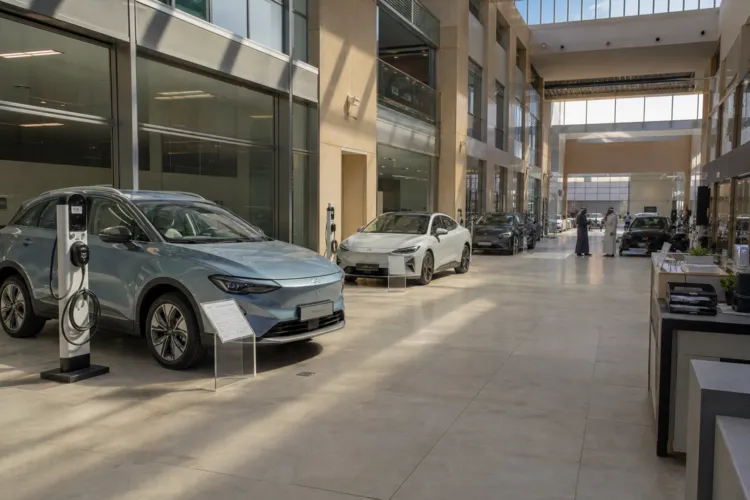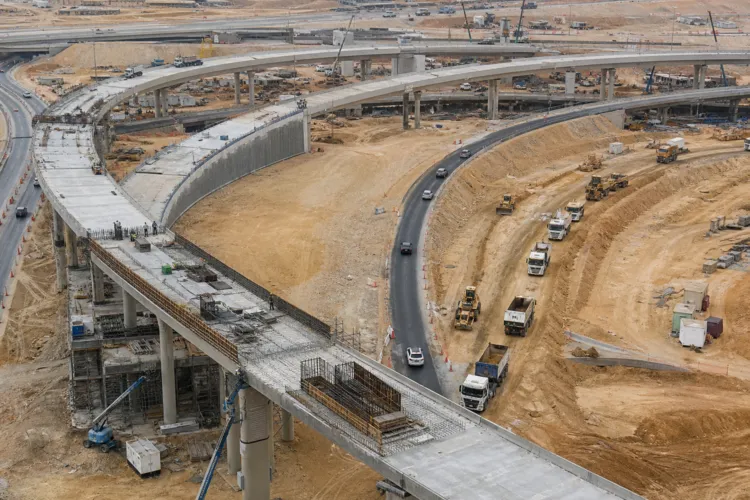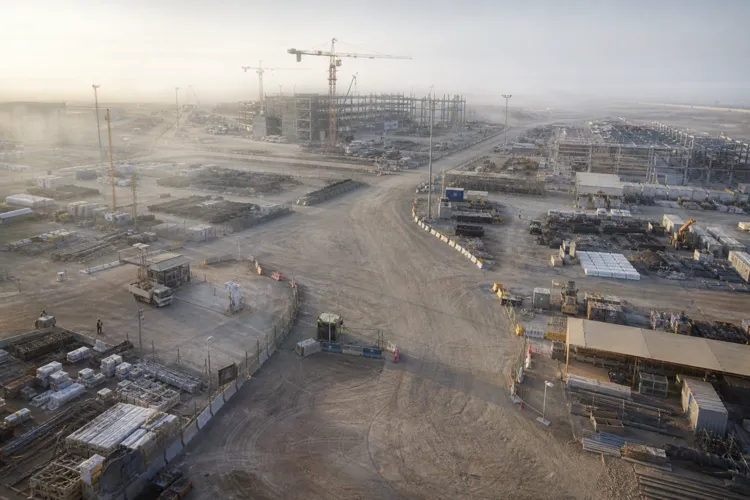
Saudi Arabia is building an automotive manufacturing sector from scratch, and King Abdullah Economic City (KAEC) is positioned as a central hub for that effort. One strategy brief frames an ambition to build a vertically integrated automotive manufacturing sector capable of producing 300,000+ vehicles per year by 2030, anchored by Lucid, Ceer, and partnerships with Japanese automakers. The same source notes Toyota’s importance in a Saudi vehicle market described as 700,000 units annually. For suppliers, that context matters because the country’s direction is explicit: shift from import dependence to local value creation, with KAEC repeatedly cited as a focal point for manufacturing and supplier clustering.
Lucid’s KAEC footprint is the anchor investment that creates a practical runway for Tier-1 localization. One Saudi manufacturing overview states the Lucid AMP-2 facility in KAEC is designed for an initial production capacity of approximately 5,000 vehicles annually, with expansion potential to 155,000 vehicles per year, producing complete vehicles for Saudi and regional markets. Another brief describes Lucid’s 150,000-unit annual capacity EV factory at KAEC, and adds that PIF has invested over USD 3.4 billion since 2018 in Lucid Group. For suppliers, these figures support a simple point: even before broader national targets are met, a single scaled plant can support multi-year sourcing programs for components, systems, engineering services, and aftermarket operations.
Why Tier-1 Suppliers Fit the KAEC Ramp-Up
Multiple market sources describe why integrated Tier-1 suppliers are becoming more important in Saudi Arabia. An IndexBox manufacturing report notes Tier-1 system suppliers provide the localized content OEMs need to meet regulatory requirements, and compete on technology, quality, and supply chain reliability rather than price alone. It also places domestic production concentration in industrial cities including KAEC, Jubail, Yanbu, and Dammam, where the government has designated automotive zones with dedicated infrastructure and incentives. For companies evaluating a KAEC automotive supplier park opportunity, the business case is less about single parts and more about subsystem delivery—chassis, drivetrain, thermal management, and electronics—aligned to OEM platform needs and localization pressure.
EV platforms intensify the Tier-1 opportunity because high-voltage architectures raise content value and qualification burden. An IndexBox contactor report projects the Saudi Arabia Electric Vehicle Contactor market to grow from an estimated USD 18–25 million in 2026 to approximately USD 85–120 million by 2035, with more than 85% of demand currently met through imports. It also states each vehicle requires 3–6 contactors for main disconnect, pre-charge, and fast-charging circuits, and that subsystem-level purchasing is gaining preference as contactors are integrated into intelligent Power Distribution Units (PDUs), with subsystem pricing cited at USD 80–200 per integrated unit. At the same time, the same source flags validation lead times of 24–36 months and bottlenecks tied to precision assembly and testing—constraints that favor established Tier-1 integrators.
Timing matters because Saudi demand signals and plant rollouts are converging, but suppliers must plan for real-world friction in getting programs to SOP. One EV market analysis points to an industrial backbone including Lucid’s AMP-2 plant, Ceer’s 1 million m² complex, and the Hyundai–PIF joint venture at KAEC, and adds that a plant aims to assemble 50,000 vehicles each year with production slated to kick off in 2026. Meanwhile, a broader vehicles market report estimates 65–75% of vehicles are still sourced as fully built units (CBU) or complete knock-down (CKD) kits, and highlights CKD operations facing 8–16 week delays for critical components, alongside 6–12 month homologation and type-approval timelines for new platforms. The win for Tier-1 entrants is to build local capability that reduces these delays while aligning to OEM qualification cycles.
What is driving Tier-1 supplier interest around KAEC?
How does the planned KAEC automotive supplier park support localization?
What figures show the scale of the Lucid and PIF commitment?
Which EV component segment illustrates import reliance and Tier-1 opportunity?
What operational hurdles should suppliers expect in Saudi vehicle programs?