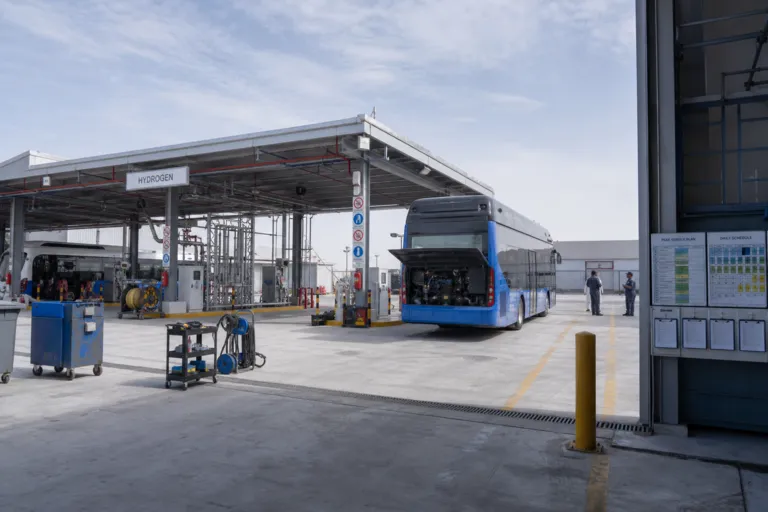
Interest in hydrogen fuel-cell buses in Saudi Arabia is moving from visibility projects to operational learning. Abdul Latif Jameel Motors and Toyota Motor Corporation have been running public demonstrations that focus on “gathering critical operational data” and building awareness of “zero emission mobility” in live settings. A recent example is the five-day public trial in Yanbu Industrial City, carried out in collaboration with the Royal Commission for Jubail and Yanbu (RCJY) and other supporting entities. The trial deployed a hydrogen fuel cell bus powered by Toyota technology during the Yanbu Flower Festival, giving residents and visitors a direct experience while the partners captured real-world insights.
That approach is relevant when people discuss a Makkah hydrogen bus Hajj pilot, because the Kingdom’s earlier hydrogen mobility efforts have already included deployments in Makkah, alongside Riyadh and Jeddah, according to the Yanbu trial announcement. The idea is not presented as a single event, but as a series of deployments and research projects meant to test adaptability “across diverse geographic and urban environments” in Saudi Arabia. In parallel, the Royal Commission for Makkah City and Holy Sites is a Saudi commission established by royal decree on 2 June 2018, and it is responsible for improving services and establishing a sustainable system at the Grand Mosque in Makkah and the holy sites.
What the Data Says: Vehicles, Fueling, and Scale
Market forecasts provide additional context on what scaling could require, but those figures must be read as projections, not outcomes. IndexBox projects the Saudi Arabia hydrogen fuel cell vehicle market could move from fewer than 50 units in 2026 to an annual volume of about 3,500–5,000 units by 2035, driven primarily by public transport and heavy-truck fleet mandates. It also estimates a total addressable market value of USD 45–65 million in 2026, expanding to USD 800 million–1.2 billion by 2035, with import dependence exceeding 95% in 2026. For buses, the same source notes government-led hydrogen mobility pilots are transitioning toward committed procurement, with 200–400 FCEV buses planned for Jeddah and Riyadh by 2028.
Infrastructure remains the gating factor in many deployments, especially when a fleet must operate reliably from depots serving fixed routes. IndexBox describes hydrogen refueling in Saudi Arabia as “critically underdeveloped,” citing only 3–5 stations operational in 2026 and a target of 25–30 stations by 2030. It also flags supply chain and workforce constraints, including platinum catalyst sourcing and recycling, carbon fiber supply for high-pressure tanks, and gaps in system integration expertise and high-pressure hydrogen safety certification. These constraints shape how any fuel-cell bus rollout is planned, because procurement and service readiness must be aligned with fueling access and maintenance capability.
Globally, hydrogen fueling infrastructure is also expanding, though those figures describe the worldwide market rather than Makkah specifically. Grand View Research values the hydrogen fueling station market at $1.0 billion in 2025 and projects growth from $1.2 billion in 2026 to $4.4 billion by 2033 at a CAGR of 19.8%. The report frames stations as a “sweet spot” for early rollouts and notes that larger stations can exceed 1,000 kg/day in daily capacity and often reach 2,000 kg/day or more. For transit planners, that matters because buses are centrally fueled and highly visible, which aligns with how the U.S. National Renewable Energy Laboratory (NREL) evaluates fuel cell electric buses to extract lessons learned for other fleets.
What is the Royal Commission for Makkah City and Holy Sites responsible for?
What happened in the Yanbu public hydrogen bus trial?
How does the Makkah hydrogen bus Hajj pilot topic connect to other Saudi hydrogen bus activity?
What does IndexBox project for hydrogen refueling stations in Saudi Arabia?
What does NREL say about why buses are early applications for fuel cells?