Saudi Arabia’s rail momentum is no longer incremental. Public statistics cited by The Traveler show national rail passenger numbers reached about 42.7 million travelers in 2024, up roughly 41% versus 2023. The same reporting says Saudi Arabia Railways (SAR) carried more than 13 million passengers across SAR-operated mainline routes in 2024, while passenger train operations increased by close to one fifth year on year. In this context, expansion discussions increasingly start with one corridor that has proven it can absorb demand and scale service quickly: the Haramain High-Speed Railway linking Makkah and Madinah via Jeddah and King Abdulaziz International Airport.
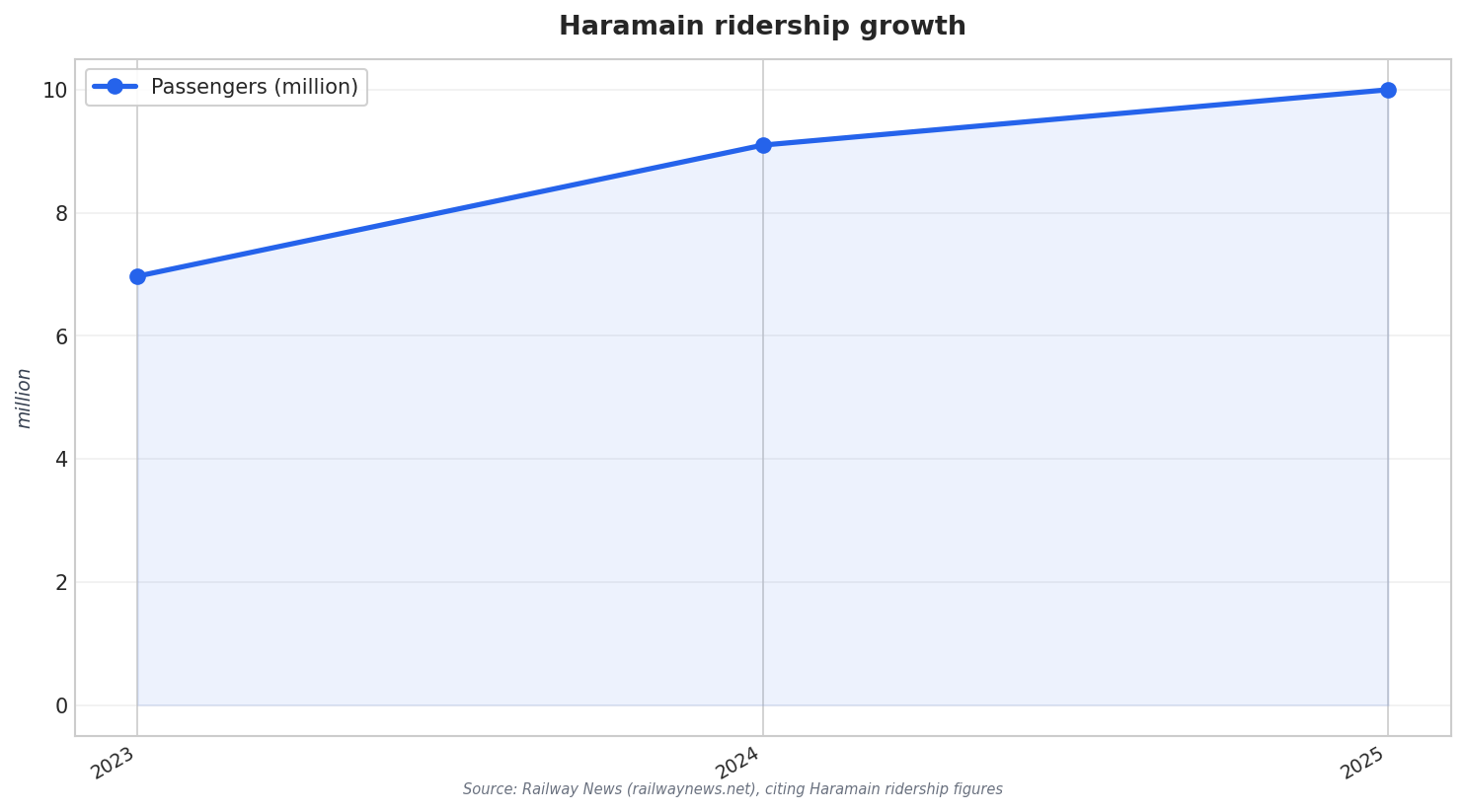
Ridership records on the Haramain line support a practical case for the next phase of growth. The Traveler cites international rail industry reports that the Haramain line carried around 6.97 million passengers in 2023, almost double the previous year and the highest figure since public opening. Railway News reports that the line then carried 9.1 million passengers in 2024 and nearly 10 million in 2025. That multi-year climb is reinforced by pilgrimage-period results: The Traveler reports more than 1.07 million passengers during the 1445 AH Hajj period alone, an increase of over 40% versus the previous Hajj, and FilmoGaz adds that nearly 2 million pilgrims used the line during the Hajj season.
Why Operational Readiness Now Matters as Much as New Track
Network expansion arguments are stronger when operations can keep pace, especially under intense seasonal peaks. FilmoGaz reports SAR ran in excess of 45,000 trips in 2025 and transported over 14 million travellers across its network, a 7.1% increase in passenger volumes over the prior year. On the Haramain corridor, the operational story includes systems. FilmoGaz says a renewal of the operation and maintenance contract will extend support for rail traffic management, signalling, telecommunications, booking, ticketing, access control, safety, and IT platforms for a minimum of five years. Railway News also reports Renfe secured a five-year €1.5 billion extension, averaging €300 million annually, covering 2033 to 2038.
The infrastructure baseline provides clarity about what has already been achieved and what could be replicated. Wikipedia describes the Haramain High-Speed Railway as a 449.2-kilometre main line plus a 3.75-kilometre airport branch, opened to the public on 11 October 2018. It is a double-track electrified railway with a service speed of 300 km/h, and Railway News similarly describes a 453 km double-track electrified line designed for a maximum commercial speed of 300 km/h with ERTMS Level 2 signalling. Vision 2030’s encyclopedia notes Talgo 350 trains capable of carrying up to 417 passengers per trainset. Together, these details explain why the corridor can add frequency and seats when demand spikes.
That is where the Haramain high-speed rail expansion debate becomes less speculative and more performance-led. The line’s record ridership, its ability to move more than 1.07 million passengers in a compressed Hajj window, and its continued year-to-year growth through 2025 demonstrate a demand pattern that planners can measure. FilmoGaz also frames a broader opportunity: passenger rail services in neighbouring states are expanding, creating openings for cross-border connectivity that could multiply the Haramain line’s strategic relevance within a wider Gulf rail network. Meanwhile, SAR’s product roadmap is evolving; FilmoGaz notes an ultra-luxury sleeper train project announced in October 2025, scheduled to begin operations in late 2026.
What ridership records has the Haramain High-Speed Railway set recently?
How does peak-season demand support a case for expanding the network?
What are the core route and speed facts about the Haramain line?
What contract and technology steps are being taken to support growth?
What is driving the push for Haramain high-speed rail expansion now?