Saudi Arabia is signaling a shift from experimentation toward commercial electric air-taxi operations, and that changes what operators must prepare for. In August 2024, GACA unveiled its Advanced Air Mobility Roadmap, describing how unmanned and vertical takeoff vehicles will be certified, monitored, and integrated into national airspace. The same year, the Kingdom also conducted an unmanned air-taxi trial in Makkah in June 2024, presented as proof of viability in dense urban settings. For air-taxi operators, these steps point to a policy environment that expects structured safety cases, clearer monitoring expectations, and disciplined integration plans rather than one-off demonstrations.
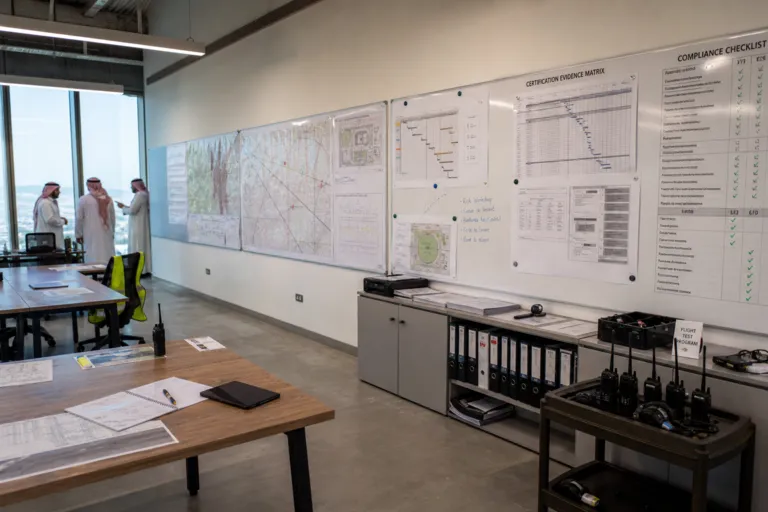
Regulatory alignment is becoming a central theme of the GACA eVTOL type certification framework and the way it will be operationalized. Joby Aviation and GACA signed a memorandum of understanding to facilitate the introduction of electric air taxi services, with the agreement described as using FAA certification protocols as the foundation for Saudi regulatory approval. Joby also describes itself as nearing the final phase of FAA Type Certification in the U.S., a stage involving FAA test pilots directly assessing aircraft performance and safety. For operators, that implies a heavy emphasis on traceable evidence. Expect to demonstrate that your aircraft, training, and operating procedures can map cleanly to FAA-style certification logic while still meeting local requirements.
What Operators Should Build Before Applying
Operators should plan for a phased ramp-up that includes test activity, infrastructure coordination, and public-facing operations readiness. In the Archer Aviation collaboration with GACA, the parties said they plan to establish a regulatory pathway for the introduction and scale-up of eVTOL air taxi operations, aligned with the FAA’s certification ruleset to support global interoperability, safety, and operational consistency. GACA also plans to model its regulatory pathway around the eVTOL Implementation Pilot Program (eIPP) in the U.S., an approach intended to enable early route testing and service introduction in Riyadh, Jeddah, and key gigaprojects such as Red Sea Global. The same MoU also mentions proof-of-concept demonstrations and experimental flights to validate regulatory approaches and support infrastructure development.
Partnership strategy matters because Saudi activity is connecting to broader international alignment work. Joby has said it was deeply engaged in developing the NAA Network’s five-nation roadmap, which aims to create global certification standards for advanced air mobility, and separate reporting notes the roadmap is multi-country and aims to align certification standards for new aviation technologies. Another report notes that, with the signing of a Joby MoU, Saudi Arabia joins the US, UK, Japan, South Korea, and the UAE as a key launch market for Joby’s forthcoming air taxi services. For operators, that context raises the bar on documentation quality, supplier controls, and the ability to operate in foreign markets under evolving regulations and standards, which Joby itself highlights as a complexity and a risk area.
Commercial readiness planning should also include how you will scale, not just how you will start. In Kazakhstan, Joby signed a letter of intent with Alatau Advance Air Group to deliver eVTOL aircraft and associated services in a deal valued at up to $250m, showing how operators may bundle aircraft, services, and operational support into a single deployment plan. In Saudi Arabia, separate activity includes a September 23, 2025 MoU in which Front End and Cluster 2 Airports partnered with EHang to roll out autonomous aerial vehicles across the Kingdom, framed as moving from trial flights to commercial deployment. Operators preparing for Saudi routes should be ready to explain how their concept of operations, partners, and service model fit within GACA’s monitoring and integration expectations under the AAM Roadmap.
How is Saudi Arabia shaping its eVTOL type certification approach under GACA?
What do GACA and Archer say the pathway will enable for operators?
Why does FAA progress matter to operators working with GACA?
What proof activities are referenced as part of Saudi readiness work?