Saudi Arabia’s General Authority of Civil Aviation (GACA) sits at the center of the Kingdom’s aviation expansion, with an unusually direct role compared with regulators that report through ministries in other jurisdictions. Headquartered in Riyadh and led by President Abdulaziz Al-Duailej (appointed 2021), GACA coordinates the aviation plank of Vision 2030. That includes a 2030 target of approximately 330 million passenger throughput and connectivity to more than 250 international destinations, alongside new national carriers and airport expansion anchored by King Salman International Airport and King Abdulaziz International Airport. This institutional structure matters for emerging flight models because it can compress coordination time between safety policy, licensing, and infrastructure decisions.
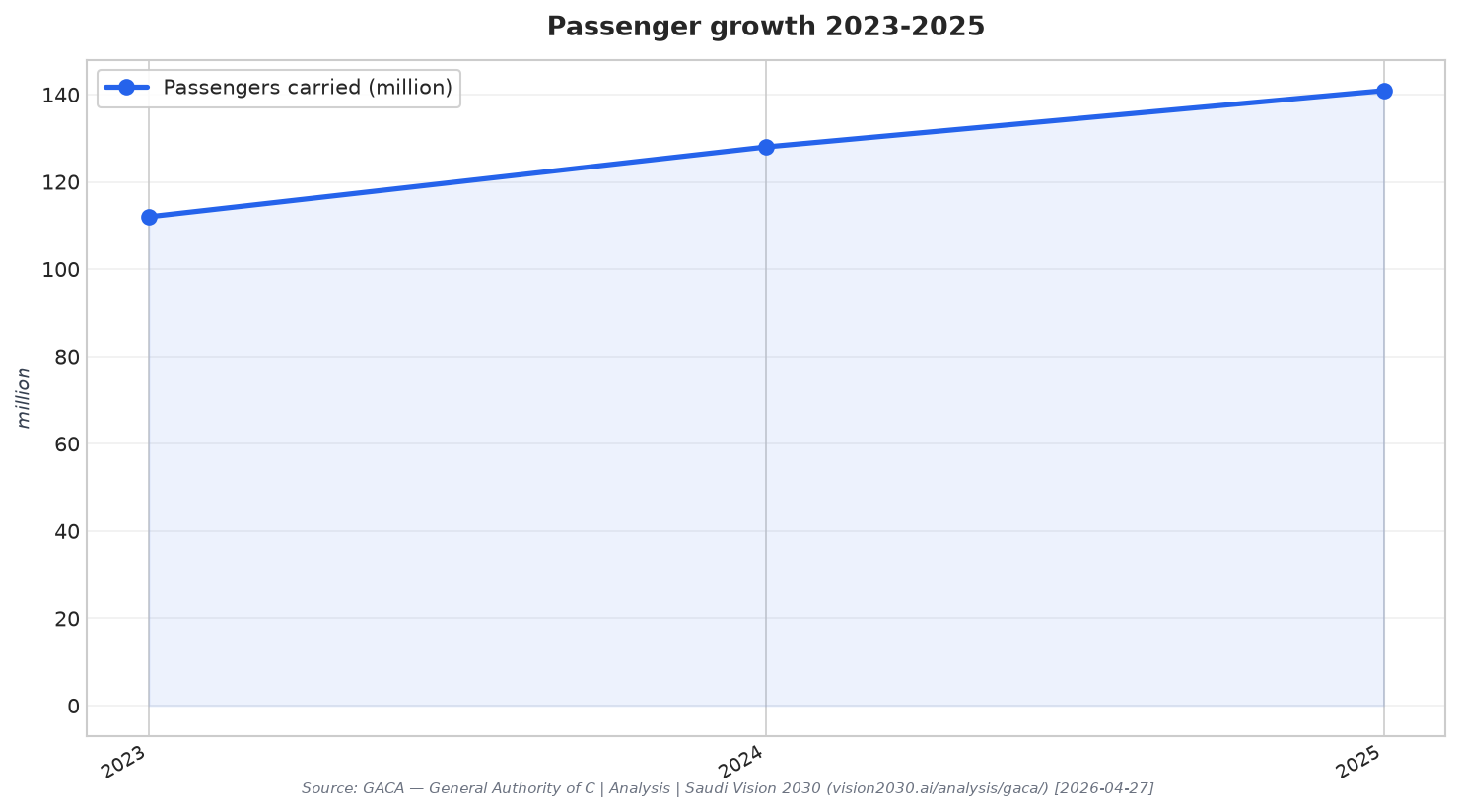
GACA’s current growth baseline also explains why the regulator is prioritizing advanced air transport rules now. The system delivered a third consecutive year of record-breaking passenger growth through 2025: 112 million passengers in 2023, 128 million in 2024, and 140.9 million in 2025, described as approximately 12% compound annual growth over the three-year window. For 2026, GACA confirmed plans to launch more than 30 new domestic and international flight routes, extend international connectivity beyond the 2025 baseline of 176 destinations, and empower more private-sector participation in airport development. Advanced air mobility (AAM) regulation is being built in parallel so drones and eVTOL services can integrate into the same national airspace safely.
From Permits to Pathways: What the Framework Enables
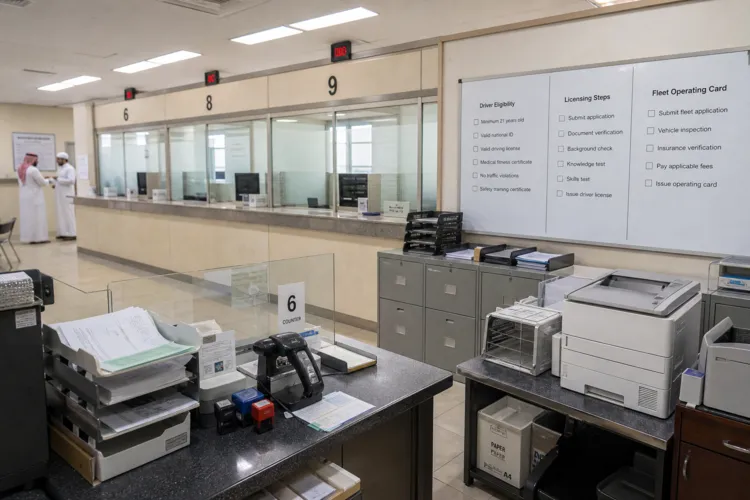
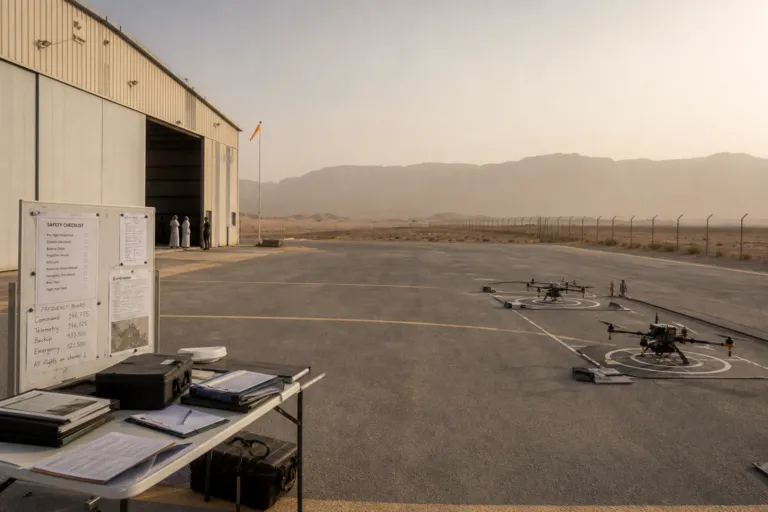
On the drone side, the operating model is explicit: professional use is not treated like casual flying. Terra Drone Arabia’s 2026 permit guide describes a multi-step legal framework where every individual operating a drone for corporate data collection must hold a valid GACA Remote Pilot Certificate, and “hobbyist” flying for business purposes is strictly prohibited. The requirements include a theoretical knowledge exam covering Saudi Air Law, meteorology, and human factors. Operators must also secure third-party liability insurance that meets Saudi Central Bank (SAMA) standards, and upload proof of insurance to the GACA portal to keep a license active. This is the compliance bedrock for commercial drone missions in sectors such as oil and gas, mining, and infrastructure operations.
For eVTOL air taxis, GACA is pairing early demonstrations with an internationally legible certification approach. In December 2025, GACA announced an agreement with Archer Aviation to collaborate to accelerate deployment of electric air taxis across the Kingdom. The parties plan to establish a regulatory pathway for the introduction and scale-up of eVTOL operations, planned to align with the FAA’s certification ruleset for global interoperability, safety, and operational consistency. GACA also plans to model its regulatory pathway around the eVTOL Implementation Pilot Program (eIPP) in the U.S., seeking to enable early route testing and service introduction in Riyadh, Jeddah, and key giga-projects such as Red Sea Global. The collaboration also includes proof-of-concept demonstrations and experimental flights to validate regulatory approaches and support infrastructure development.
Partnership work is also being used to translate policy into operating rules that fit Saudi air traffic management. In May 2026, an Advanced Air Mobility Feasibility Analysis launched under a MoU between Boeing Saudi Arabia and GACA, with Boeing Saudi Arabia, SkyGrid, and KAUST collaborating to advance the GACA AAM Roadmap. The study is intended to define roles and responsibilities across AAM stakeholders, propose regulatory adjustments for integration into existing air traffic management frameworks, and chart a course from today’s Visual Flight Rules (VFR) and Instrument Flight Rules (IFR) toward fully Automated Flight Rules (AFR) operations. Put together, the GACA advanced air mobility framework is becoming a practical runway: clear licensing expectations for drones, a certification pathway and pilots for eVTOL, and feasibility work to make scaling compatible with the broader aviation growth agenda.
What is GACA’s role in Saudi Arabia’s advanced air transport plans?
What commercial requirements apply to professional drone operations in Saudi Arabia?
How is GACA approaching eVTOL air taxi regulation with Archer Aviation?
How does the GACA advanced air mobility framework connect to air traffic management?
What aviation growth context is GACA planning around for 2026 and beyond?