Saudi Arabia is entering a new phase of Vision 2030, and the Public Investment Fund’s 2026–2030 strategy is a clear signal of what changes next. Multiple sources describe a shift away from broad, simultaneous expansion and toward disciplined capital allocation, governance, and long-term value creation. This is not framed as a retreat. It is a recalibration under fiscal pressure and lower oil revenues, with funding concentrating in priority areas and fewer blank-check project launches. For transport stakeholders, the story is about what qualifies as “priority,” and what proof of sustainability suppliers and operators will need to show.
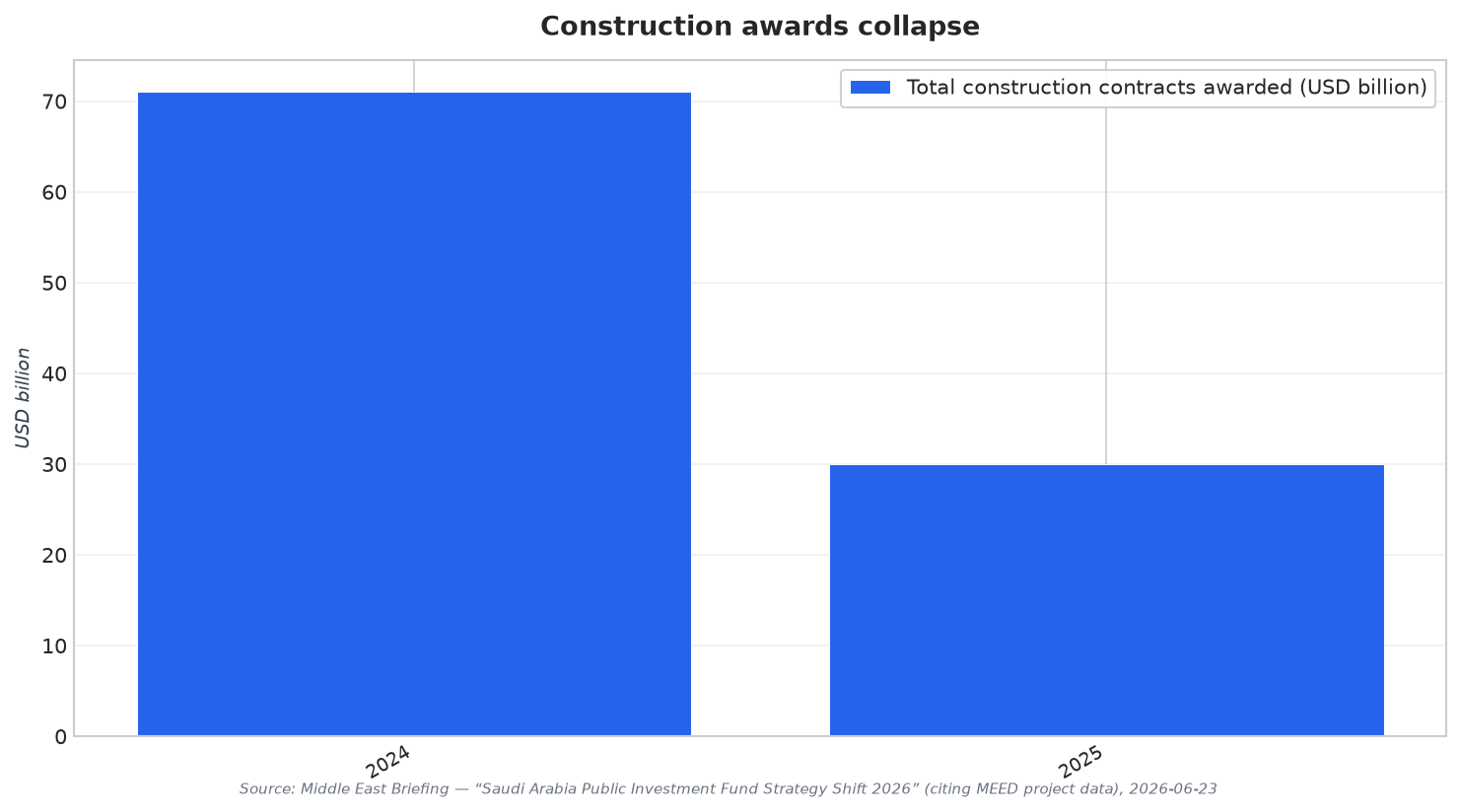
The macro correction is visible in construction award data. One source reports that total construction contracts awarded fell to below USD 30 billion in 2025, down from USD 71 billion in 2024, a decline of nearly 60%. In the same period, PIF’s share of those awards fell from around 38% to 14%. Another source links the spending adjustment to a December 2024 board decision approving a minimum 20% reduction across a portfolio described as “100-plus” companies, with some project budgets reduced by as much as 60% and others put on hold. In transport, this environment favors projects that can move beyond announcement into repeatable cash flows, tighter scopes, and investable operating models.
From Mega-Launches to Platform-Led Mobility Delivery
Several sources emphasize that the 2026–2030 approach is also structural: more localization, Saudisation, technology transfer, domestic capability-building, and industrial development. One practical change is how PIF intends to organize and justify capital. A confirmed strategy approved on 15 April 2026 organizes investments into three portfolios: Vision, Strategic, and Financial. The Vision Portfolio is designed to catalyze six domestic ecosystems, including “Industrials & Logistics” and “Urban Development & Livability,” which are directly relevant to transport delivery. In parallel, PIF is described as both a major direct investor and a “platform creator,” using portfolio companies and sector platforms to crowd in private-sector and foreign participation rather than funding projects alone.
In mobility and transport, the opportunity increasingly sits inside these platforms and their ecosystems. Public examples of platform-building include Tasaru in automotive and mobility. The partnership model described in the sources is not a simple bilateral deal. It typically combines a PIF platform or portfolio company, a foreign strategic company providing technology and operating capability, and Saudi partners contributing capital, assets, procurement familiarity, and localization support. One source also cites a SAR 70 billion (USD 18.7 billion) private sector support facility as part of a “crowd in” posture. For contractors and operators, this implies more scrutiny on technology transfer, localized delivery capacity, and governance-ready project execution.
Transport planning also sits alongside large demand catalysts that can shape sequencing. One source states that PIF will be the central financing channel for stadia, hospitality infrastructure, transport upgrades, and tournament-period operations linked to the 2034 FIFA World Cup, and that aggregate capex commitments are expected to exceed USD 200 billion across PIF, the Ministry of Sport, and project-specific SPVs. At the same time, the strategy narrative stresses selective scaling and investment efficiency, not maximal expansion. The net implication for Saudi transport projects is sharper prioritization: mobility programs that align with ecosystem goals, attract third-party capital, and demonstrate operating durability are better positioned than those that rely mainly on continued sovereign-funded acceleration.
What is changing in the PIF 2026–2030 strategy for mobility-focused projects?
What do the latest construction award figures suggest about capital discipline in Saudi Arabia?
How does the three-portfolio structure affect transport and logistics opportunities?
Which PIF platform is publicly linked to automotive and mobility in the sources?
How can investors interpret the PIF 2026-2030 strategy mobility priorities in practice?