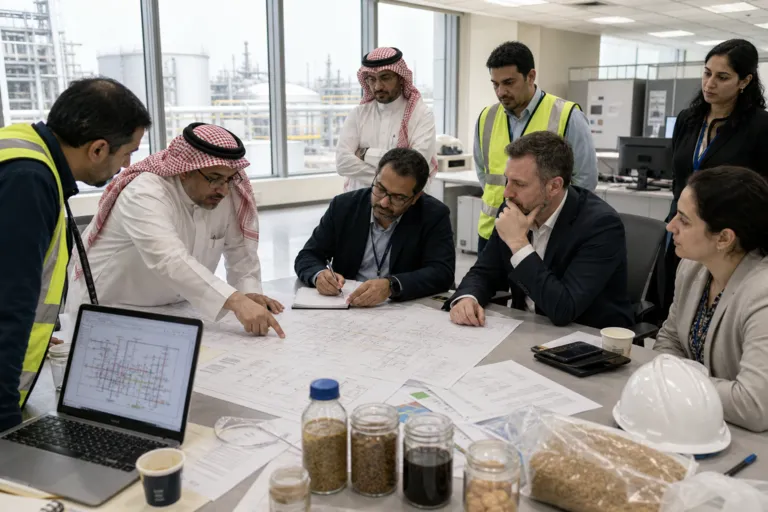
Saudi Arabia is now on the early path toward a commercial SAF project. TotalEnergies states that TotalEnergies, Aramco, and SIRC will evaluate the possibility of building a SAF plant in Saudi Arabia. That evaluation sits inside a wider aviation decarbonization logic: SAF can be used in existing aircraft fleets without requiring structural redesign, which makes it an immediate pathway for airlines and fuel suppliers to act within current infrastructure. TotalEnergies also describes how SAF is produced and then blended with JET A-1 to obtain aviation fuel containing SAF that can be directly supplied to aircraft. It also highlights “co-processing,” where circular-economy raw materials are incorporated into traditional refinery units alongside fossil-based feedstock to directly produce already-blended aviation fuel containing SAF.
Feedstock strategy will decide whether a Saudi sustainable aviation fuel plant can move from concept to financeable reality. Fortune Business Insights notes that many current SAF pathways rely on waste oils, animal fats, and agricultural residues, but these materials are finite and already utilized in other biofuel industries. The same source warns that competition for feedstock increases price volatility and restricts market expansion. For Gulf conditions, a ScienceDirect assessment of SAF readiness in the GCC region identifies municipal solid waste (MSW), halophytes, and algae as the most viable feedstocks based on availability, conversion potential, and regional adaptability. That same study’s feedstock scorecard ranks MSW, halophytes, and algae for SAF in the GCC, and frames targeted investments and collaboration as a way to support a competitive regional SAF industry despite uncertainties around costs and scalability.
Offtake and Policy Signals: Turning Decarbonization Into Bankable Demand
Offtake is a core commercial lever because it converts demand into a structure lenders and investors can underwrite. Fortune Business Insights links airline decarbonization commitments to long-term fuel procurement strategies, and notes that many airlines have already entered multi-year SAF offtake agreements with producers, ensuring supply while supporting project financing for new production facilities. Evolvance Market Research adds that mandatory blending targets in the EU, UK, and ICAO net-zero mandates are pushing airlines to lock in long-term SAF supply contracts, and that buyers are shifting from spot purchases to multi-year offtake agreements. The same source also flags execution risk on the supply side, stating that only 30% of announced SAF production capacity was completed by the end of 2025.
The decarbonization business case is also sharpened by what SAF can deliver and how it can be used. Evolvance describes SAF as chemically equivalent to conventional jet fuel, requiring no changes to aircraft engines or airport fuel systems, and says it can be blended at ratios up to 50% with conventional Jet A-1 under current ASTM D7566 certification standards. For measurable outcomes in a specific geography, it cites the European Union Aviation Safety Agency (EASA): SAF delivered at EU airports in 2024 achieved approximately 91% lower lifecycle emissions than fossil jet fuel, saving 714,000 tonnes of CO₂e. That kind of quantified outcome matters for airlines reporting under ESG frameworks and facing investor scrutiny, and it clarifies why airlines treat procurement as strategic planning rather than trial purchasing.
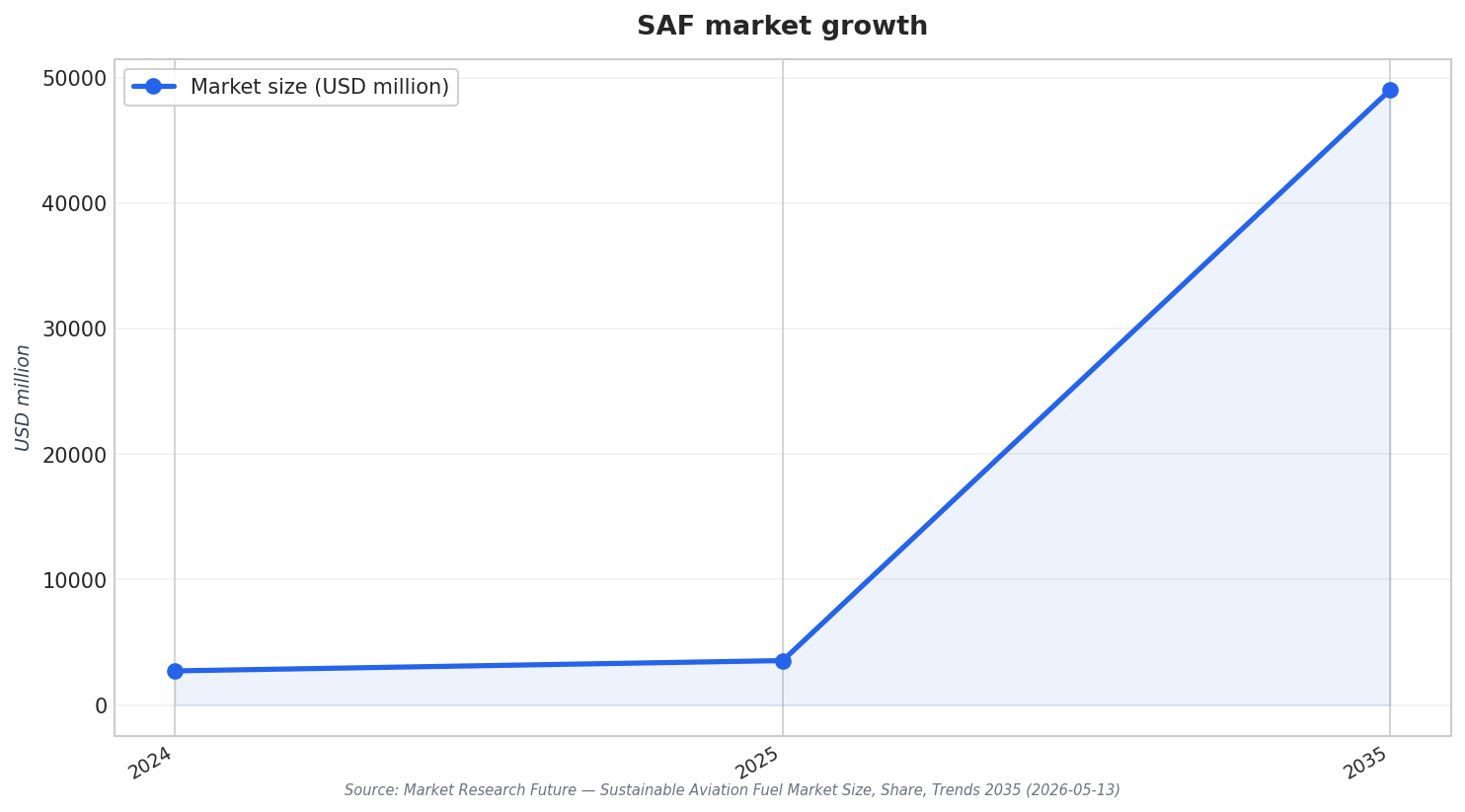
Finally, project developers still need to select pathways that align with available feedstocks and refinery integration options. The GCC-focused ScienceDirect study analyzes ASTM-approved SAF pathways and finds Gasification Fischer–Tropsch (FT) and Hydroprocessed Esters and Fatty Acids (HEFA) emerging as the most promising for GCC conditions. Market context also shows why early projects prioritize secure inputs and secured sales: Market Research Future values the global SAF market technology at USD 2,720.93 million in 2024 and projects growth from USD 3,542.65 million in 2025 to USD 49,060.92 million by 2035, with a CAGR of 30.2% for 2025–2035. Within this backdrop, Saudi Arabia’s evaluation effort can focus on a bankable triangle: credible GCC-suitable feedstocks, ASTM-aligned conversion, and long-term airline offtake that supports financing.
What is being evaluated for Saudi Arabia’s first commercial SAF project?
Which feedstocks look most viable for SAF in the GCC region?
Why do offtake agreements matter for financing a SAF plant?
How can SAF be used in today’s aircraft and fuel systems?
What quantified emissions outcome is reported for SAF in Europe?