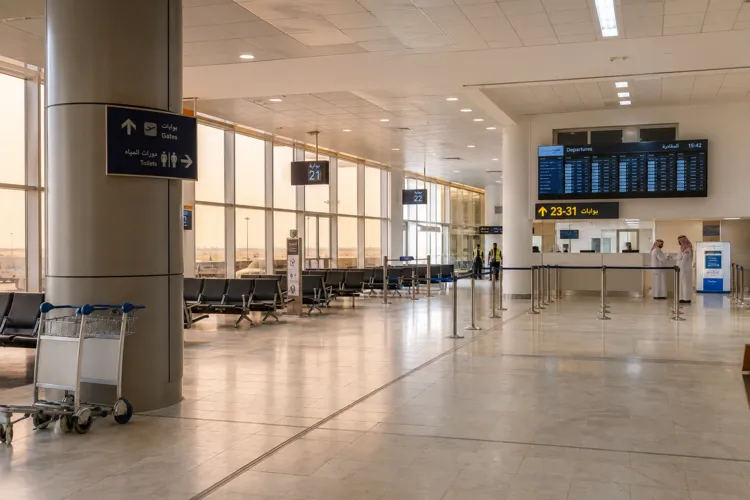

Riyadh’s Q-Express is being positioned as a fast rail link that connects King Salman International airport and the King Abdullah Financial District (KAFD) with Qiddiya City. According to MEED, the line is planned to operate at speeds of up to 250 kilometres an hour and reach Qiddiya in 30 minutes on the direct link. The Royal Commission for Riyadh City is working in collaboration with Qiddiya Investment Company (QIC) and the National Centre for Privatisation & PPP as the scheme advances under a public-private partnership (PPP) model. This structure matters because the procurement has been framed around private participation, with multiple market sounding steps used to build competition and define delivery expectations.
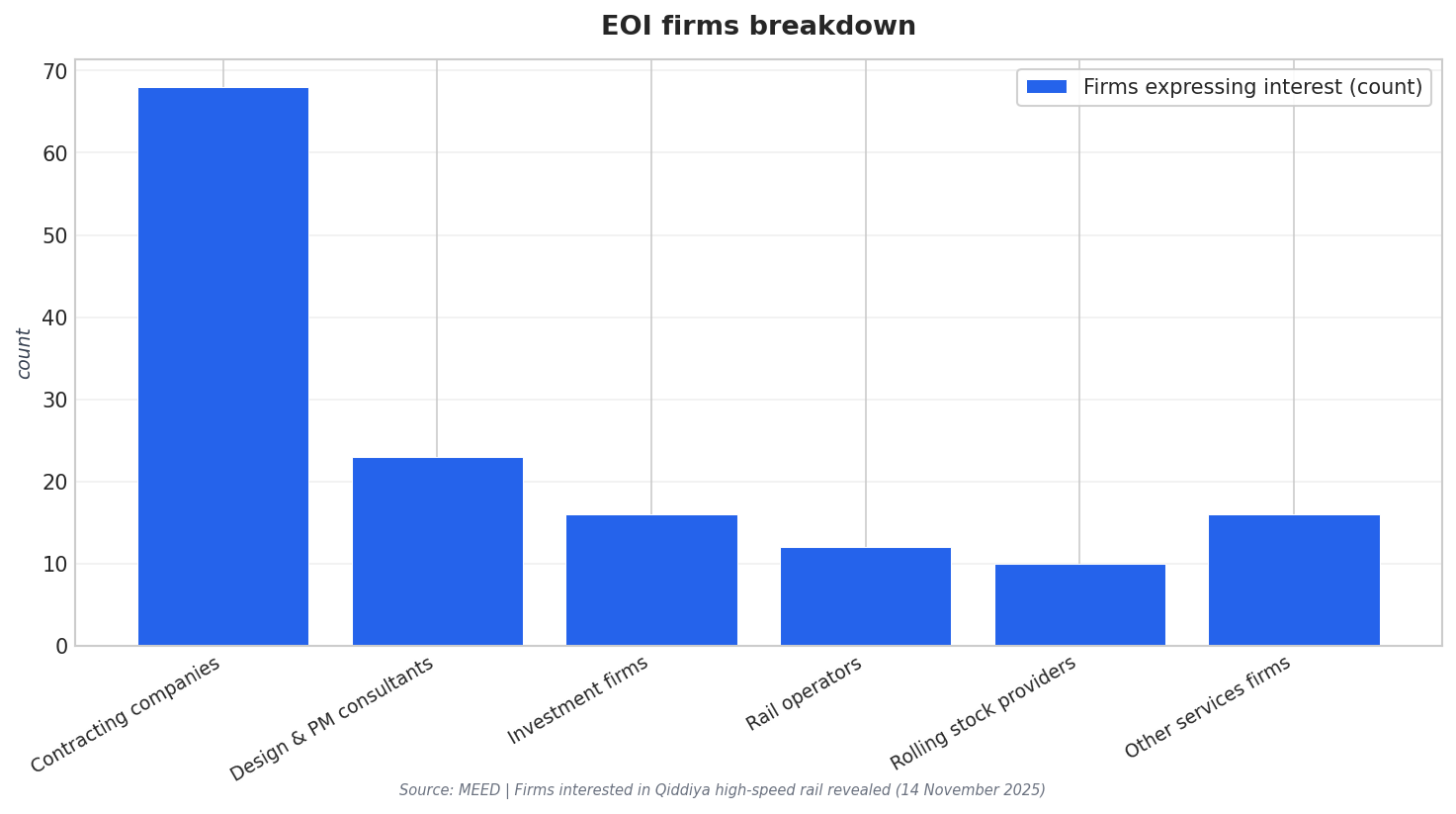
In the run-up to the latest procurement step, MEED reported that the client team invited expressions of interest with a submission deadline of 12 October. By November 2025, MEED said interest had been received from over 145 local and international companies. The same report broke that pool down into 68 contracting companies, 23 design and project management consultants, 16 investment firms, 12 rail operators, 10 rolling stock providers, and 16 other services firms. This breadth shows the project is being approached as a full rail system and financing proposition, not only a civil works package, with delivery roles spanning developers, operators, and specialist suppliers.
What the Two-Phase Route Plan Covers
The line is expected to be developed in two phases, with each phase extending the network deeper into Riyadh’s growth areas. MEED said the first phase will connect Qiddiya with KAFD and King Khalid International airport. The second phase will start from a development known as the North Pole and travel to the New Murabba development, King Salman Park, central Riyadh, and Industrial City in the south of the city. The overall context is tied to Qiddiya’s scale: MEED described Qiddiya as one of Saudi Arabia’s five official gigaprojects, covering a total area of 376 square kilometres, with 223 square kilometres of developed land.
In 2026, the procurement moved into formal prequalification activity for a combined delivery and funding scope. MEED reported that bids were received on 16 April for the engineering, procurement, construction and financing (EPCF) package for the Qiddiya high-speed rail project in Riyadh. The same reporting stated that firms interested in bidding on a PPP basis were given until 30 April to submit their prequalification statements. MEED also noted key milestones earlier in the year: the prequalification notice was issued on 19 January, and a project briefing session was held on 23 February at Qiddiya Entertainment City.
The advisory team has also been identified in the public reporting, which helps clarify how the process is being managed and governed. MEED stated that French consultant Egis had been appointed as technical adviser, and that UK-based Ernst & Young is acting as transaction adviser. Legal adviser references vary across MEED reports, with Latham & Watkins named in September 2025 and Ashurst named in April 2026. For readers tracking the Qiddiya high-speed rail project, these details point to a structured PPP pipeline, with the market already demonstrating deep capacity through the “over 145” expressions of interest and the subsequent 2026 EPCF prequalification step.
What is the Q-Express rail line expected to connect?
How fast will the line run and how long is the trip to Qiddiya expected to take?
How is Saudi Arabia structuring procurement for the Qiddiya high-speed rail project?
What does the two-phase plan include?
How many firms expressed interest, and what types of companies were included?